
Adaptive Anisotropic Gaussian Splatting for Multi-contrast MRI Arbitrary-Scale Super-Resolution with Anatomy Guidance
Abstract
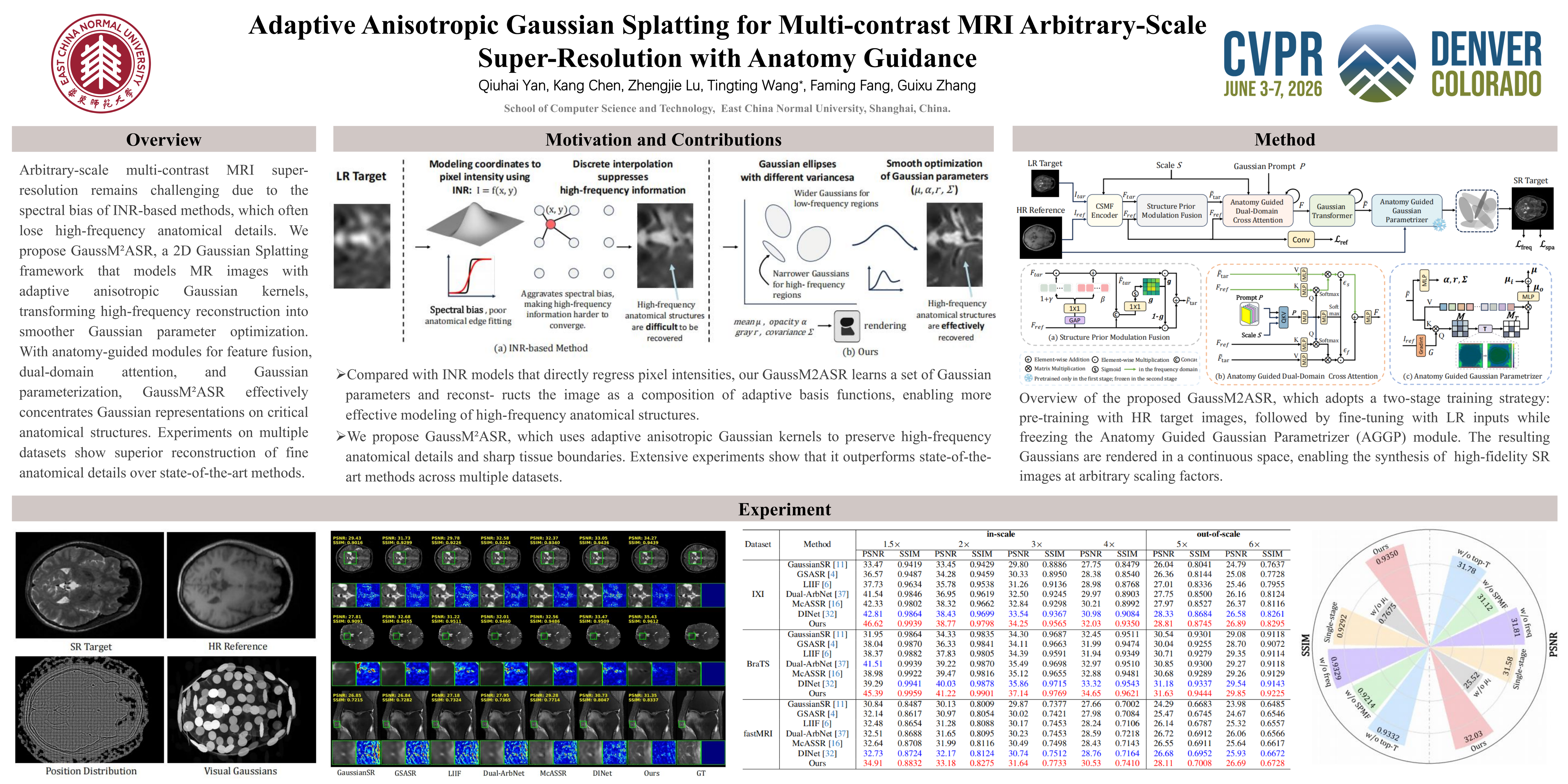
Implicit neural representation (INR) based methods learn a continuous mapping from a low-resolution (LR) target magnetic resonance (MR) image and a high-resolution (HR) reference image to achieve arbitrary-scale super-resolution (SR). However, their inherent spectral bias favors learning low-frequency (LF) components, often failing to capture the sharp transitions at anatomical boundaries and resulting in the loss of high-frequency (HF) details. Inspired by 3D Gaussian splatting, we propose GaussM²ASR (Gaussian Multi-contrast MRI Arbitrary-scale Super-Resolution), which converts the challenging task of HF anatomical reconstruction into a smoother parameter optimization problem by learning the parameters of anisotropic 2D Gaussian kernels. To handle inter-contrast discrepancies, we introduce an anatomy-guided pipeline comprising three core modules: a Structure Prior Modulation Fusion (SPMF) module for feature enhancement; an Anatomy-Guided Dual-Domain Cross Attention (AG-DDCA) module for joint spatial-frequency modeling; and an Anatomy-Guided Gaussian Parametrizer (AGGP) that leverages gradient-based sparse attention to concentrate Gaussian centers on critical anatomical structures. Extensive experiments on multiple datasets demonstrate that GaussM²ASR surpasses state-of-the-art methods in recovering fine anatomical details. The source code will be made publicly available upon acceptance.