
Bézier Degradation Modeling for LiDAR-based Human Motion Capture
Abstract
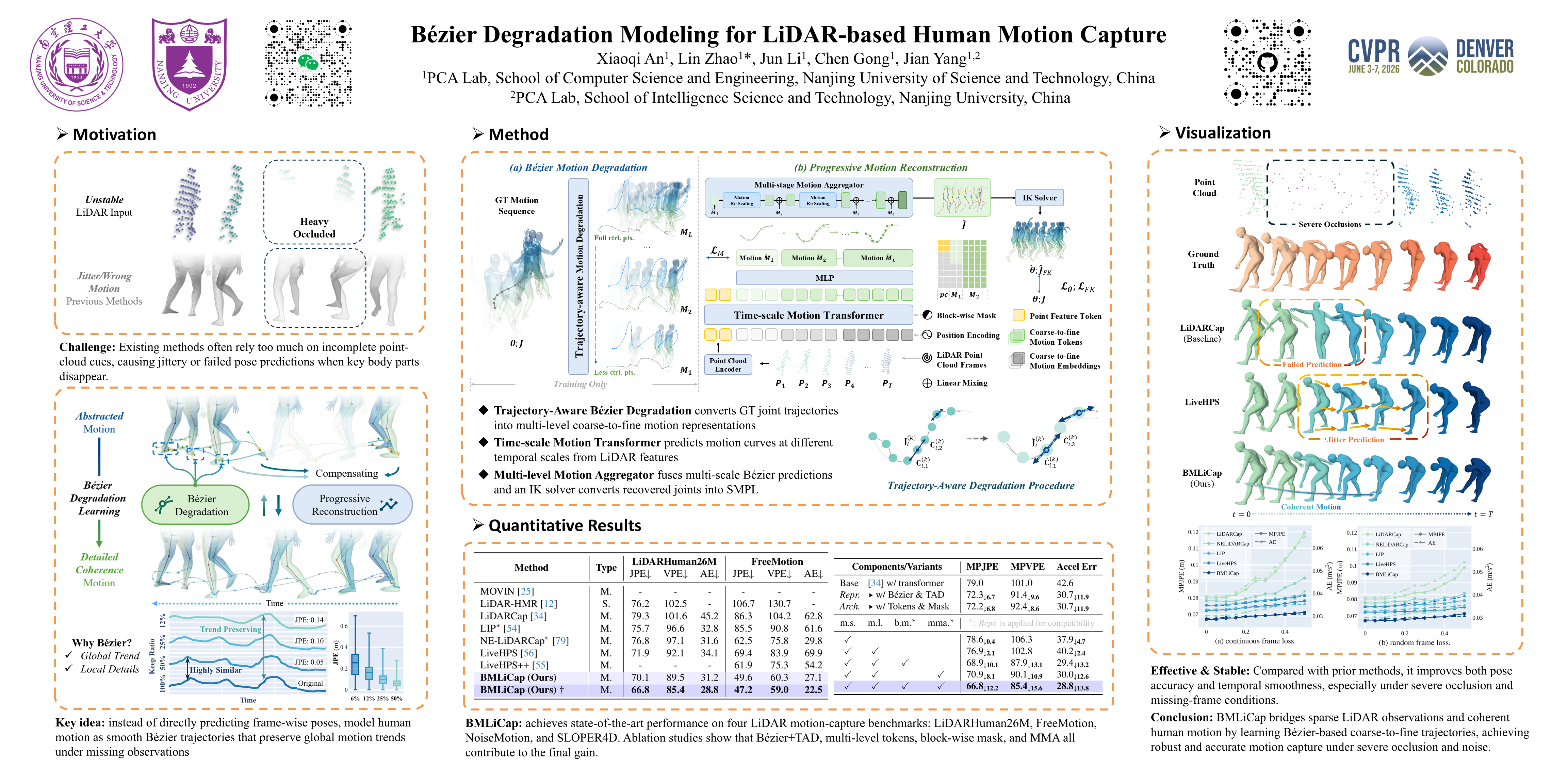
LiDAR-based 3D human motion capture has broad applications in fields such as autonomous driving and robotics, where accurate motion reconstruction is crucial. However, existing methods often struggle with unstable inputs and severe occlusions, leading to jittery or even failed pose predictions. To address these challenges, we propose BMLiCap, a coarse-to-fine framework that models motion using temporally compressible Bézier curves. By reducing control points through a trajectory-preserving strategy, we obtain a coherent and learning-friendly motion representation. To reconstruct human actions from LiDAR point-cloud cues, we design a progressive motion-reconstruction module. Specifically, a Time-scale Motion Transformer (TMT) is introduced to predict motion curves at multiple temporal scales, and a Multi-level Motion Aggregator (MMA) is utilized to adaptively fuse the multi-scale curves to recover detailed, temporally coherent poses, effectively bridging observation gaps caused by occlusions and noise. Across four mainstream benchmarks LiDARHuman26M, FreeMotion, NoiseMotion, and SLOPER4D, BMLiCap achieves state-of-the-art accuracy and temporal continuity in complex scenes, demonstrating its ability to compensate for severe occlusions and reduce prediction jitter.