
Perceiving the Near, Reasoning the Distant: Coherent Long-Horizon Trajectory Prediction for Autonomous Driving
Hua Hu ⋅ Zikang Zhou ⋅ Qian Zhou ⋅ Zihao WEN ⋅ Junjie Hu ⋅ Xinhong Chen ⋅ Zhengmin JIANG ⋅ Yung-Hui Li ⋅ Jianping Wang
Abstract
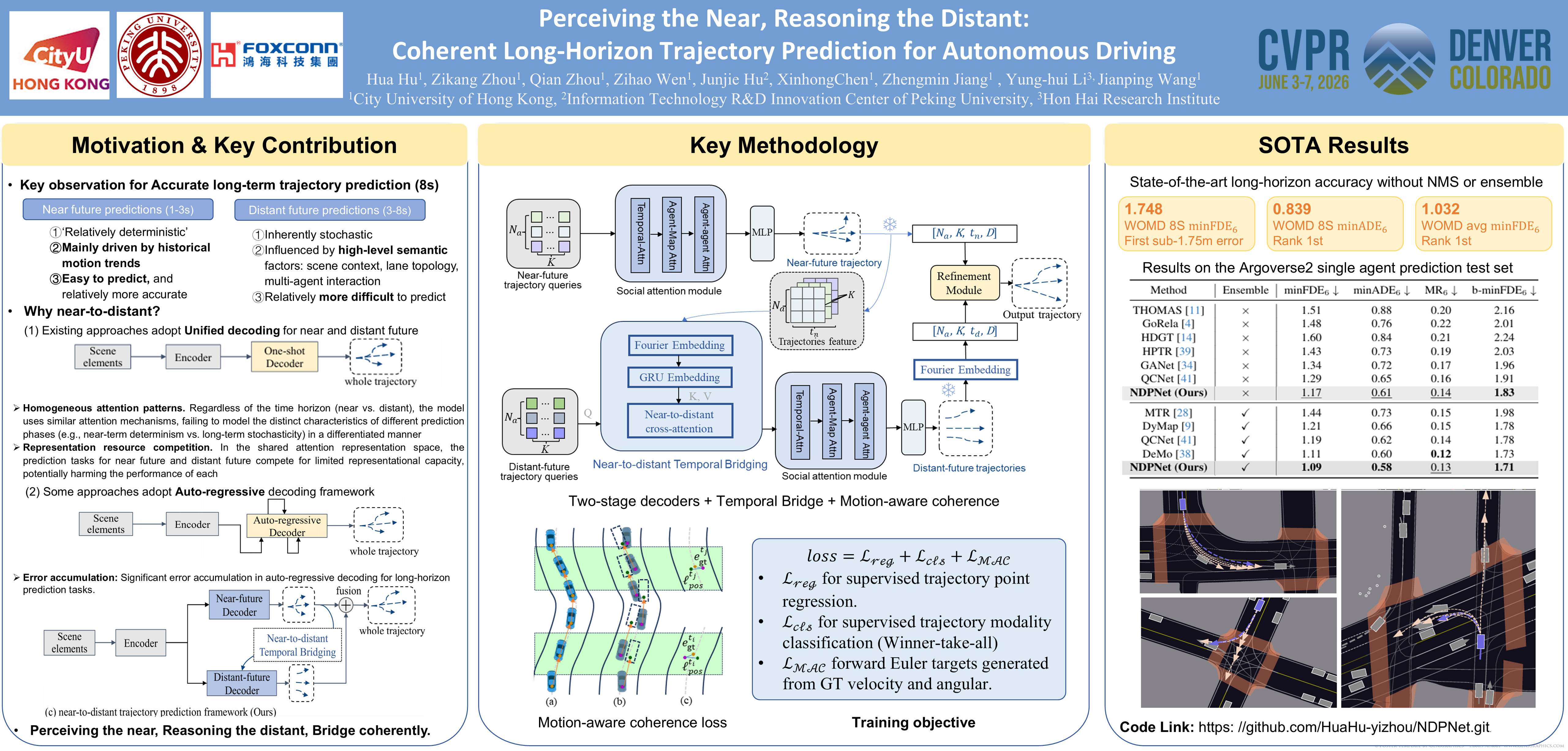
Reliable long-horizon trajectory prediction requires both high positional accuracy and physically plausible temporal motion consistency. However, existing methods suffer from two fundamental limitations. First, they overlook the inherent difference in prediction logic: near-future trajectories are primarily governed by historical dynamics, whereas distant-future behaviors are driven by high-level semantic context. Yet, most methods employ a unified decoding pathway that blurs the temporal distinction.Second, although the near future is relatively easier to predict, existing methods lack mechanisms for coherent trajectory propagation across time horizons, often resulting in kinematically implausible predictions with inconsistent heading evolution and degraded long-horizon performance. To address these challenges, we propose NDPNet, a dual-stage architecture that decouples near- and distant-horizon modeling into specialized pathways, with a dedicated transition module ensuring smooth temporal bridging. Furthermore, we introduce a novel motion-aware coherence loss that explicitly embeds kinematic priors to enforce trajectory consistency. Extensive experiments show that NDPNet achieves SOTA performance on Argoverse 2 and WOMD. Notably, on WOMD, it ranks 1$^{\text{st}}$ in both minFDE${}_6$ and minADE${}_6$ across all standard horizons (3s, 5s, 8s) without ensemble learning or NMS post-processing, and is the first to achieve sub-1.75 minFDE${}_6$ for 8s prediction, surpassing prior methods by a large margin. The code will be released subsequently.
Chat is not available.
Successful Page Load