
Decompose, Mix, Adapt: A Unified Framework for Parameter-Efficient Neural Network Recombination and Compression
Abstract
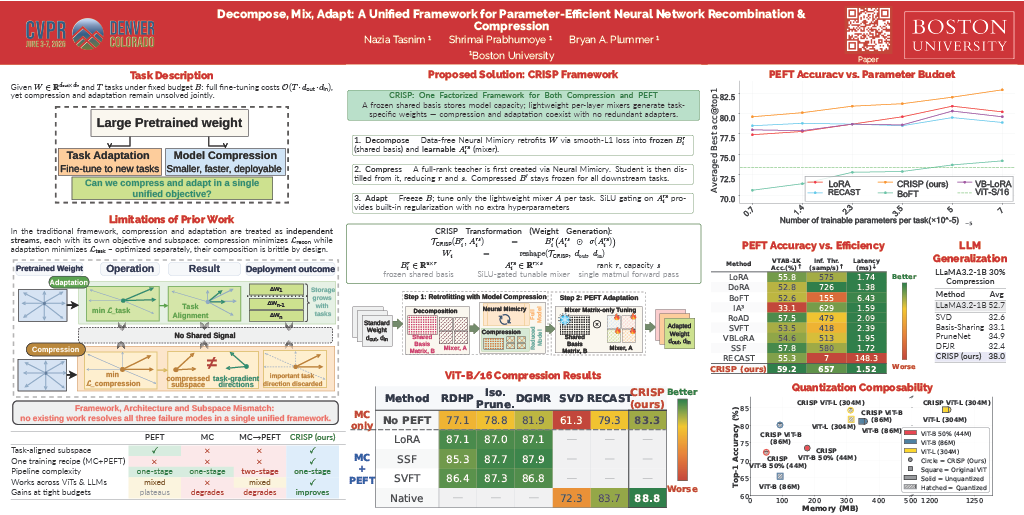
Parameter Recombination (PR) methods aim to efficiently compose the weights of a neural network, and encompasses tasks like Parameter-Efficient FineTuning (PEFT) and Model Compression (MC), among others. Most methods typically focus on one application of PR, which can make composing them challenging. For example, when deploying a large model you may wish to compress the model and also quickly adapt to new settings. However, PEFT methods often can still contain millions of parameters. This may be small compared to the original model size, but can be problematic in resource constrained deployments like edge devices, where they take a larger portion of the compressed model's parameters. To address this, we present Coefficient-gated weight Recombination by Interpolated Shared basis Projections (\method{}), a general approach that can address multiple PR tasks within the same framework, which can enable seamless integration. It accomplishes this by using a factorization process that decomposes pretrained weights into basis matrices and their component projections. Sharing these basis matrices across layers and adjusting its size enables us to perform MC, whereas the small size of the projection weights (fewer than 200 in some experiments) enables \method{} support PEFT. Experiments on ViT models show \method{} outperforms methods from prior work capable of dual-task applications by 4-5\% while also outperforming the state-of-the-art in PEFT by 1.5\% and PEFT+MC combinations by almost 1\%.