
Seeing Through Blur: Tackling Defocus in Spike-Based Imaging
Abstract
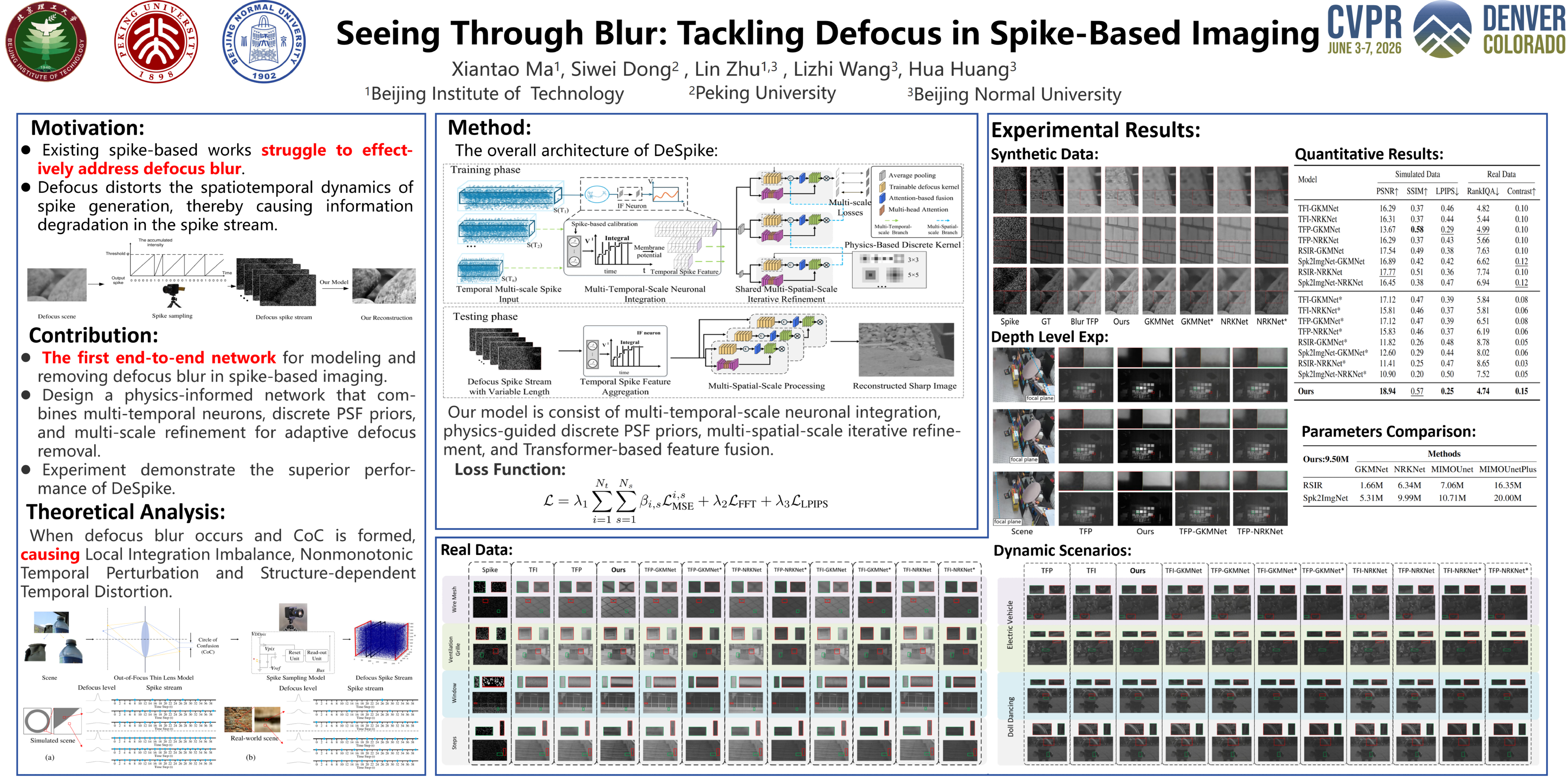
Spike cameras are a novel class of neuromorphic vision sensors that capture scene dynamics with ultra-high temporal resolution via spike planes. While recent methods have addressed motion blur and noise in spike-based reconstruction, defocus blur caused by shallow depth of field or lens adjustment delays remains a critical yet underexplored issue in real-world applications such as autonomous driving. In this work, we present DeSpike, the first end-to-end defocus removal framework specifically designed for spike cameras. Our method begins by explicitly modeling the defocus formation process using a physics-inspired thin-lens approximation to simulate spike responses under optical blur. Guided by this formulation, DeSpike employs multi-temporal-scale integrate-and-fire (IF) neurons to compensate for FPN and extract defocus-aware features from spike streams. These features are then processed by a physics-informed deblurring module constructed from learnable discrete PSF priors. To address spatially variant blur, we introduce a Transformer-based fusion mechanism that adaptively weighs multi-scale deblurring results through attention across defocus levels. Finally, a coarse-to-fine iterative refinement stage combines spike features and PSF priors for progressive restoration. Extensive experiments on both synthetic and real-world defocused spike datasets demonstrate that our method achieves superior performance over state-of-the-art deblurring approaches in terms of structural fidelity, perceptual sharpness, and contrast, setting a new benchmark for defocus-aware spike-based image reconstruction.