
Imbalanced View Contribution Evaluation and Refinement for Deep Incomplete Multi-View Clustering
Abstract
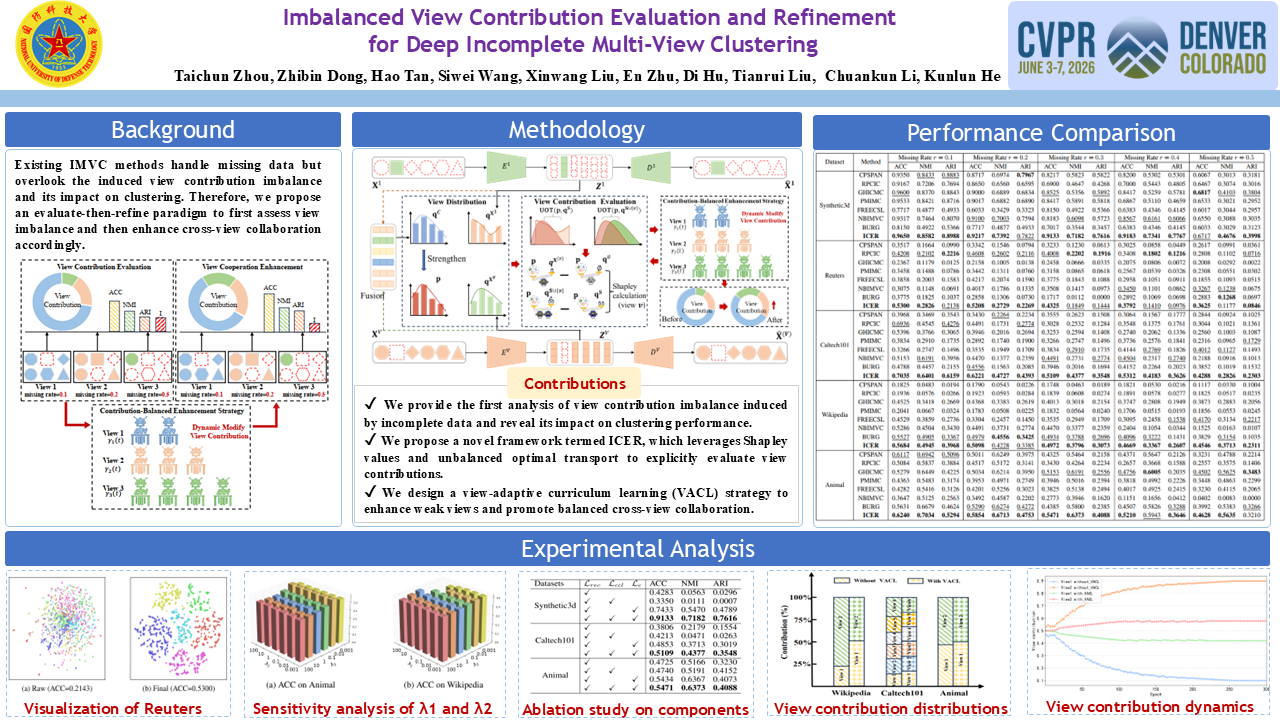
In real-world applications, multi-view data often suffer from missing situations due to privacy protection and sensor failure factors. The Incomplete scenarios not only lead to partial information availability but also cause significant imbalance learning among views: certain “strong views” dominate the fusion process, while “weak views” contribute marginally, thereby undermining cross-view collaboration. Existing incomplete multi-view clustering methods mainly focus on "how to handle missing data", yet they largely overlook the imbalance view contribution induced by incompleteness and its profound impact on representation learning and clustering performance. To address these issues, our paper first analyzes the data imbalance caused by missing views and the resulting disparities in view learning quality. Then, we propose a collaborative evaluation and enhancement framework (\textbf{ICER}) for imbalanced incomplete multi-view clustering . Specifically, we employ shapley values to quantify the marginal contribution of each view, and incorporate imbalanced optimal transport to characterize distributional deviations across views. On this basis, we construct the view contribution imbalance metric to comprehensively evaluate cross-view collaboration and fusion quality, and design a collaboration enhancement module to explicitly reinforce inter-view cooperative optimization and feature fusion. Extensive experiments on multiple benchmark datasets demonstrate that the proposed method outperforms existing incomplete multi-view clustering approaches, validating the effectiveness and necessity of explicitly modeling and mitigating view imbalance in imbalanced incomplete scenarios.