
InstantViR: Real-Time Video Inverse Problem Solver with Distilled Diffusion Prior
 Highlight
Abstract
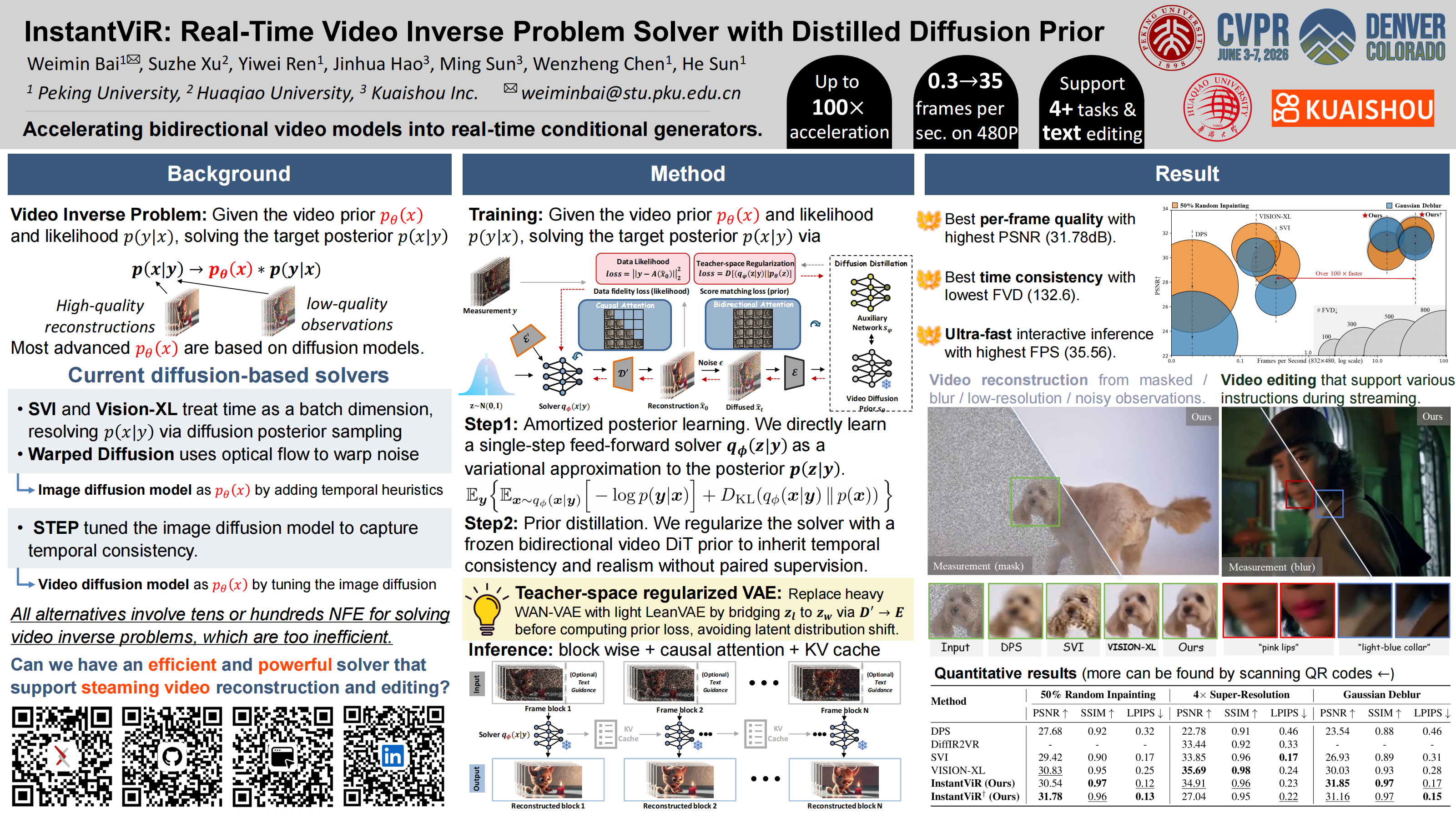
Video inverse problems such as inpainting, deblurring and super-resolution are fundamental to streaming, telepresence, and AR/VR, where high perceptual quality must coexist with tight latency constraints. Diffusion-based priors currently deliver state-of-the-art reconstructions, but existing approaches either adapt image diffusion models with ad hoc temporal regularizers—leading to temporal artifacts—or rely on native video diffusion models whose iterative posterior sampling is far too slow for real-time use. We introduce InstantViR, an amortized inference framework for ultra-fast video reconstruction powered by a pre-trained video diffusion prior. We distill a powerful bidirectional video diffusion model (teacher) into a causal autoregressive student that maps a degraded video directly to its restored version in a single forward pass, inheriting the teacher’s strong temporal modeling while completely removing iterative test-time optimization. The distillation is prior-driven: it only requires the teacher diffusion model and known degradation operators, and does not rely on externally paired clean/noisy video data. To further boost throughput, we replace the standard VAE in video diffusion backbone with a highly efficient LeanVAE, enabling low-latency latent-space processing. Across streaming random inpainting, Gaussian deblurring and super-resolution, InstantViR matches or surpasses the reconstruction quality of diffusion-based baselines while running at over 35 FPS on NVIDIA A100 GPUs, achieving up to 100x speedups over iterative video diffusion priors. These results show that diffusion-based video reconstruction is compatible with real-time, interactive, editable, streaming scenarios, turning high-quality video restoration into a practical component of modern vision systems.