
OptiMVMap: Offline Vectorized Map Construction via Optimal Multi-vehicle Perspectives
Abstract
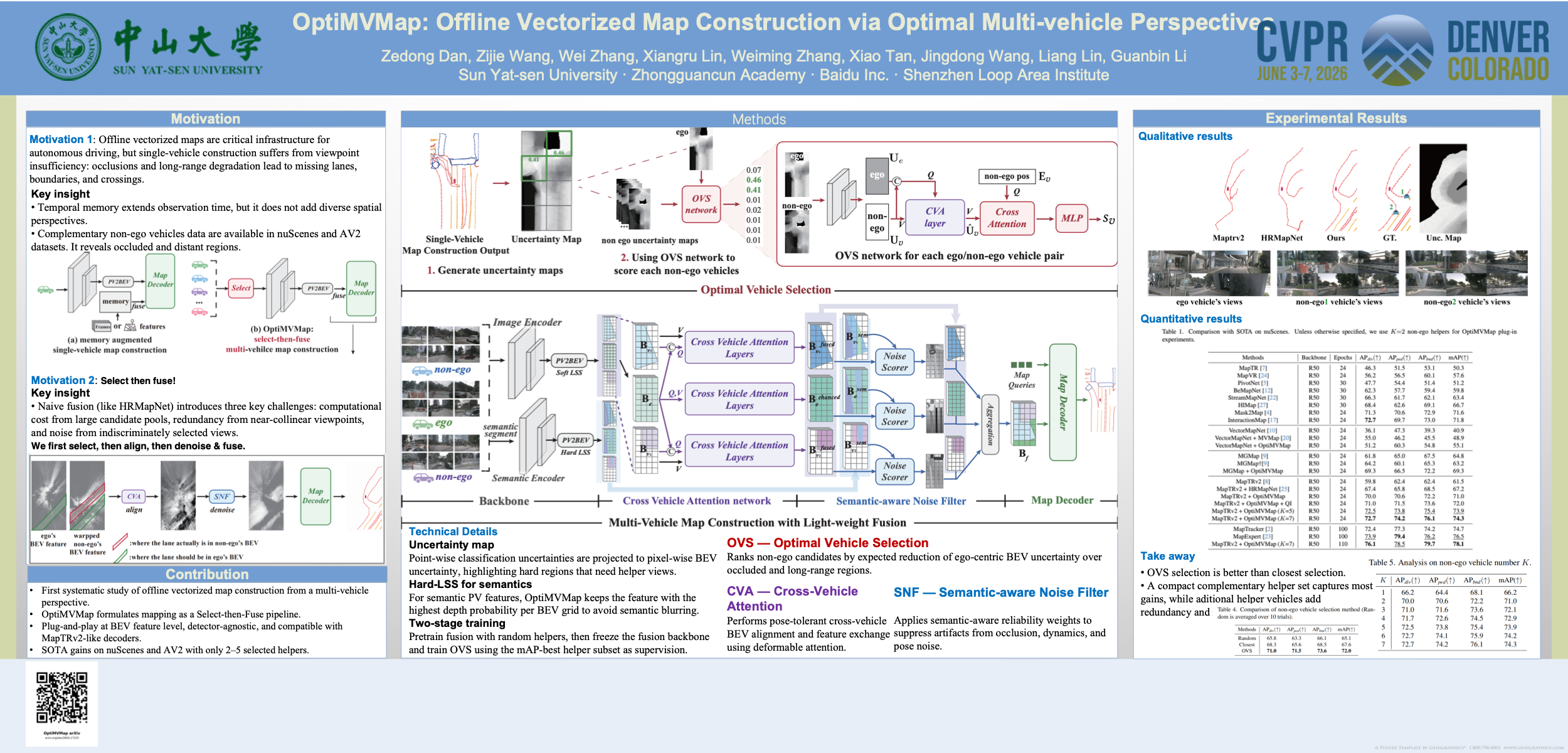
Offline vectorized maps constitute critical infrastructure for high-precision autonomous driving and mapping services. Existing approaches rely predominantly on single ego-vehicle trajectories, which fundamentally suffer from viewpoint insufficiency: while memory-based methods extend observation time by aggregating ego-trajectory frames, they lack the spatial diversity needed to reveal occluded regions. Incorporating views from surrounding vehicles offers complementary perspectives, yet naive fusion introduces three key challenges: computational cost from large candidate pools, redundancy from near-collinear viewpoints, and noise from pose errors and occlusion artifacts.We present OptiMVMap, which reformulates multi-vehicle mapping as a select-then-fuse problem to address these challenges systematically. An Optimal Vehicle Selection (OVS) module strategically identifies a compact subset of helpers that maximally reduce ego-centric uncertainty in occluded regions, addressing computation and redundancy challenges. Cross-Vehicle Attention (CVA) and Semantic-aware Noise Filter (SNF) then perform pose-tolerant alignment and artifact suppression before BEV-level fusion, addressing the noise challenge. This targeted pipeline yields more complete and topologically faithful maps with substantially fewer views than indiscriminate aggregation.On nuScenes and Argoverse2, OptiMVMap improves MapTRv2 by +10.5 mAP and +9.3 mAP, respectively, and surpasses memory-augmented baselines MVMap and HRMapNet by +6.2 mAP and +3.8 mAP on nuScenes. These results demonstrate that uncertainty-guided selection of helper vehicles is essential for efficient and accurate multi-vehicle vectorized mapping.