
Hilbert-Geo: Solving Solid Geometric Problems by Neural-Symbolic Reasoning
Abstract
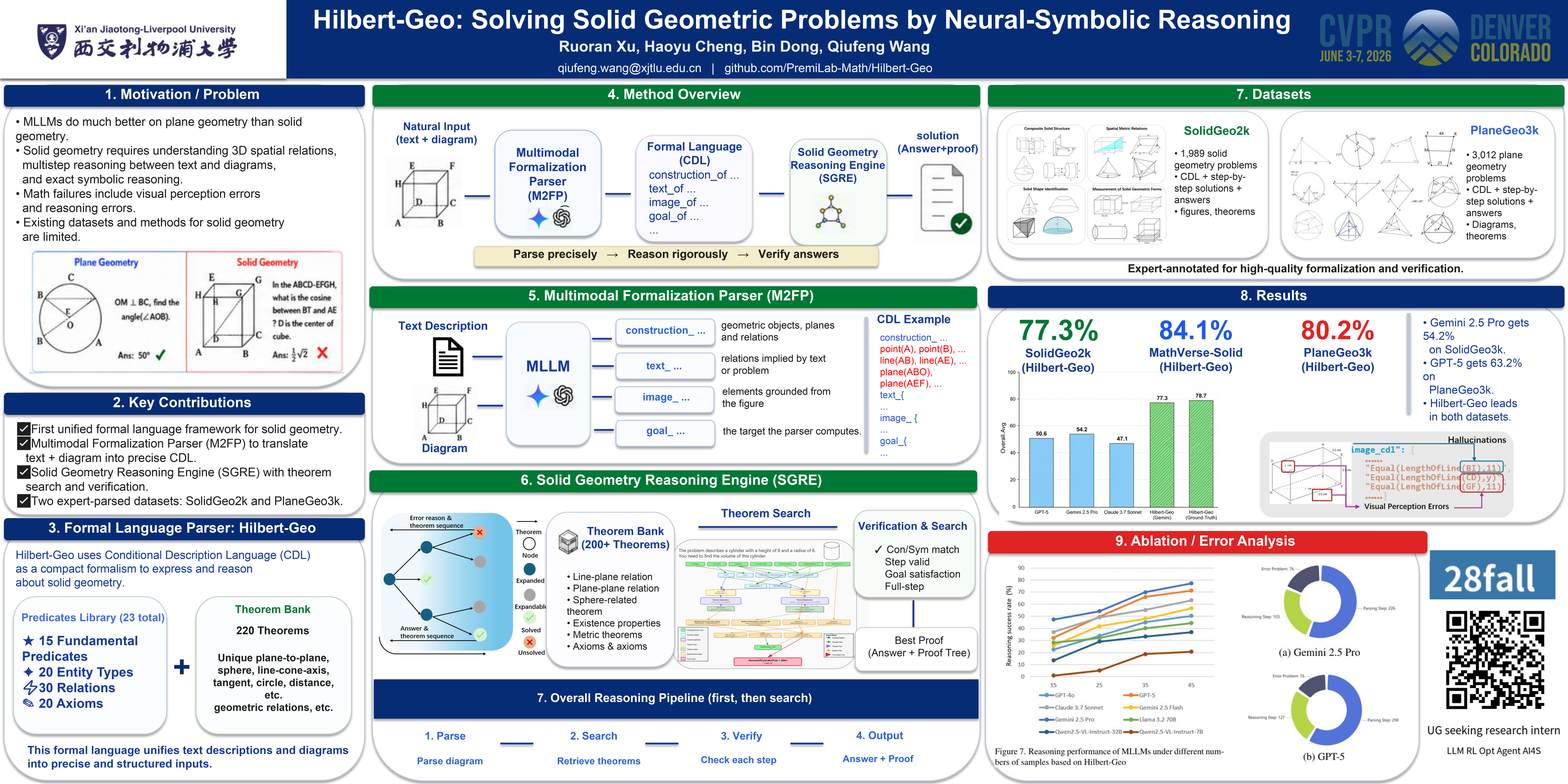
Geometric problem solving, as a typical multimodal reasoning problem, has attracted much attention and made great progress recently, however most of works focus on plane geometry while usually fail in solid geometry due to 3D spatial diagrams and complex reasoning. To bridge this gap, we introduce Hilbert-Geo, the first unified formal language framework for solid geometry, including an extensive predicate library and a dedicated theorem bank. Based on this framework, we propose a Parse2Reason method containing two steps of first parsing then reasoning. In the parsing step, we utilize conditional description language (CDL), a formalized language composed of predicates specifically designed to construct geometric conditions, to represent both problem description (natural text) and solid diagrams (visual image).In the reasoning step, we leverage those formal CDL and the theorem bank to perform relational inference and algebraic computation, generating strictly correct, verifiable, and human-readable reasoning processes.Notably, our proposed Hilbert-Geo is also applicable to plane geometry.To advance geometric reasoning, we curate two expert-annotated dataset SolidFGeo2k and PlaneFGeo3k, which are furnished with geometric formal language annotations, solutions and answers. Extensive experiments show that our proposed method achieves the state-of-the-art (SOTA) performance 77.3\% in SolidFGeo2k and 84.1\% in MathVerse-Solid (one small subset in MathVerse dedicated to solid geometry), substantially outperforming leading MLLMs, such as Gemini-2.5-pro (54.2\% on SolidFGeo2k) and GPT-5 (62.9\% on MathVerse-Solid). In addition, our method achieves the SOTA accuracy 80.2\% in PlaneFGeo3k, demonstrating the generality of the Hilbert-Geo in geometric reasoning. Our code and datasets will be publicly available.