
BDNet:Bio-Inspired Dual-Backbone Small Object Detection Network
Abstract
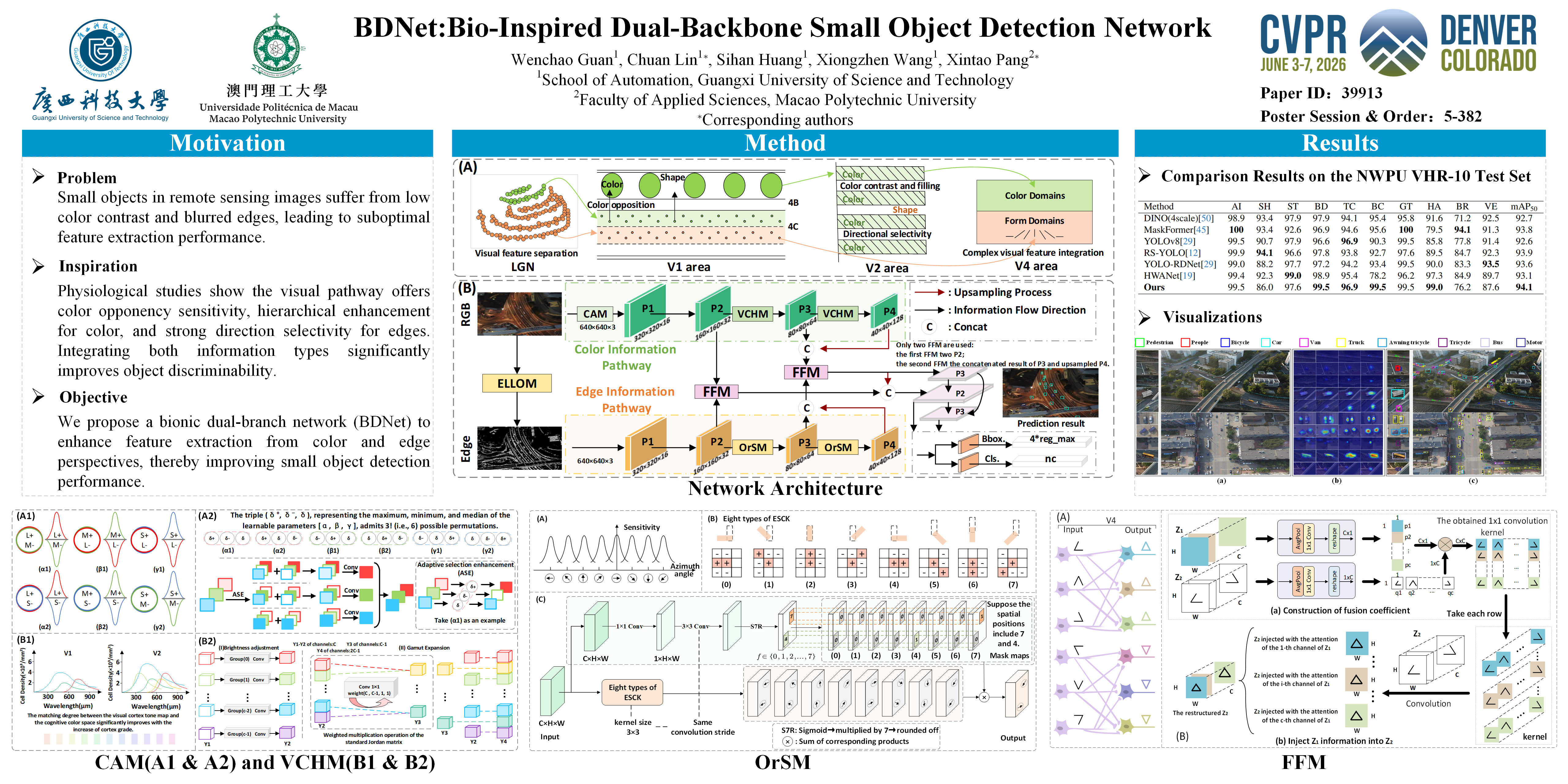
In remote sensing images, small objects often suffer from low color contrast and blurred edges, resulting in suboptimal feature extraction performance. Physiological studies indicate that the LGN/V1–V2–V4 pathway offers color opponency sensitivity and hierarchical enhancement advantages for the extraction of color information, while the V1–V4 pathway shows strong orientation selectivity in edge information extraction. The integration of these two types of information in the V4 region significantly improves target discrimination.Inspired by this, this paper proposes a dual-backbone network (BDNet) to enhance small object feature extraction. BDNet adopts a dual-backbone parallel structure to capture fine-grained features from color and edge dimensions: the color extraction backbone simulates the color antagonistic mechanism in the LGN/V1 region by designing a Color Antagonism Module (CAM) to amplify color differences, and further mimics the chromatic processing hierarchy in the V2 region with a Visual Cortex Hue-enhancement Module (VCHM) to enrich hue representations. These two components work collaboratively to address the issue of low color contrast.The edge extraction backbone simulates the orientation selectivity of receptive fields in the V1 region by designing an Orientation Selective Module (OrSM) to select and enhance salient edges, thereby mitigating the issue of edge blurring caused by dispersed edge information. Finally, the two types of extracted features are interactively integrated through a Feature Fusion Module (FFM) that emulates the integration mechanism in the V4 region, generating a comprehensive feature representation.Experiments demonstrate that BDNet outperforms state-of-the-art (SOTA) methods on the VisDrone2019, NWPU VHR-10, and AI-TODv2 datasets, thus providing a bio-inspired solution for small object detection in remote sensing images.