
Parallelised Differentiable Straightest Geodesics for 3D Meshes
Abstract
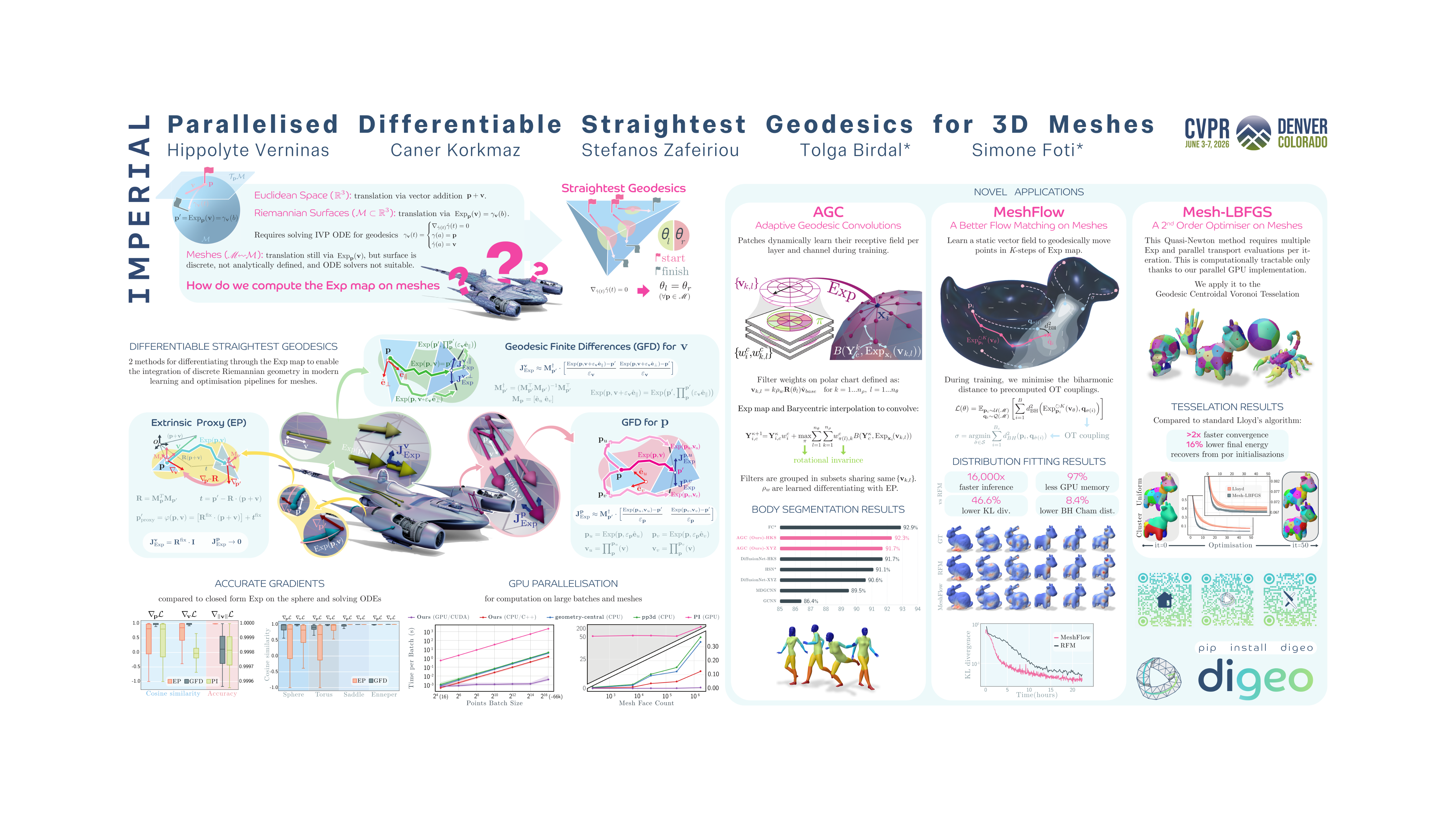
Machine learning has been progressively generalised to operate within non-Euclidean domains, but geometrically accurate methods for learning on surfaces are still falling behind. The lack of closed-form Riemannian operators, the non-differentiability of their discrete counterparts, and poor parallelisation capabilities have been the main obstacles to the development of the field on meshes. A principled framework to compute the exponential map on Riemannian surfaces discretised as meshes is straightest geodesics, which also allows to trace geodesics and parallel-transport vectors as a by-product. We provide a parallel GPU implementation and derive two different methods for differentiating through the straightest geodesics, one leveraging an extrinsic proxy function and one based upon a geodesic finite differences scheme. After proving our parallelisation performance and accuracy, we demonstrate how our differentiable exponential map can supercharge geometrically-correct learning and optimisation pipelines. In particular, to showcase the versatility of our method, we propose a new geodesic convolutional layer, a new flow matching method for learning on meshes, and a second-order optimiser that we apply to centroidal Voroni tesselation. Our code, pre-trained models, and pip-installable library will be made available upon publication.