
PrivateEyes: Gaze-Preserving Anonymization for Data Sharing
Surabhi Gupta ⋅ Dinesh Prabhu Muthumariappan ⋅ Biplab Ch Das ⋅ Anoop Kolar Rajagopal ⋅ Kiran Nanjunda Iyer ⋅ Donghwan Seo
Abstract
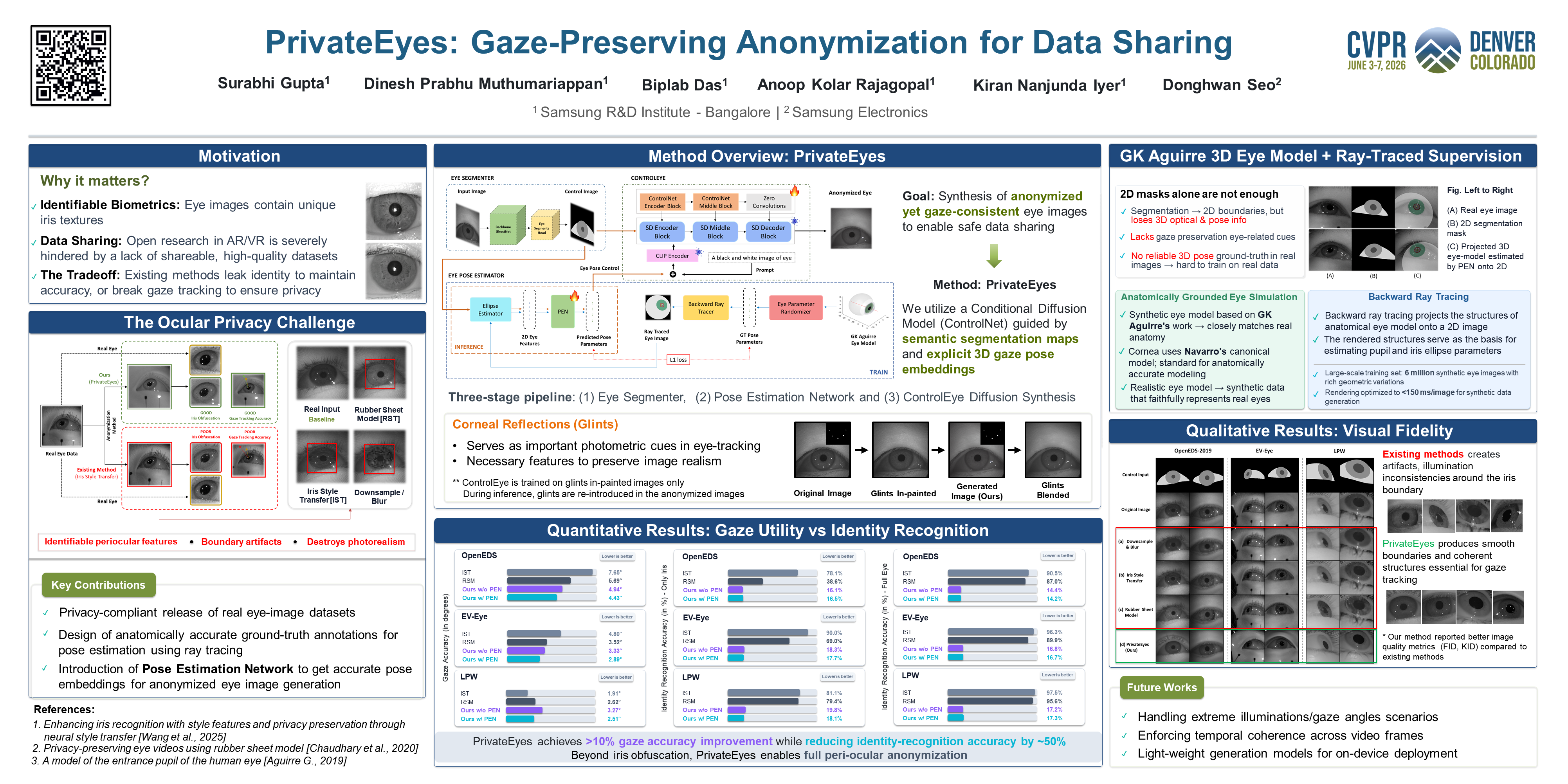
Eye images captured from wearable devices such as head-mounted displays (HMDs) contain identifiable biometric cues, posing significant challenges for safe data sharing. Existing eye anonymization techniques often degrade downstream performance, particularly gaze estimation while still retaining iris-recognizable features. Although these methods aim to anonymize the iris, they introduce noticeable visual artifacts that reduce image fidelity. To address these limitations, we propose \textbf{PrivateEyes}, a privacy-preserving framework that synthesizes anonymized yet gaze-consistent eye images. Our approach employs a three-stage pipeline: (1) a deep segmentation network that isolates semantic eye regions and provides structural control signals for synthesis, (2) a pose estimation network (PEN) trained on anatomically accurate synthetic eye renders to infer precise eye pose, and (3) a conditional diffusion model that reconstructs realistic, anonymized eye images conditioned on segmentation and pose. Extensive experiments across multiple benchmark datasets show that PrivateEyes achieves superior gaze-estimation accuracy compared to state-of-the-art anonymization baselines, improving performance by over 10\% while reducing iris-recognition accuracy by $\sim$50\%. Our method also produces higher-fidelity images compared to other existing approaches. By enabling task-preserving and privacy-secure sharing of eye images, PrivateEyes supports responsible research and development in AR/VR and other gaze-driven applications.
Chat is not available.
Successful Page Load