
A More Word-like Image Tokenization for MLLMs
Abstract
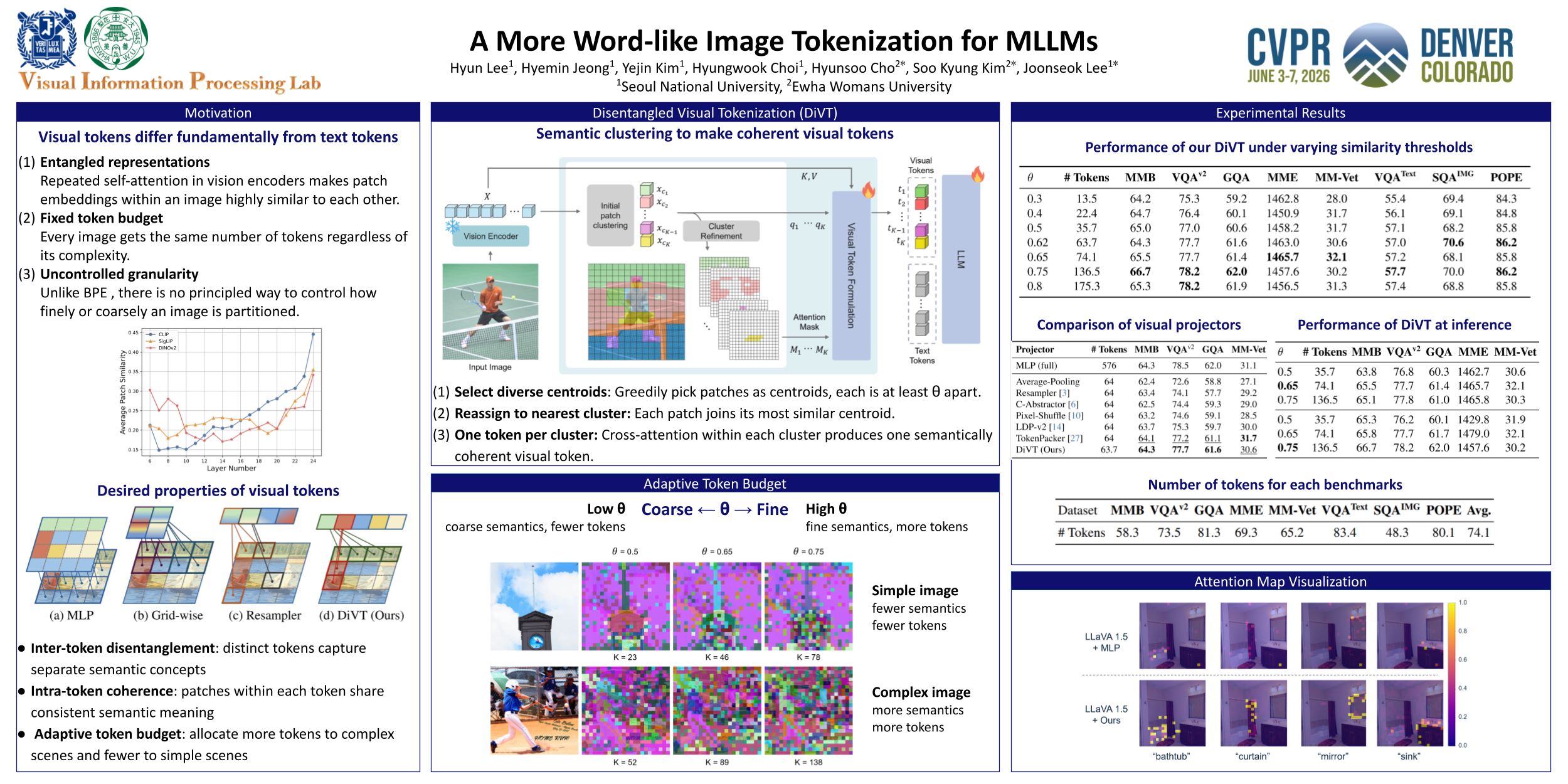
Modern multimodal large language models (MLLMs) typically keep the language model fixed and train a visual projector that maps the pixels into a sequence of tokens in its embedding space, so that images can be presented in essentially the same form as text. However, the language model has been optimized to operate on discrete, semantically meaningful tokens, while prevailing visual projectors transform an images into a long stream of continuous and highly correlated embeddings. This causes the visual tokens to behave differently from the word-like units that LLMs are originally trained to understand. We propose a novel Disentangled Visual Tokenization (DiVT) that clusters patch embeddings into coherent semantic units, so each token corresponds to a distinct visual concept instead of a rigid grid cell. DiVT further adapts its token budget to image complexity, providing an explicit accuracy compute trade-off modifying neither the vision encoder nor the language model. Across diverse multimodal benchmarks, DiVT matches or surpasses standard LLaVA 1.5 using only about 11% of the original visual tokens, substantially reducing memory and latency and making visual inputs more compatible with LLM-based reasoning.