
Virtual Nodes Guided Dynamic Graph Neural Network for Brain Tumor Segmentation with Missing Modalities
Abstract
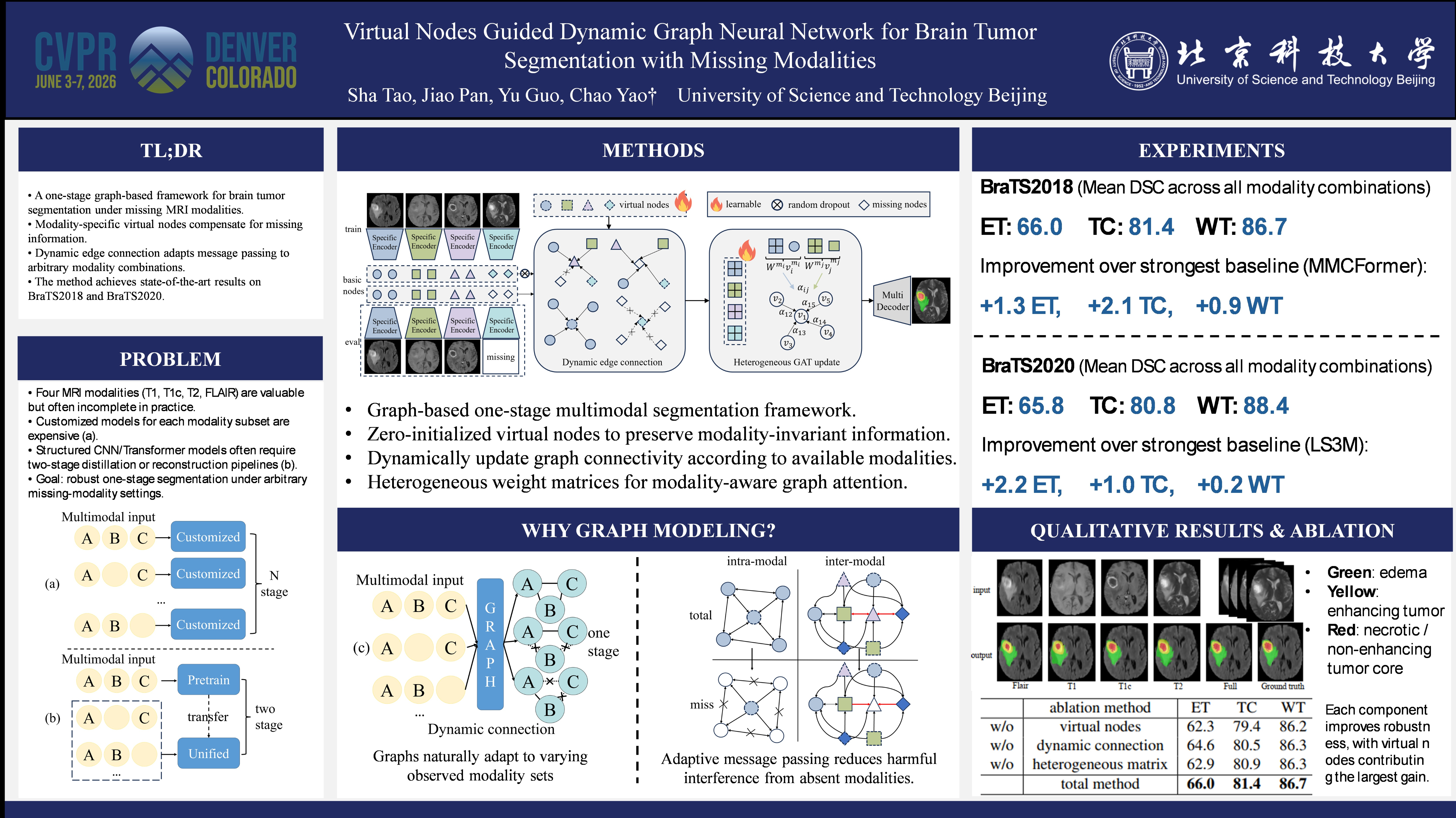
Multimodal magnetic resonance imaging (MRI) is crucial for brain tumor segmentation, with many methods leveraging its four key modalities to capture complementary information for effective sub-region analysis. However, the absence of several modalities is very common in practice, leading to severe performance degradation in existing full-modality segmentation methods. Limited by the structured data model, recent works often adopt a multi-stage training strategy for full-modality and missing-modality scenarios, which increases training costs and inadequately addresses the interference of miss. In this work, we propose a graph-based one-stage framework for robust brain tumor segmentation with missing modalities. Specifically, we introduce modality-specific virtual nodes that serve as supplementary information sources to compensate for missing modalities. To enhance model robustness against arbitrary modality combinations, we leverage the inherent flexibility of graph networks to devise a dynamic connection strategy. This mechanism dynamically adjusts the adjacency matrix based on modality availability, preserving beneficial information flow while mitigating interference effects caused by missing modalities. Furthermore, we enhance the graph network through heterogeneous weight matrices, enhancing its adaptability to multimodal scenarios. Extensive experiments on the BRATS-2018 and BRATS-2020 datasets demonstrate that our method outperforms the state-of-the-art methods on almost all subsets of incomplete modalities.