
EDGS: Eliminating Densification for Efficient Convergence of 3DGS
Abstract
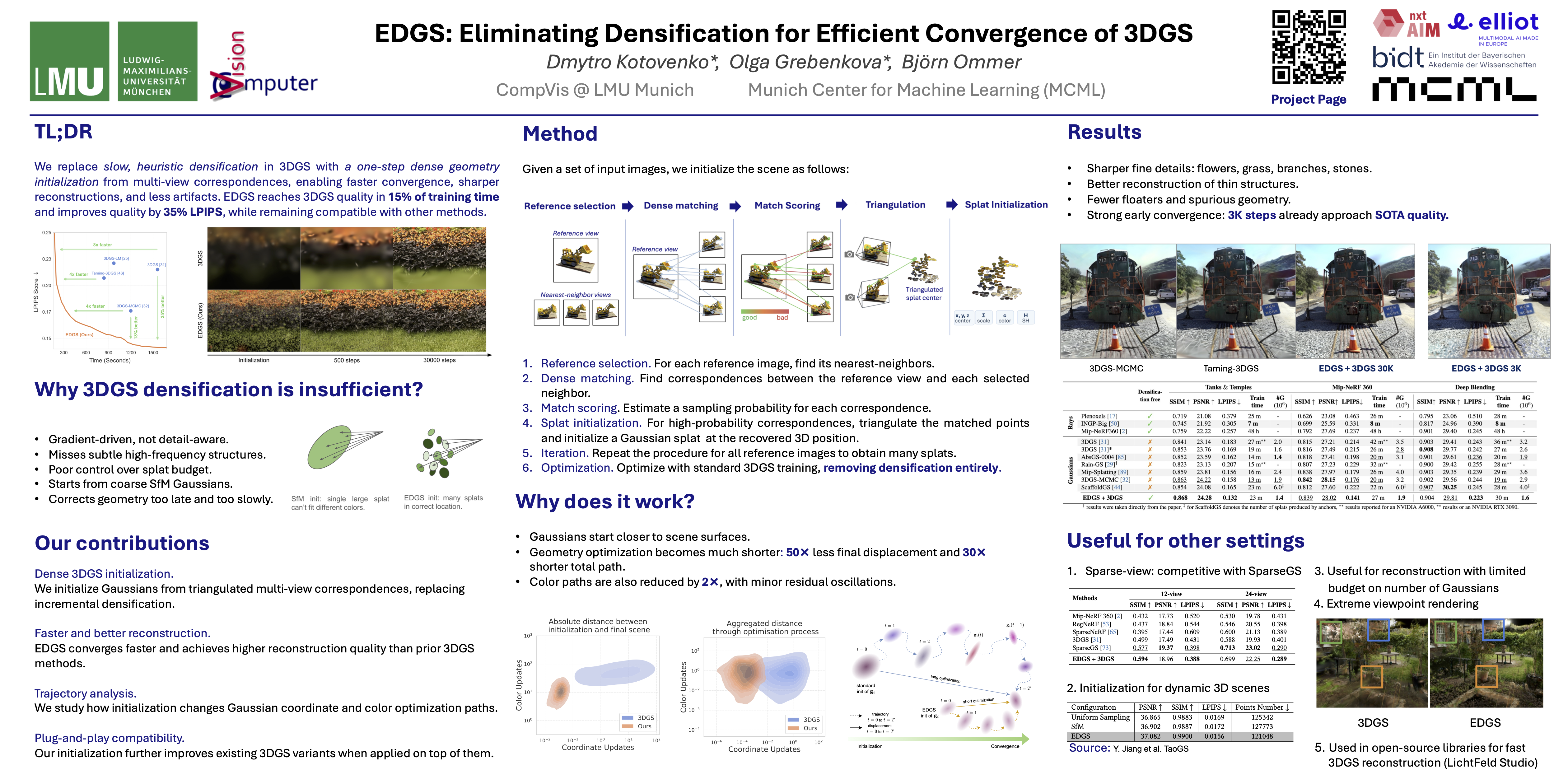
3D Gaussian Splatting reconstructs scenes by starting from a sparse Structure-from-Motion initialization and refiningunder-reconstructed regions. This process is slow, as it requires multiple densification steps where Gaussians arerepeatedly split and adjusted, following a lengthy optimization path. Moreover, this incremental approach often yieldssuboptimal renderings in high-frequency regions. We propose a fundamentally different approach: eliminate densification with a one-step approximation of scenegeometry using triangulated pixels from dense image correspondences. This dense initialization allows us to estimatethe rough geometry of the scene while preserving rich details from input RGB images, providing each Gaussian withwell-informed color, scale, and position. As a result, we dramatically shorten the optimization path and remove theneed for densification. Unlike methods that rely on sparse keypoints, our dense initialization ensures uniform detailacross the scene, even in high-frequency regions where other methods struggle. Moreover, since all splats are initializedin parallel at the start of optimization, we remove the need to wait for densification to adjust new Gaussians.EDGS reaches LPIPS and SSIM performance of standard 3DGS significantly faster than existing efficiency-focused approaches. When trained further, it exceeds the reconstruction quality of state-of-the-art models aimed at maximizing fidelity. Our method is fully compatible with other acceleration techniques, making it a versatile and efficient solution that can be integrated with existing approaches.