
Diffusion-Based Native Adversarial Synthesis for Enhanced Medical Segmentation Generalization
 Highlight
Abstract
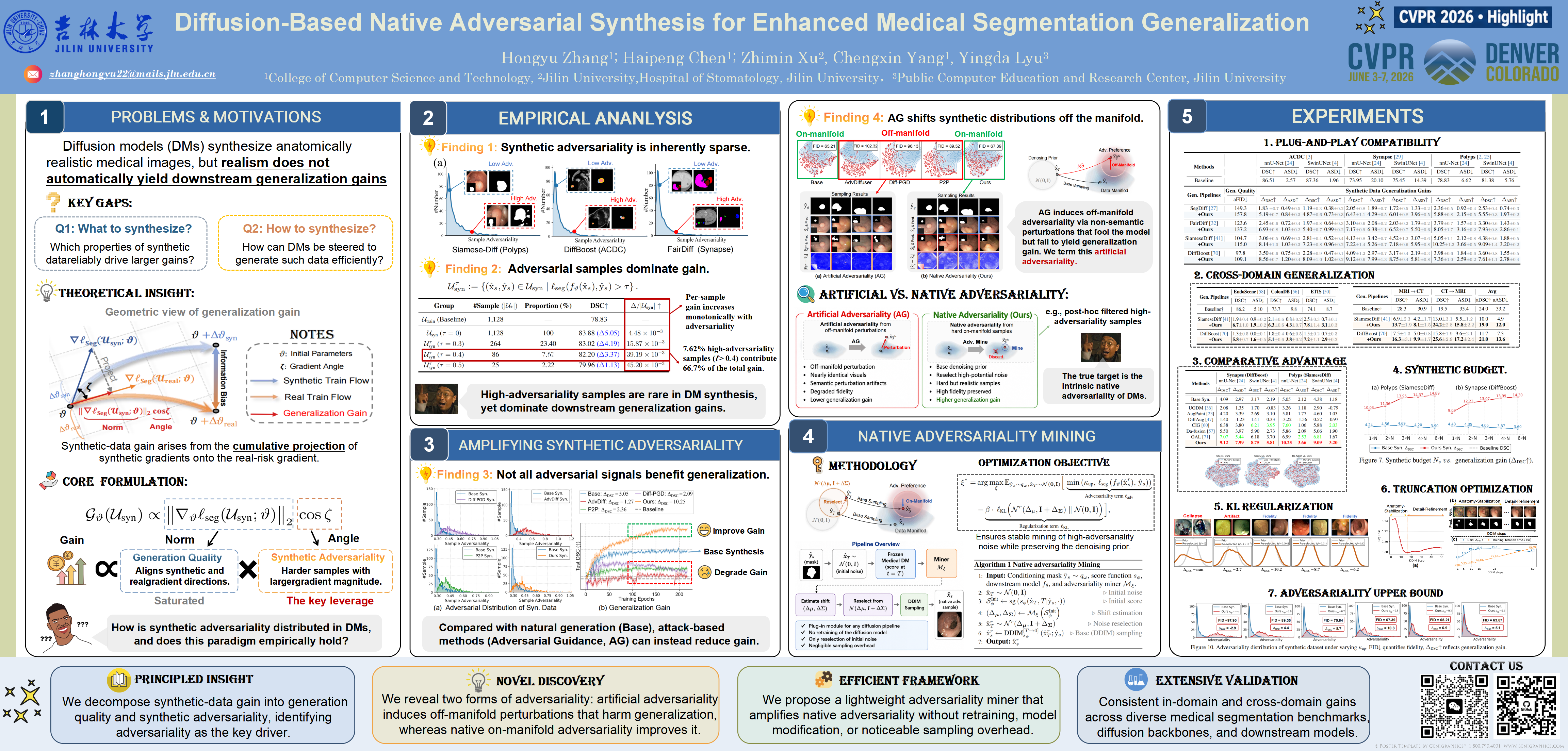
Diffusion models (DMs) demonstrate strong capabilities in generating anatomically realistic medical images, enabling promising avenues for improving model generalization via synthetic augmentation. However, bridging the gap between generative prowess (realism) and measurable improvements in downstream generalization (utility) remains a key challenge. This work unifies theory and practice to tackle two central questions: (1) What to synthesize? We identify synthetic adversariality—the expected empirical loss induced by synthetic data—as a key driver of generalization. Crucially, only native adversariality (i.e., hard examples drawn from the DM's distribution) yields consistent improvements, while artificial adversariality from attack-style perturbations degrades performance. (2) How to synthesize? We introduce the Adversariality Miner, a lightweight, plug-and-play module that efficiently selects initial noise to elicit native adversarial samples, without modifying or retraining the DM. Extensive experiments across diverse diffusion backbones and medical benchmarks confirm the effectiveness of our approach, establishing a principled path toward diffusion-driven generalization.