
Scaling Spatial and Temporal Context for Robotic Imitation Learning Policies With Scene Graphs
Abstract
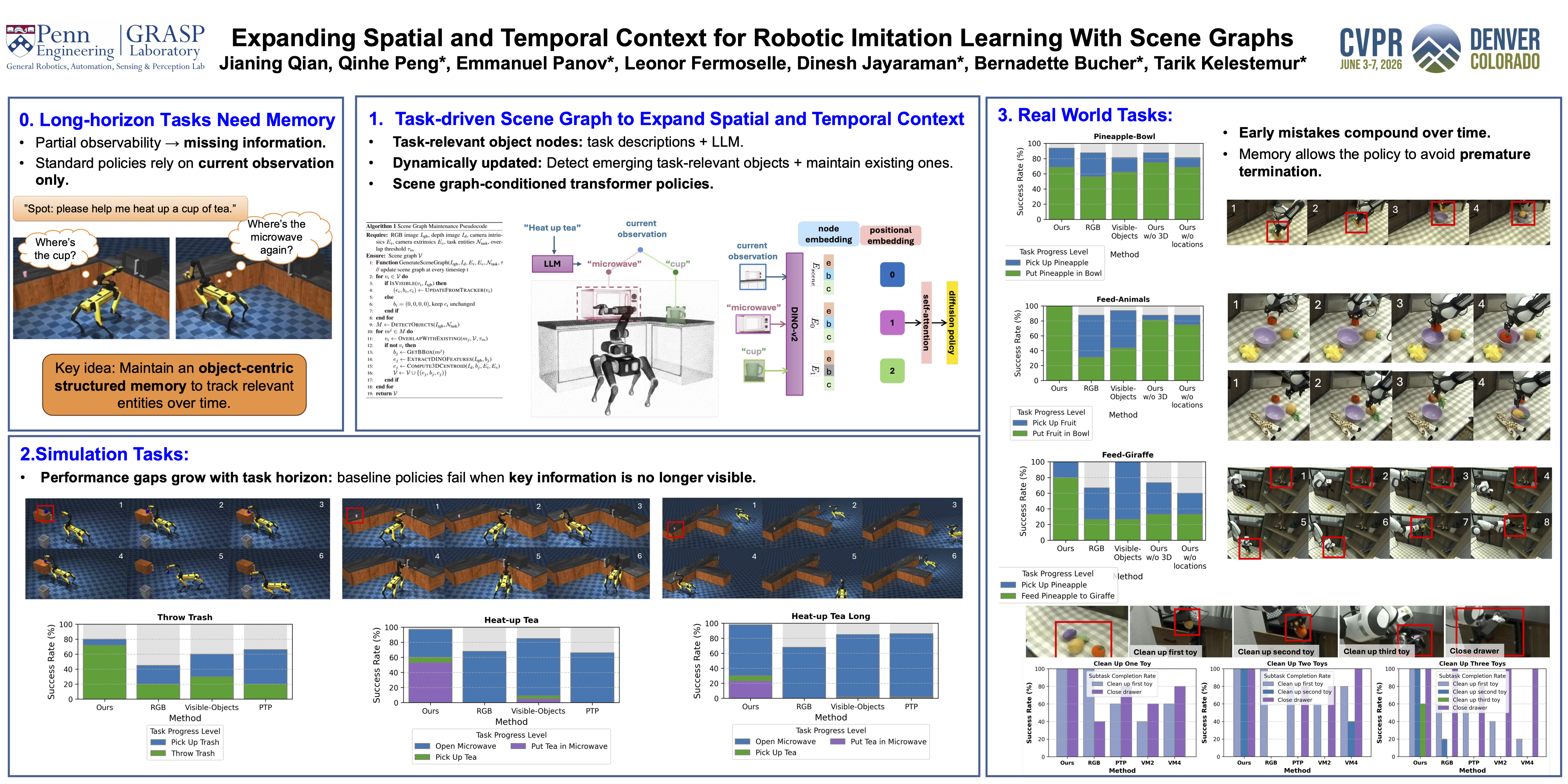
Imitation learning enables robots to learn how to execute tasks via observation. However, real-world environments like homes and offices are often severely partially observed due to their large spatial scales. In addition, many tasks involve executing a series of subtasks requiring autonomous robots to reason over extended time horizons. To address these challenges, we propose using scene graphs as an explicit and structured memory mechanism in imitation learning. By maintaining a dynamic scene graph that captures object-centric relationships and their evolution over time, our method allows the agent to retain relevant historical context during task execution to efficiently reason over incrementally accrued scene information. Our experiments on simulated mobile manipulation and real-world tabletop manipulation demonstrate that our approach substantially improves policy performance, particularly in settings that demand long-term reasoning and robust generalization under partial observability.