
GeneVAR: Causal MeanFlow for Autoregressive Gene-to-WSI Tile Synthesis
Jianwei Zhao ⋅ Fan Yang ⋅ XIN LI ⋅ Qiang Zhai ⋅ Ao Luo ⋅ Ziqi Ren ⋅ Zhicheng Jiao ⋅ Hong Cheng
Abstract
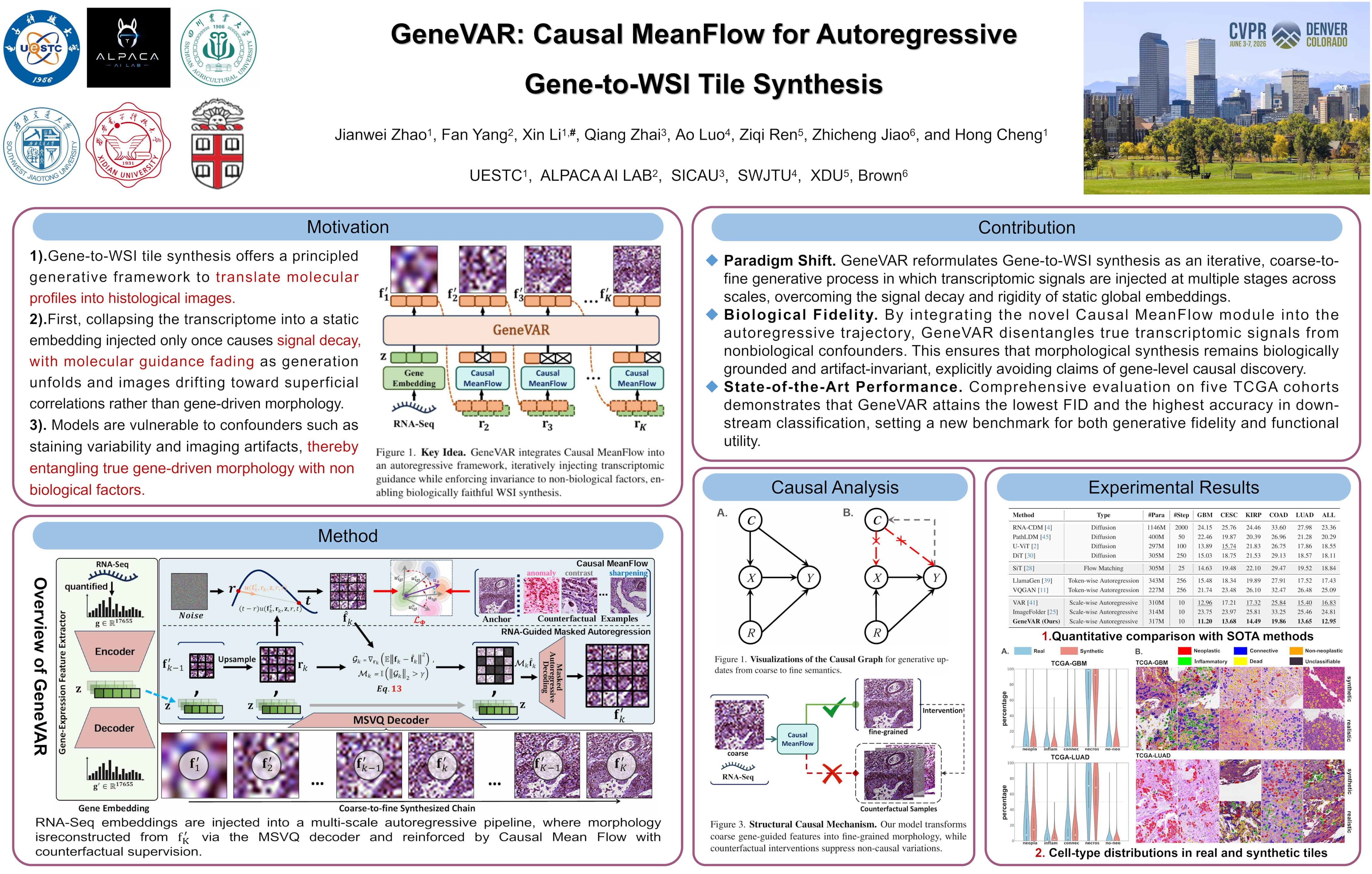
Understanding how transcriptomic programs shape tissue morphology remains a central challenge in computational pathology. Gene-to-WSI tile synthesis offers a principled generative framework to translate molecular profiles into histological images. However, most existing methods compress RNA-Seq into a single global embedding injected once at initialization, an oversimplified design that weakens transcriptomic signals and induces non-causal associations between gene expression and tissue morphology. We present GeneVAR, an Autoregressive Gene-to-WSI model that reformulates synthesis as an iterative, coarse-to-fine generative process. At its core is a novel Causal MeanFlow module that reinforces transcriptome-informed guidance at multiple stages and mitigates non-causal factors through counterfactual-style interventions, thereby ensuring biological fidelity throughout the generative trajectory. Combined with a $\beta$-VAE for compact gene embeddings and a multi-scale vector quantizer for discrete morphology representation, GeneVAR generates H\&E-stained WSI tiles that are both visually realistic and transcriptomically faithful. Extensive experiments across five TCGA cancer benchmarks demonstrate consistent state-of-the-art performance, surpassing prior methods in both generative fidelity and downstream classification accuracy. All models and code will be released to facilitate reproducibility.
Chat is not available.
Successful Page Load