
Divide, Conquer, and Aggregate: Asymmetric Experts for Class-Imbalanced Semi-Supervised Medical Image Segmentation
Yajun Liu
Abstract
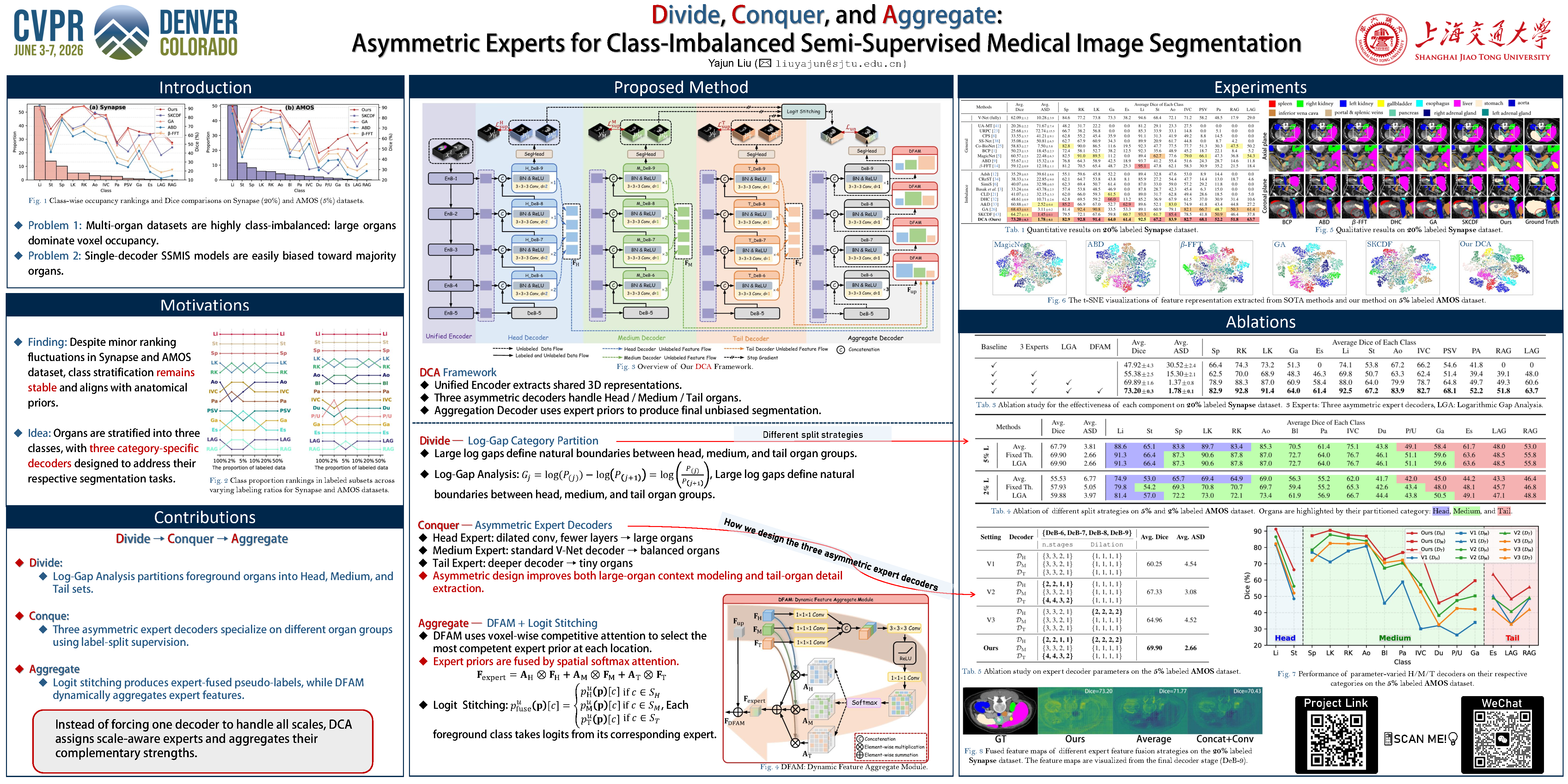
Semi-supervised medical image segmentation (SSMIS) aims to alleviate annotation scarcity, but general methods, often developed on few-class datasets, suffer performance degradation in class-imbalanced multi-organ scenarios. Existing class-imbalanced SSMIS methods also struggle, as their single-decoder architecture is forced to handle vastly different scales with shared parameters. This process is easily dominated by majority classes, fundamentally limiting tail-class segmentation capability.To address this, we propose a ‘’$\textbf{D}$ivide, $\textbf{C}$onquer, and $\textbf{A}$ggregate" ($\textbf{DCA}$) framework, featuring a unified encoder, three expert decoders, and an aggregation decoder. First, we $\textbf{D}$ivide by applying a Logarithmic Gap Analysis to statically partition foreground classes into stable Head, Medium, and Tail sets, which aligns with anatomical priors. Then, we $\textbf{C}$onquer by training the three architecturally asymmetric experts independently using a label-split strategy. This fundamentally alleviates the burden on a single decoder. The experts' predictions on unlabeled data are fused via logit stitching to generate high-quality pseudo-labels. Finally, we $\textbf{A}$ggregate using an aggregation decoder with a Dynamic Feature Aggregation Module (DFAM), which dynamically fuses priors from all three experts to achieve unbiased predictions and fully leverage unlabeled data. Experiments demonstrate that our DCA framework significantly outperforms state-of-the-art general and class-imbalanced SSMIS methods.
Chat is not available.
Successful Page Load