
Keep It Frozen: Domain-Routed Conditional Residual Modulation for Multi-Domain Vision Transformers
 Highlight
Abstract
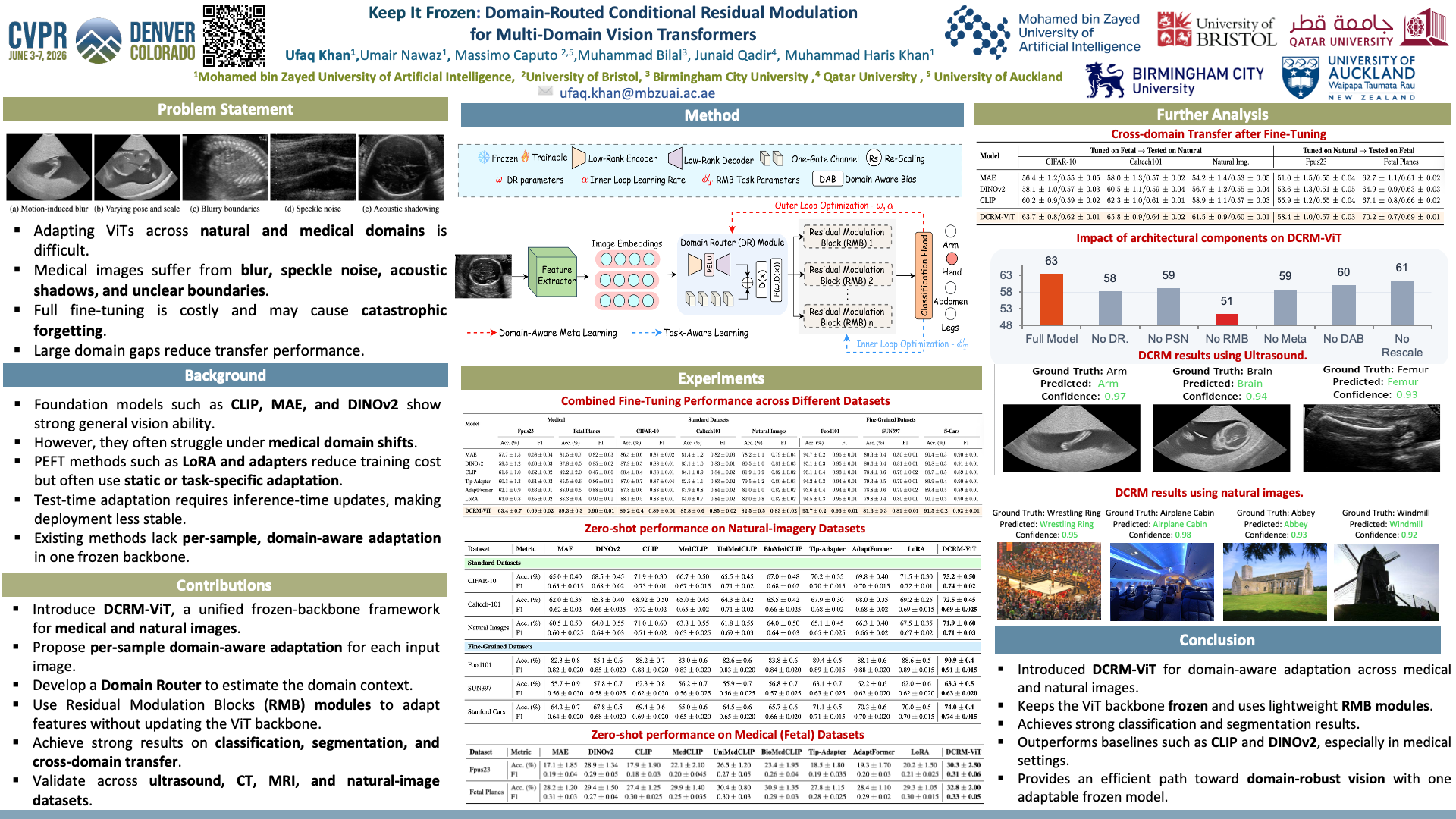
Medical imaging presents significant challenges due to acoustic shadows, motion blur, and indistinct boundaries. Addressing these issues is crucial for improving diagnostic accuracy. Many conventional vision require extensive fine-tuning on task-specific data and often lose generalizability to natural-image domains. We propose DCRM-ViT, a domain-conditioned residual modulation framework for Vision Transformers that preserves general-vision capability while adapting to diverse domains. DCRM-ViT keeps the backbone frozen and augments each block with a lightweight Residual Modulation Block (RMB) whose parameters are synthesized per sample by a Domain Router (DR) and Parameter Synthesizer Network (PSN). The router outputs soft domain weights from input features, whereas the synthesizer maps these weights to low-rank residuals that modulate selected projections and, optionally, add a domain-aware bias to attention. Crucially, we learn routing and modulation via a bi-level optimization scheme: a short inner loop adapts RMB parameters to task supervision, while an outer loop updates DR, PSN, and RMB initializations/step sizes so the synthesized residuals generalize across medical and natural domains. Across fine-grained classification (Food101, SUN397, Stanford Cars) and medical segmentation (ultrasound, CT, MRI), DCRM-ViT improves over strong baselines while using modest trainable compute. The ablation studies confirmed the benefits of our architectural enhancements, showing improved performance and adaptability. The results demonstrate DCRM-ViT's potential to offer high diagnostic performance with reduced computational overhead of using 4.7 GFLOPs and 0.3 training min/epoch. Our code will be publicly available upon acceptance.