
CUBic: Coordinated Unified Bimanual Perception and Control Framework
Abstract
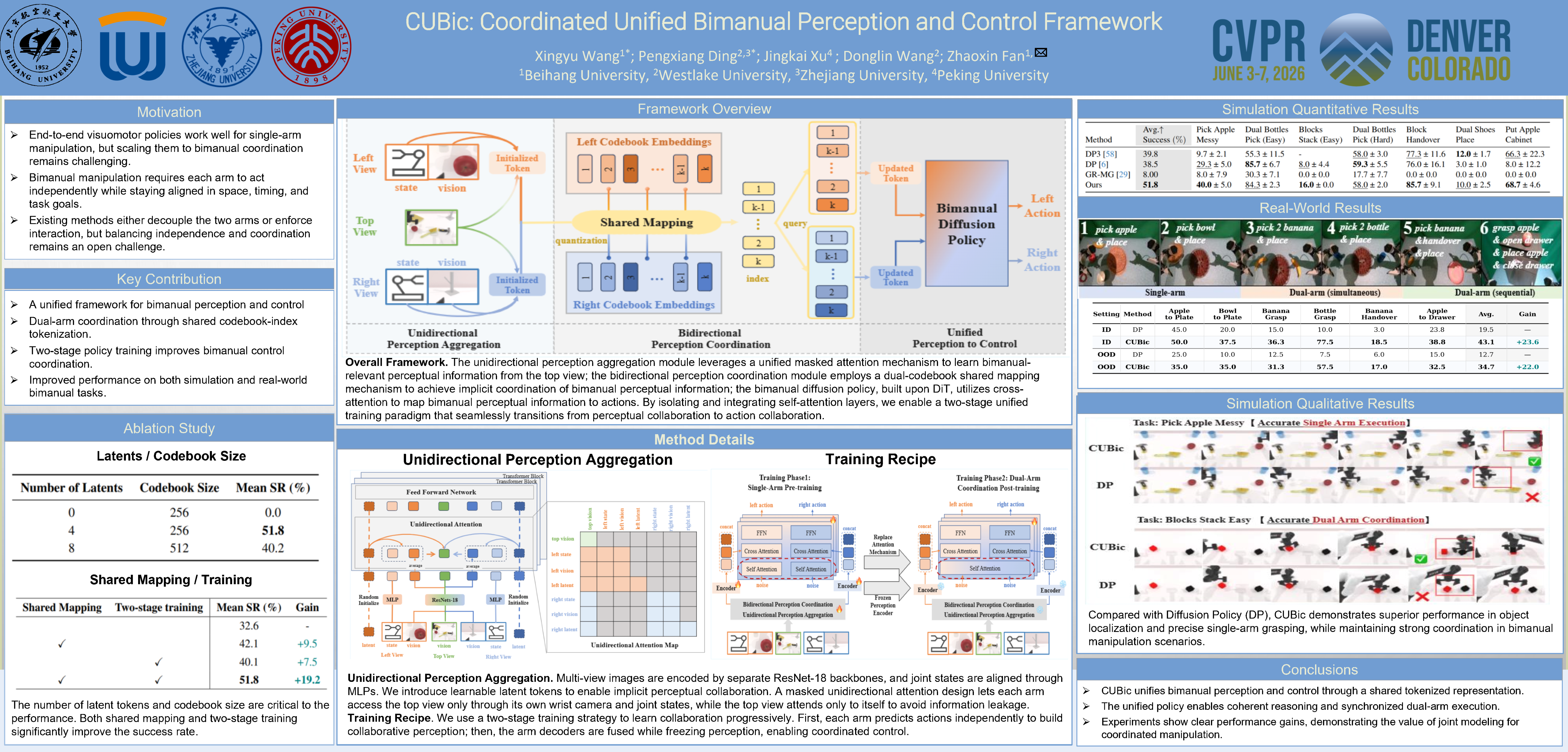
Recent advances in visuomotor policy learning have enabled robots to perform control directly from visual inputs. Yet, extending such end-to-end learning from single-arm to bimanual manipulation remains challenging due to the need for both independent perception and coordinated interaction between arms. Existing methods typically favor one side—either decoupling the two arms to avoid interference or enforcing strong cross-arm coupling for coordination—thus lacking a unified treatment. We propose CUBic, a Coordinated and Unified framework for Bimanual perception and control} that reformulates bimanual coordination as a unified perceptual modeling problem. CUBic learns a shared tokenized representation bridging perception and control, where independence and coordination emerge intrinsically from structure rather than from hand-crafted coupling. Our approach integrates three components: unidirectional perception aggregation, bidirectional perception coordination through two codebooks with shared mapping, and a unified perception-to-control diffusion policy. Extensive experiments on the RoboTwin benchmark show that CUBic consistently surpasses standard baselines, achieving marked improvements in coordination accuracy and task success rates over state-of-the-art visuomotor baselines.