
Regulating Rather than Constraining: Adaptive Guidance for Complex Spectral Reconstruction in Pansharpening
Abstract
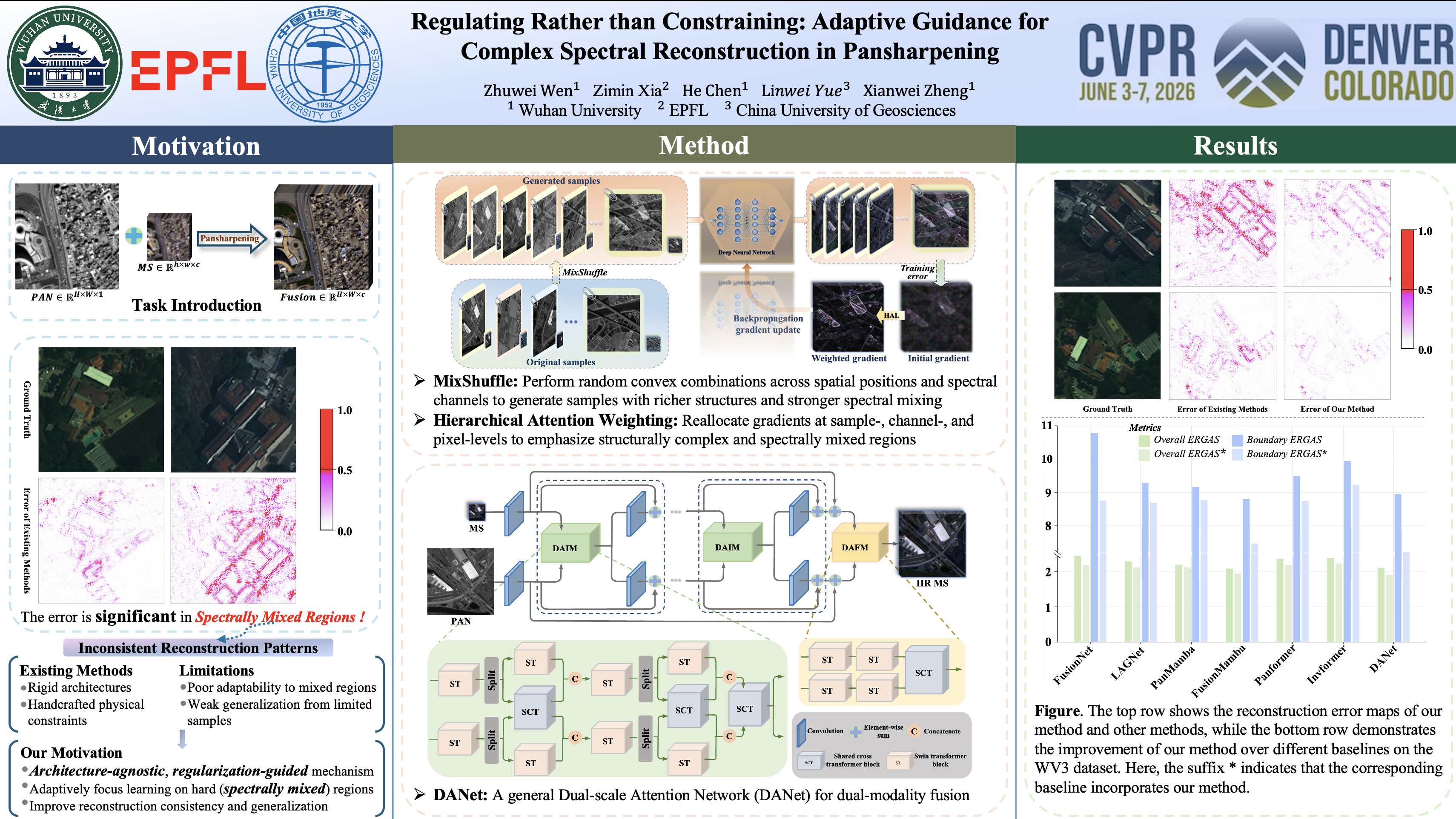
In remote sensing pansharpening, spectrally mixed regions, where the spectral interactions among adjacent land covers lead to highly inconsistent reconstruction patterns, remain the most challenging areas. Due to the complex spatial distribution and heterogeneous spectral characteristics of ground objects, existing methods relying on rigid architectures and physical constraints struggle to learn generalized reconstruction patterns from limited spectral mixing samples, resulting in unstable generalization. To address this limitation, we propose an architecture-agnostic regularization-guided mechanism that adaptively directs the model to focus on learning reliable reconstruction priors for challenging regions. Specifically, we introduce a simple data-level transformation, MixShuffle, which performs random convex combinations across spatial positions and spectral channels to generate training data with richer spatial structures and stronger spectral mixing. In parallel, we propose a hierarchical attention weighting mechanism, a loss-level gradient reallocation strategy at the sample, channel, and pixel levels, enabling the model to emphasize structurally complex regions. Extensive experiments on multiple benchmark datasets (WV3, GF2, QB) and across various network architectures demonstrate the strong generality and effectiveness of the proposed strategies, achieving state-of-the-art performance when integrated into DANet.