
MoVie: Broaden Your Views with Human Motion for Action Detection
Abstract
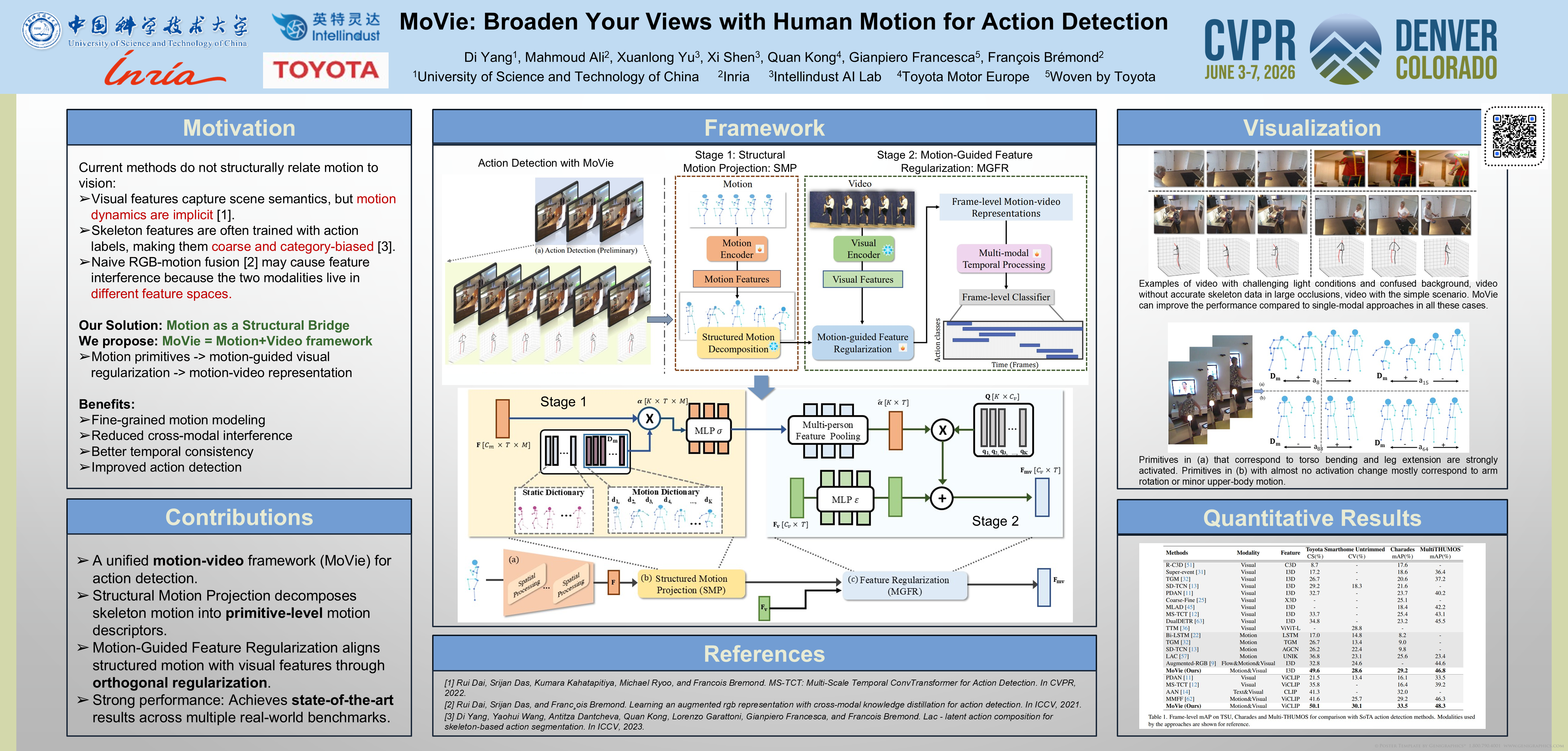
Human action detection in videos requires both semantic recognition and accurate modeling of motion. While recent video foundation models have advanced visual semantics, they still struggle to capture complex and compositional actions due to the limited representation ability of motion. Human skeleton sequences, which explicitly describe the body structure and movement, provide valuable physical and geometric motions that complement RGB videos. However, combining video and skeleton modalities faces two key challenges: (i) label-driven skeleton features are too coarse to describe fine-grained motion, and (ii) skeleton motion and RGB video lie in heterogeneous feature spaces, so current fusion strategies often cause feature interference. To address these, we propose MoVie, a unified Motion-Video processing framework that uses structured human motion as a bridge between the two signals. We first propose a Structural Motion Projection module that decomposes motion into primitive components using a learnable motion dictionary, to produce fine-grained descriptors. Then, we design a Motion-guided Feature Regularization mechanism that aligns visual features with motion through an orthogonality-based transformation, so that fine-grained motion cues can guide visual representations without collapsing semantic diversity. Extensive evaluations on Toyota Smarthome Untrimmed, Charades, Multi-THUMOS and PKU-MMD datasets demonstrate that MoVie significantly improves state-of-the-art action detection performance.