
Deformable Gaussian Occupancy: Decoupling Rigid and Nonrigid Motion with Factorized Distillation
Abstract
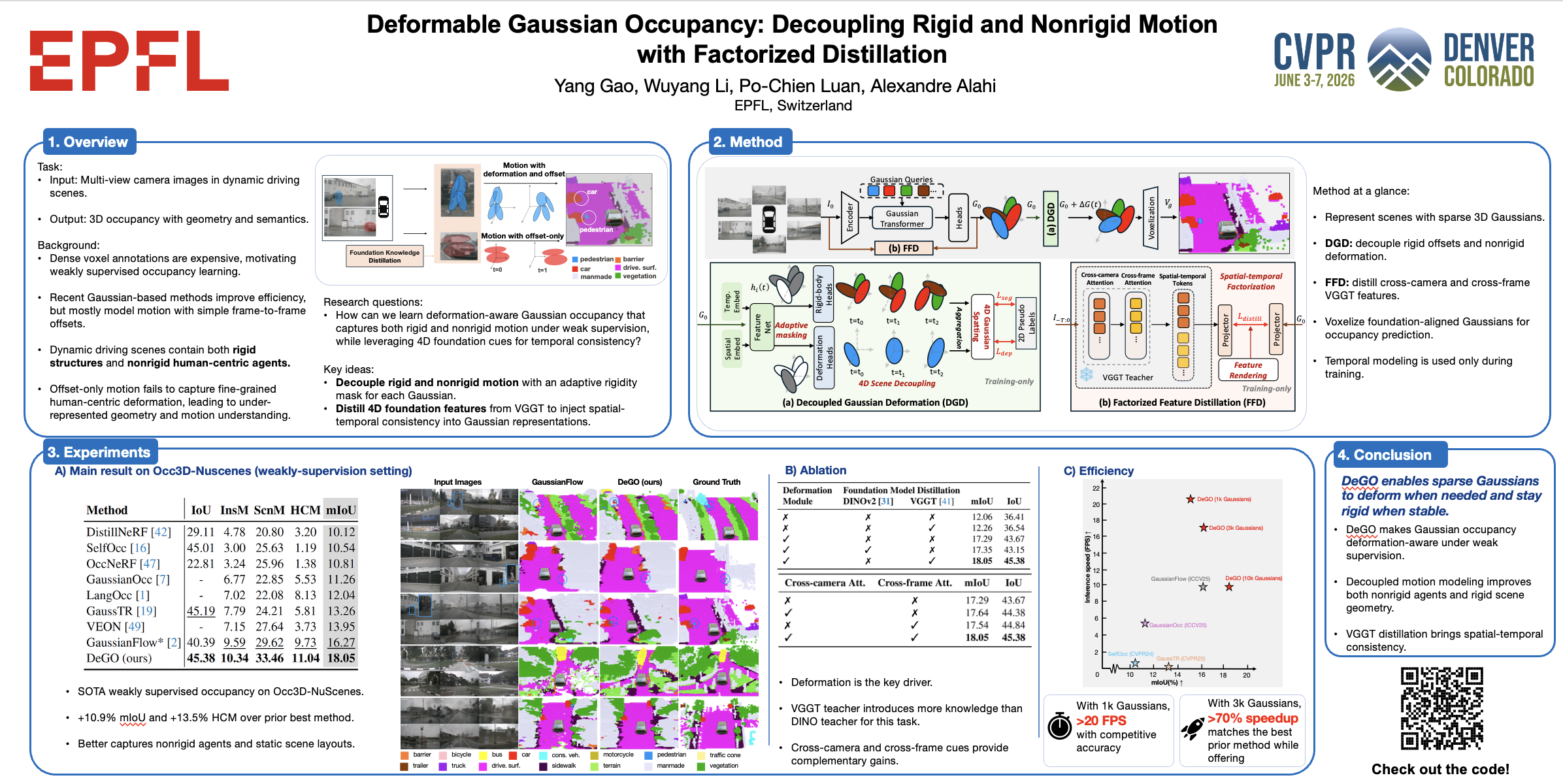
Understanding dynamic 3D environments is essential for safe autonomous driving, particularly when reasoning about human-centric, nonrigid agents. However, existing self-supervised occupancy prediction frameworks predominantly assume rigid-body motion and rely on simple frame-to-frame offsets, limiting their ability to capture fine-grained deformations and maintain temporal coherence. To address this issue, we propose DeGO, a deformable Gaussian occupancy framework that unifies decoupled Gaussian deformation with factorized 4D foundation-model distillation. DeGO disentangles rigid and nonrigid motion, enabling each Gaussian primitive to evolve through both deformation and offset-based updates. In parallel, a factorized 4D distillation strategy transfers cross-camera and cross-frame knowledge from the VGGT foundation model, producing foundation-aligned features that enhance temporal consistency. Experiments on the Occ3D-NuScenes benchmark demonstrate that our method achieves state-of-the-art performance under self-supervision, delivering 13.5\% gains on human-centric instances and 10.9\% overall improvements. These results highlight the effectiveness of deformation-aware and foundation-guided occupancy modeling for dynamic scene understanding.