
Global Underwater Geolocation from Time-Lapse Polarization Imagery
Abstract
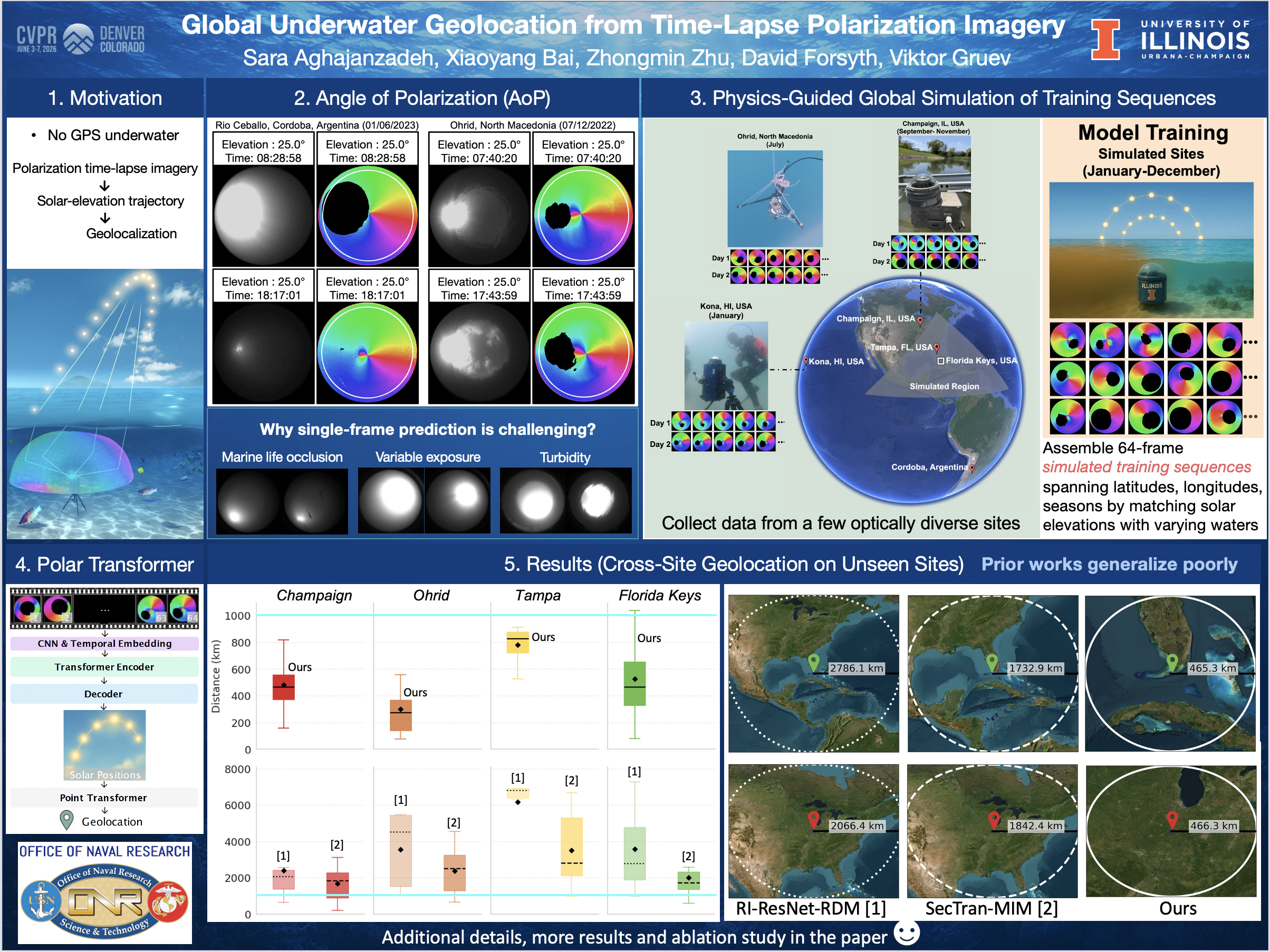
It is extremely hard for an underwater agent to know where it is. Satellite signals disappear within centimeters of the surface; acoustic baselines require heavy infrastructure to instrument small regions. The polarization of the sky, visible underwater, reveals the elevation of the sun. The pattern of elevation over the day reveals location to an agent with a clock. However, recovering elevation from polarization images is very difficult. SOTA geolocalization methods can localize well for locations where they have seen data, but accuracy collapses when the data comes from a new location. Our physics-guided synthesis pipeline expands a huge library of polarization images from a small set of sites to 2.8~million solar-elevation–matched training sequences spanning latitudes, seasons, and water types. A compact two-stage transformer reconstructs the solar-elevation curve and predicts geolocation. Under leave-one-site-out tests, the site averaged median geodesic error is ~500km—about an eightfold improvement over previous deep-learning baselines; with limited target-site data, the median error contracts to single-digit kilometers.