
Temporal Interaction in Spiking Transformers with Multi-Delay Mixer
Abstract
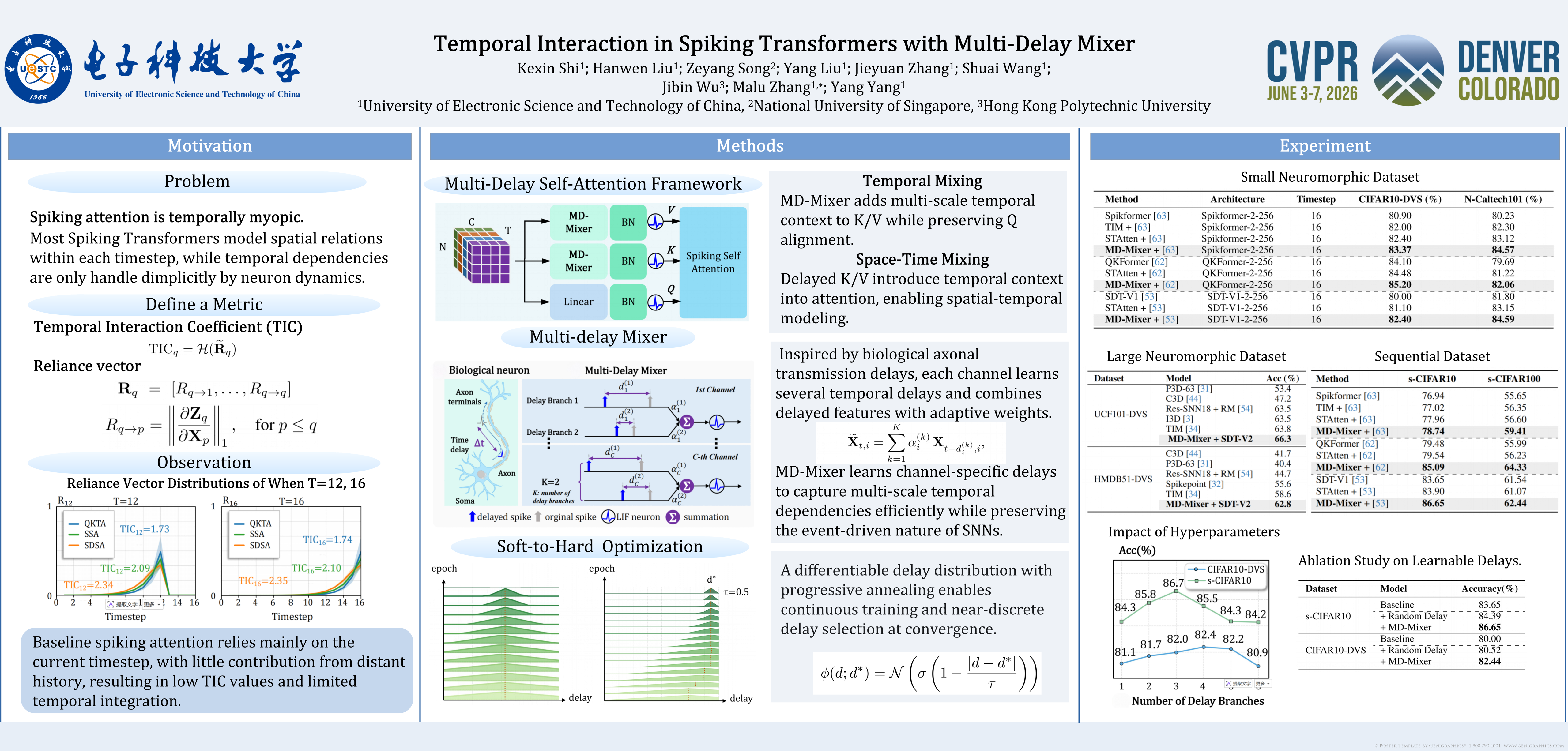
Spiking Neural Networks (SNNs) have gained significant attention due to their event-driven computational paradigm, making them promising for neuromorphic computing. In recent years, the integration of SNNs and Transformer architectures has made remarkable progress in various tasks. However, existing spiking self-attention mechanisms predominantly focus on spatial information while neglecting explicit temporal modelling, leading to suboptimal performance. In this paper, we introduce the Temporal Interaction Coefficient (TIC) to analyze temporal dependency patterns in these spatial-only attention mechanisms, revealing their limited temporal interactions and restricted pattern diversity. To overcome this issue, we propose the \textbf{M}ulti-\textbf{D}elay \textbf{Mixer} (\textbf{MD-Mixer}), drawing inspiration from time delay mechanisms in the nervous system. Specifically, MD-Mixer introduces multiple temporal delays to perform effective time mixing and facilitate temporally enriched spatial attention. In addition, it can be integrated seamlessly into existing Spiking Transformers as a drop-in replacement while maintaining energy efficiency. Extensive evaluations on static and neuromorphic benchmarks demonstrate that MD-Mixer substantially improves the performance of Spiking Transformers, outperforming existing state-of-the-art (SOTA) methods. This work establishes MD-Mixer as an effective and general solution for temporal modelling in event-driven architectures.