
Parallel Rigidity Matters for Bundle Adjustment
 Highlight
Abstract
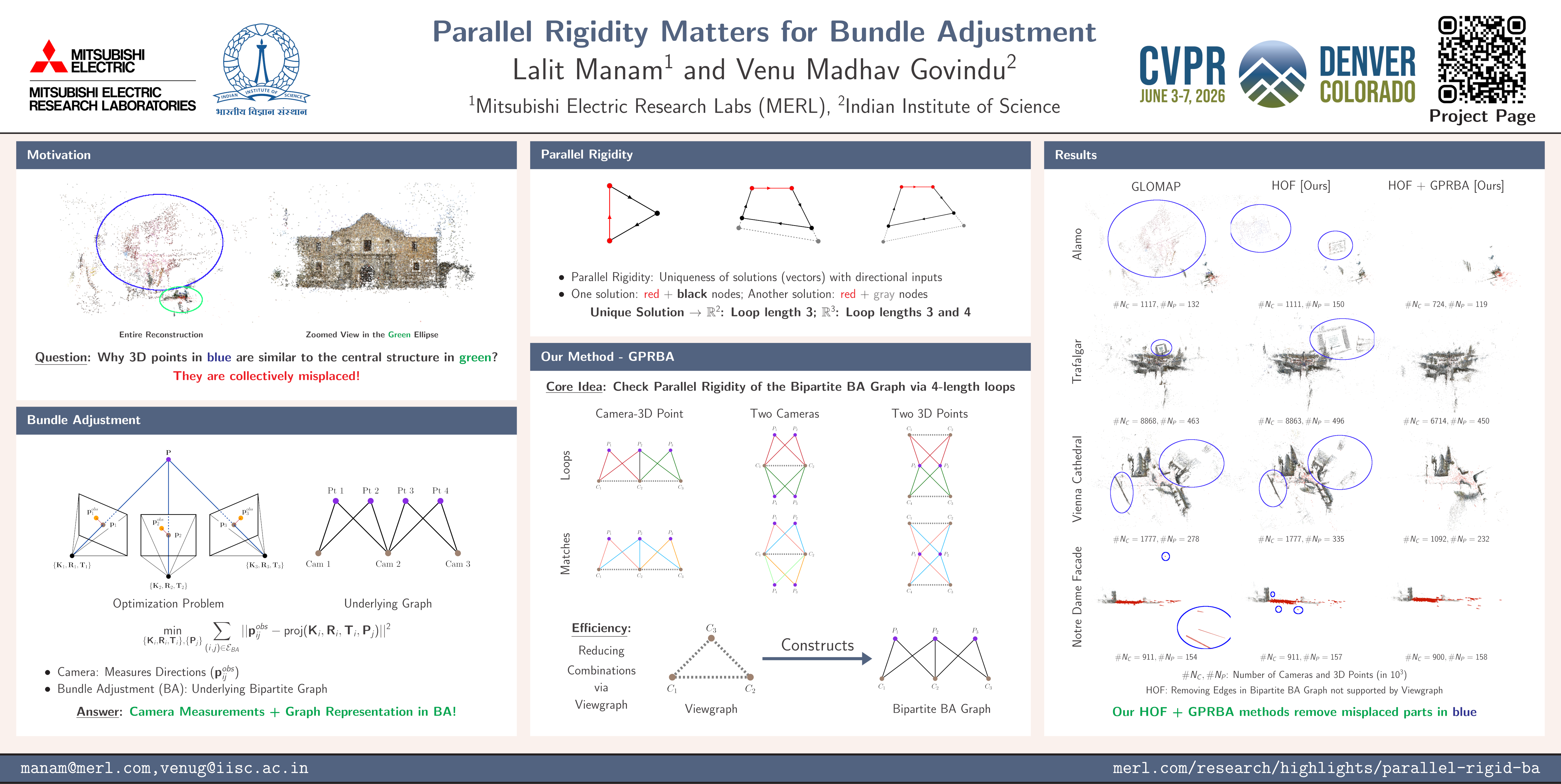
Bundle adjustment is a long-standing problem in computer vision that solves for camera parameters and 3D point coordinates from 2D image observations. While there has been much work on various aspects, like adaptation to different camera models and sensors, and considerations for solving the optimization problem, in this paper, we deal with a fundamental and distinct aspect of the uniqueness of its solution. In particular, we examine the unique solvability of the 3D reconstruction problem using parallel rigidity theory. We design an algorithm to ensure that the topology of the bipartite graph formed by the camera-3D point relations in bundle adjustment does not result in independent scaling of the edges in its subgraphs. To tackle the generally large-sized bipartite graph, we leverage camera-camera relationships in 3D reconstruction problems for efficiency. We demonstrate the benefits of our analysis on a global structure-from-motion pipeline. Applying our proposed algorithm results in significantly cleaner reconstructions by removing misplaced cameras and 3D points.