
Polyphony: Diffusion-based Dual-Hand Action Segmentation with Alternating Vision Transformer and Semantic Conditioning
Abstract
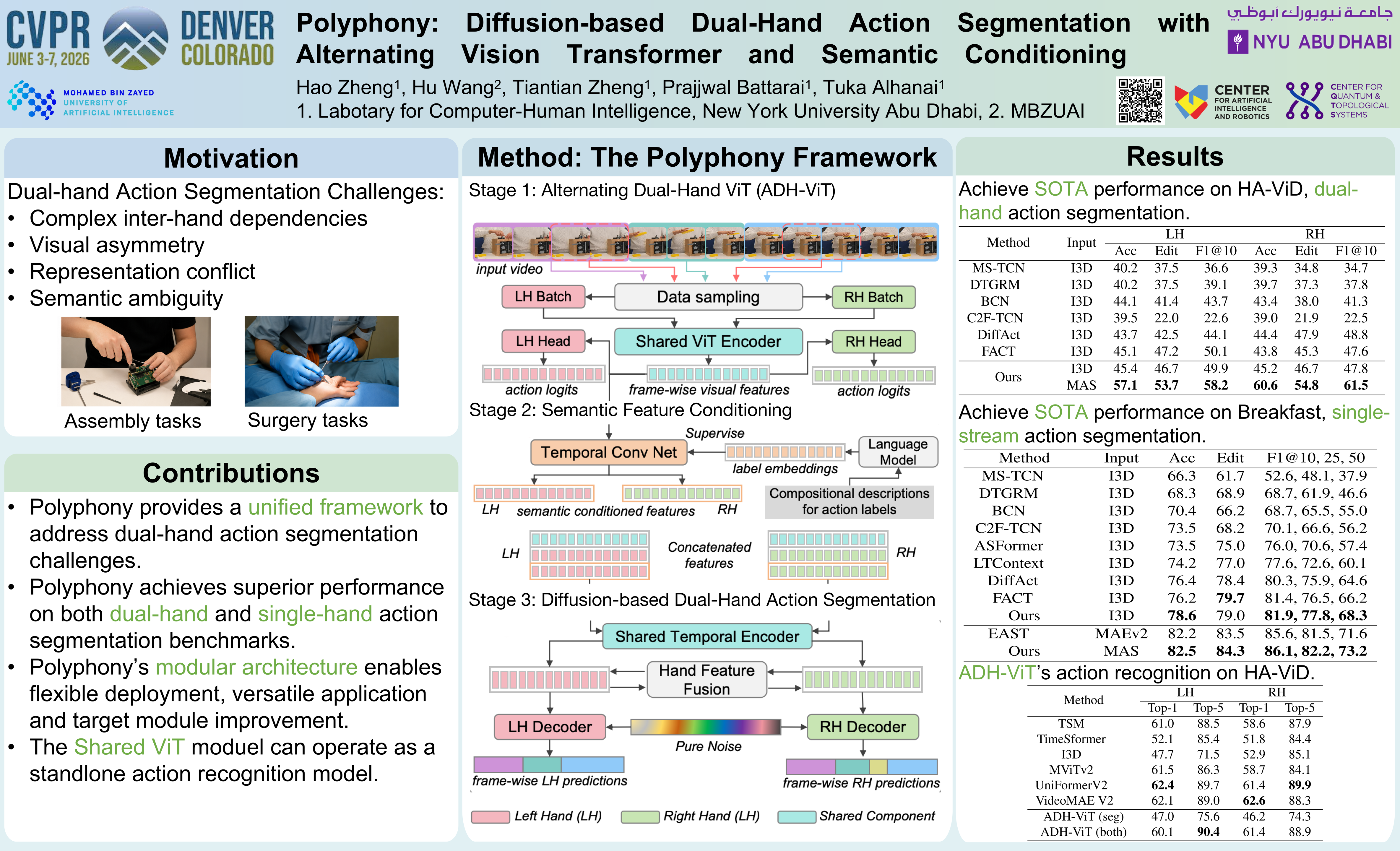
Dual-hand action segmentation, densely predicting actions for both hands from untrimmed videos, is essential for understanding complex bimanual activities. However, it poses several unique challenges: complex inter-hand dependencies, visual asymmetry between hands, representation conflicts where the dominant hand monopolizes gradients, and semantic ambiguity in fine-grained actions. We propose Polyphony, a three-stage method to address these challenges through: (1) an Alternating Dual-Hand Vision Transformer that alternates training between left- and right-hand mini-batches to ensure balanced gradient contributions from both hands while sharing a spatio-temporal encoder; (2) Semantic Feature Conditioning that aligns visual features with structured, compositional action descriptions to enhance discrimination of semantically similar actions; and (3) Diffusion-Based Segmentation with cross-hand feature fusion for inter-hand coordination and adaptive loss weighting for balancing performance. Polyphony achieves state-of-the-art on both dual-hand datasets (HA-ViD, ATTACH) with improvements up to 16.8 points, and on the single-stream Breakfast dataset (82.5\%), outperforming the prior best method that uses a 12× larger backbone. Notably, our unified model with a single shared backbone surpasses baselines requiring separate per-hand models. Code is at \url{https://github.com/polyphony-cvpr/polyphony}.