
Random Wins All: Rethinking Grouping Strategies for Vision Tokens
Abstract
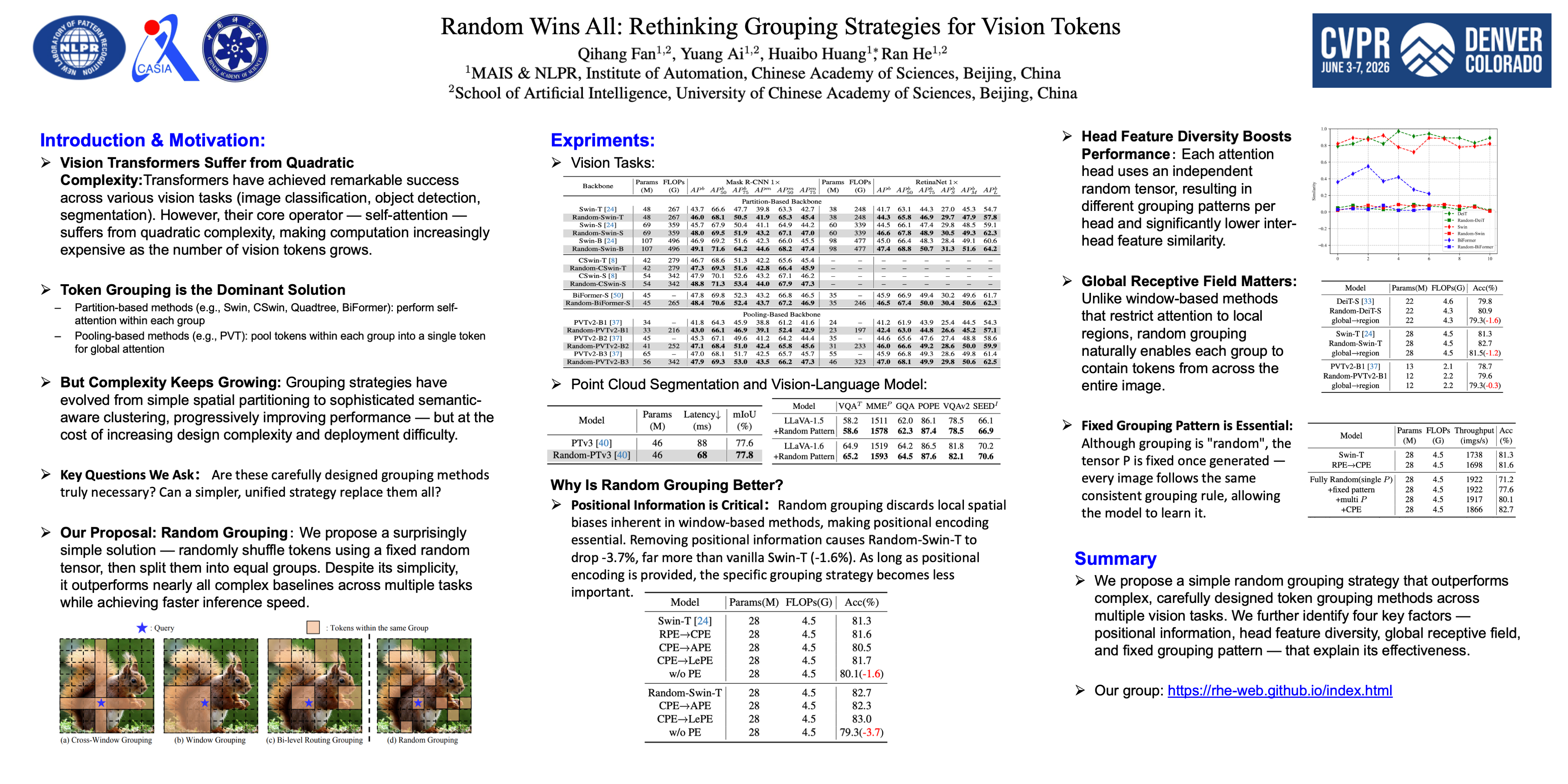
Since Transformers are introduced into vision architectures, their quadratic complexity has always been a significant issue that many research efforts aim to address. A representative approach involves grouping tokens, performing self-attention calculations within each group, or pooling the tokens within each group into a single token. To this end, various carefully designed grouping strategies have been proposed to enhance the performance of Vision Transformers. Here, we pose the following questions: \textbf{Are these carefully designed grouping methods truly necessary? Is there a simpler and more unified token grouping method that can replace these diverse methods?} Therefore, we propose the random grouping strategy, which involves a simple and fast random grouping strategy for vision tokens. We validate this approach on multiple baselines, and experiments show that random grouping almost outperforms all other grouping methods. For example, compared to the classic Swin Transformer, our random grouping strategy achieves improvements of \textbf{+1.3}, \textbf{+0.9}, and \textbf{+0.9} across three model sizes. When transferred to downstream tasks, such as object detection, random grouping demonstrates even more pronounced advantages. In response to this phenomenon, we conduct a detailed analysis of the advantages of random grouping from multiple perspectives and identify several crucial elements for the design of grouping strategies: \textbf{positional information}, \textbf{head feature diversity}, \textbf{global receptive field}, and \textbf{fixed grouping pattern}. We demonstrate that as long as these four conditions are met, vision tokens require only an extremely simple grouping strategy to efficiently and effectively handle various visual tasks.