
Robust Remote Sensing Image–Text Retrieval with Noisy Correspondence
Abstract
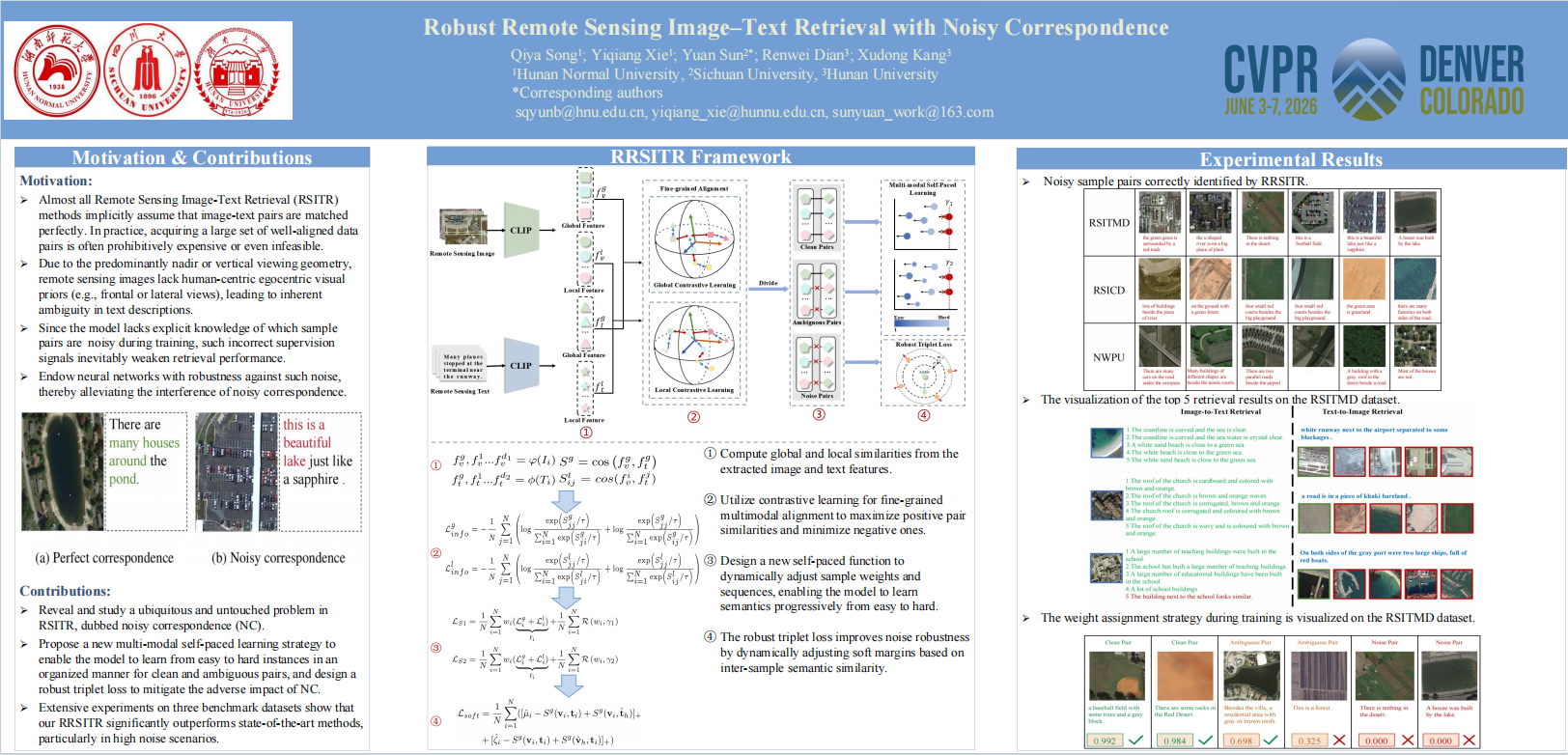
As a pivotal task that bridges remote visual and linguistic understanding, Remote Sensing Image-Text Retrieval (RSITR) has attracted considerable research interest in recent years. However, almost all RSITR methods implicitly assume that image-text pairs are matched perfectly. In practice, acquiring a large set of well-aligned data pairs is often prohibitively expensive or even infeasible. Although several studies have acknowledged the presence of noisy pairs, little work has explored how to endow neural networks with robustness against such noise. Based on the above observations, we reveal an important but untouched problem in RSITR, i.e., Noisy Correspondence (NC). To overcome these challenges, we propose a novel Robust Remote Sensing Image–Text Retrieval (RRSITR) paradigm that designs a self-paced learning strategy to mimic human cognitive learning patterns, thereby learning from easy to hard from multi-modal data with NC. Specifically, we first divide all training sample pairs into three categories based on the loss magnitude of each pair, i.e., clean sample pairs, ambiguous sample pairs, and noisy sample pairs. Then, we respectively estimate the reliability of each training pair by assigning a weight to each pair based on the values of the loss. Further, we respectively design a new self-paced function to dynamically regulate the training sequence and weights of the samples, thus establishing a progressive learning process. Finally, for noisy sample pairs, we present an enhanced triplet loss to dynamically adjust the soft margin based on semantic similarity, thereby enhancing the robustness against noise. Extensive experiments on three popular benchmark datasets demonstrate that the proposed RRSITR significantly outperforms the state-of-the-art methods, especially in high noise rates.