
CausalVAD: De-confounding End-to-End Autonomous Driving via Causal Intervention
 Highlight
Abstract
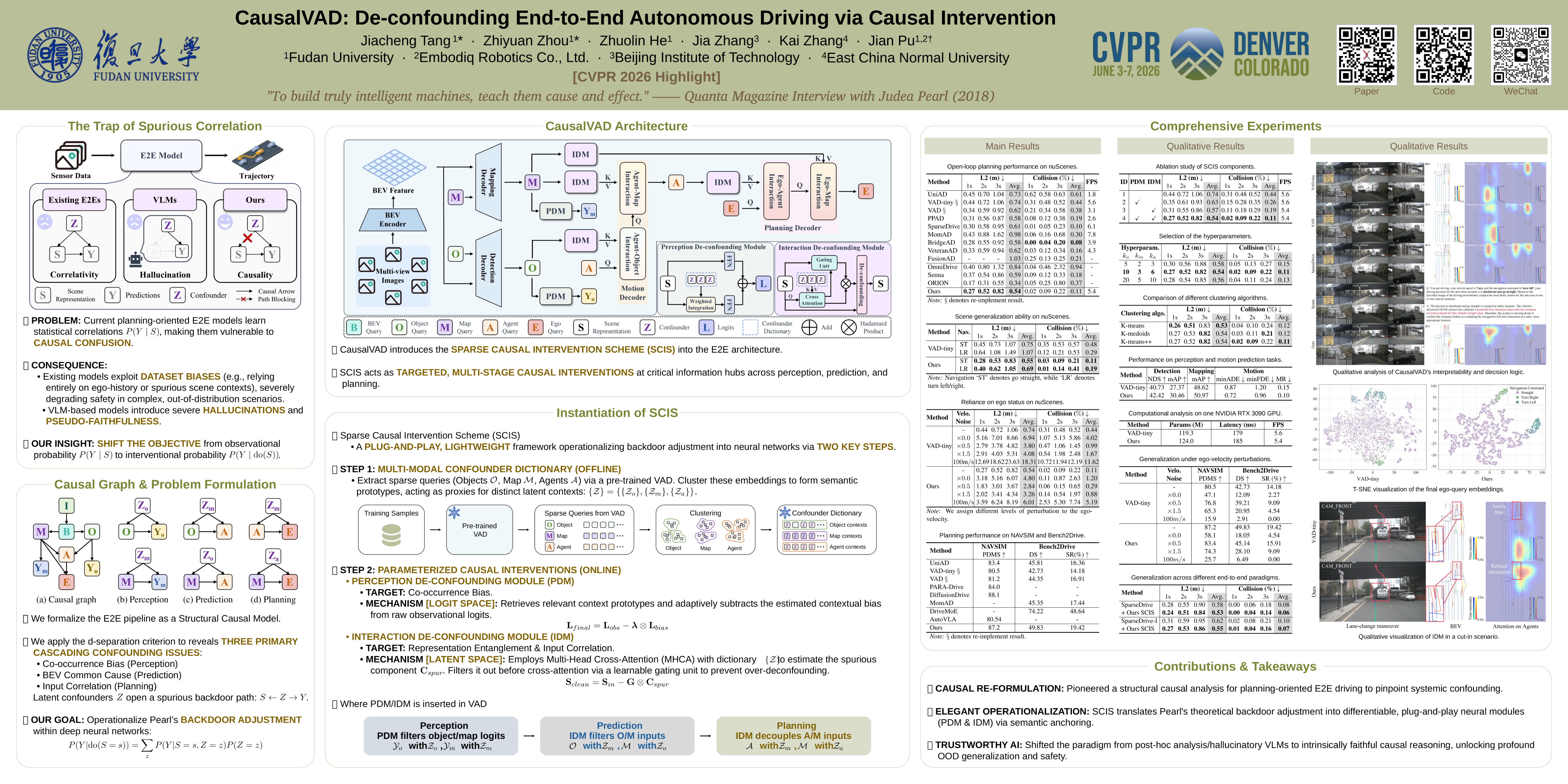
Planning-oriented end-to-end driving models show great promise, yet they fundamentally learn statistical correlations instead of true causal relationships. This vulnerability leads to causal confusion, where models exploit dataset biases as shortcuts, critically harming their reliability and safety in complex scenarios. To address this, we introduce CausalVAD, a de-confounding training framework that leverages causal intervention. As its core, we design the sparse causal intervention scheme (SCIS), a lightweight, plug-and-play module to instantiate the backdoor adjustment theory in neural networks. SCIS first constructs a dictionary of prototypes representing latent driving contexts. It then uses this dictionary to intervene on the model's sparse vectorized queries. This step actively eliminates spurious associations induced by confounders, thereby purifying the representations for downstream tasks. Extensive experiments on benchmarks like nuScenes show CausalVAD achieves state-of-the-art planning accuracy and safety. Furthermore, our method also demonstrates superior robustness against both data bias and noisy scenarios specifically configured to induce causal confusion. We will release our code upon paper acceptance.