
LLMind: Bio-inspired Training-free Adaptive Visual Representations for Vision-Language Models
 Highlight
Abstract
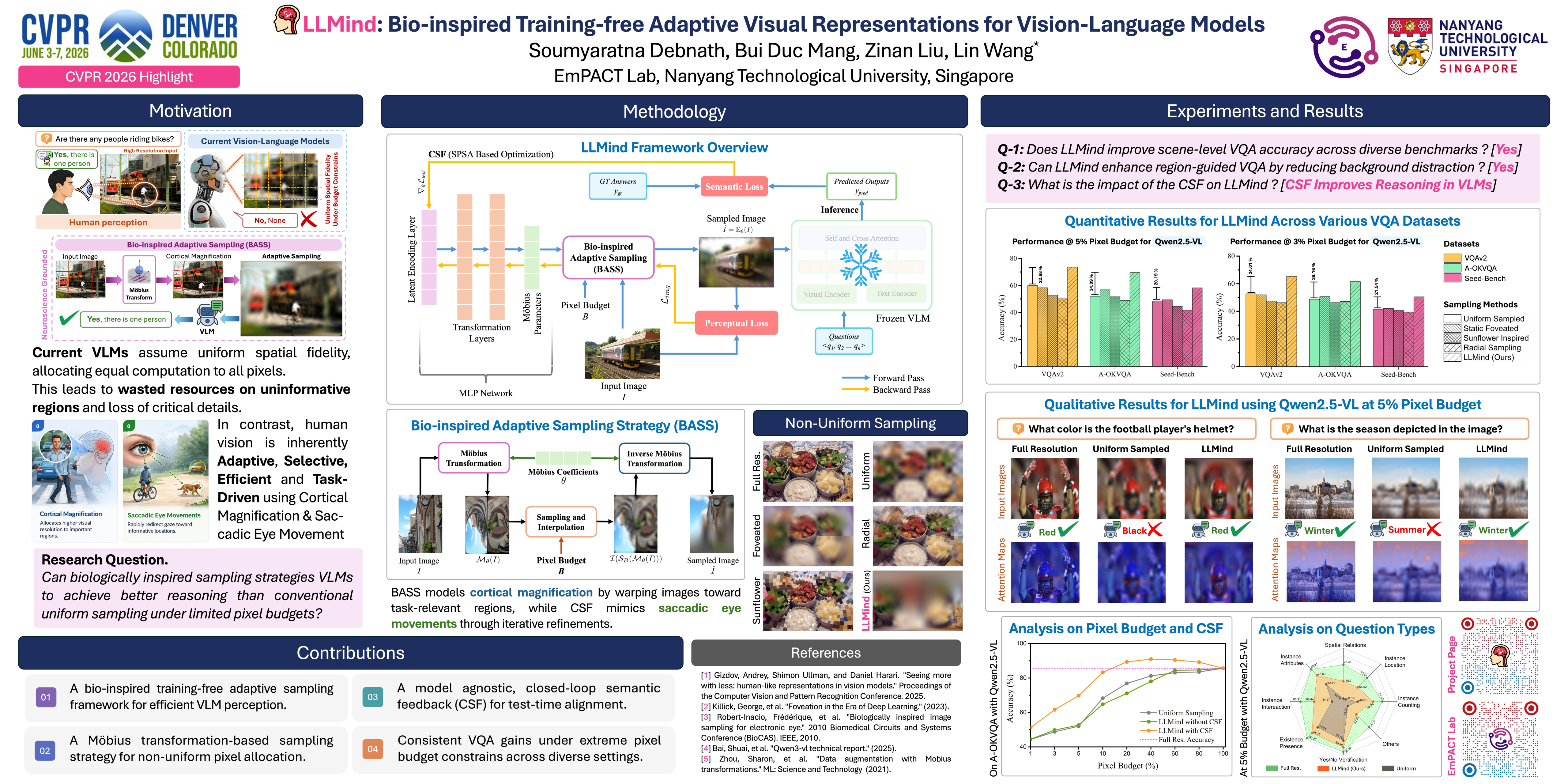
Vision-Language Models (VLMs) typically assume a uniform spatial fidelity across the entire field of view of visual inputs, dedicating equal precision to even the uninformative regions. By contrast, human vision is neither uniform nor static. It is adaptive, selective, and resource-efficient. In light of this, we present the first systematic analysis of bio-inspired visual representation methods, providing insights for more efficient and adaptive VLMs. We propose LLMind (Looking Like the Mind), a novel training-free framework that mimics foveated encoding and cortical magnification in human vision to achieve adaptive, efficient representations for VLMs under tight pixel budgets. Our key idea is to explore a Bio-inspired Adaptive Sampling Strategy (BASS). This empowers us to design a Möbius-parameterized module that performs non-uniform sampling while preserving global scene structure. On top of BASS, we introduce closed-loop semantic feedback (CSF) via test-time adaptation to align the perceptual saliency with the textual information from the frozen VLM. We evaluate LLMind against uniform and other sampling baselines across diverse scene-level and region-guided visual question answering (VQA) benchmarks. The results show that ours achieves dramatic gains, with average improvements by +20% on VQAv2, +38% on Seed-Bench, and +37% on A-OKVQA compared to uniform sampling under tight pixel budgets. More surprisingly, results reveal that LLMind can retain up to 82%, 92% and 97% of the full-resolution performance with only 1%, 3% and 5% of the pixels, respectively. Moreover, LLMind is lightweight, plug-and-play, and compatible with existing VLMs without requiring architectural changes.