
Negative Binomial Variational Autoencoders for Overdispersed Latent Modeling
Abstract
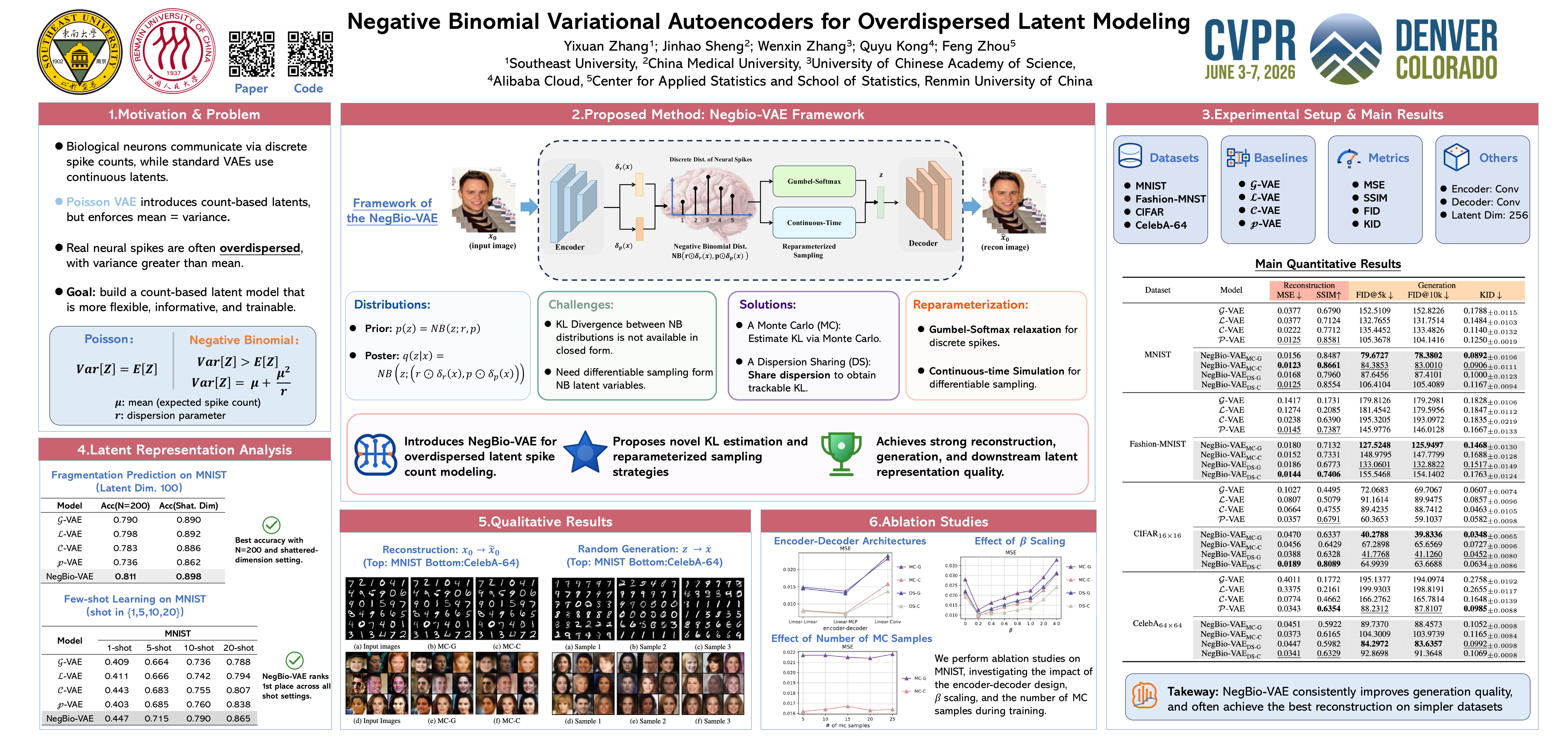
Although artificial neural networks are often described as brain-inspired, their representations typically rely on continuous activations, such as the continuous latent variables in variational autoencoders (VAEs), which limits their biological plausibility compared to the discrete spike-based signaling in real neurons. Extensions like the Poisson VAE introduce discrete count-based latents, but their equal mean-variance assumption fails to capture overdispersion in neural spikes, leading to less expressive and informative representations. To address this, we propose NegBio-VAE, a negative-binomial latent-variable model with a dispersion parameter for flexible spike count modeling. NegBio-VAE preserves interpretability while improving representation quality and training feasibility via novel KL estimation and reparameterization. Experiments on four datasets demonstrate that NegBio-VAE consistently achieves superior reconstruction and generation performance, and yields robust, informative latent representations for downstream tasks. Extensive ablation studies are performed to verify the model’s robustness w.r.t. various components.