
Structure-to-Intensity Diffusion for Adverse-Weather LiDAR Generation
Peiyang Ni ⋅ Longyu Yang ⋅ Lu Zhang ⋅ Kuniaki Saito ⋅ Yap-Peng Tan ⋅ Fumin Shen ⋅ Heng Tao Shen ⋅ Xiaofeng Zhu ⋅ Ping Hu
Abstract
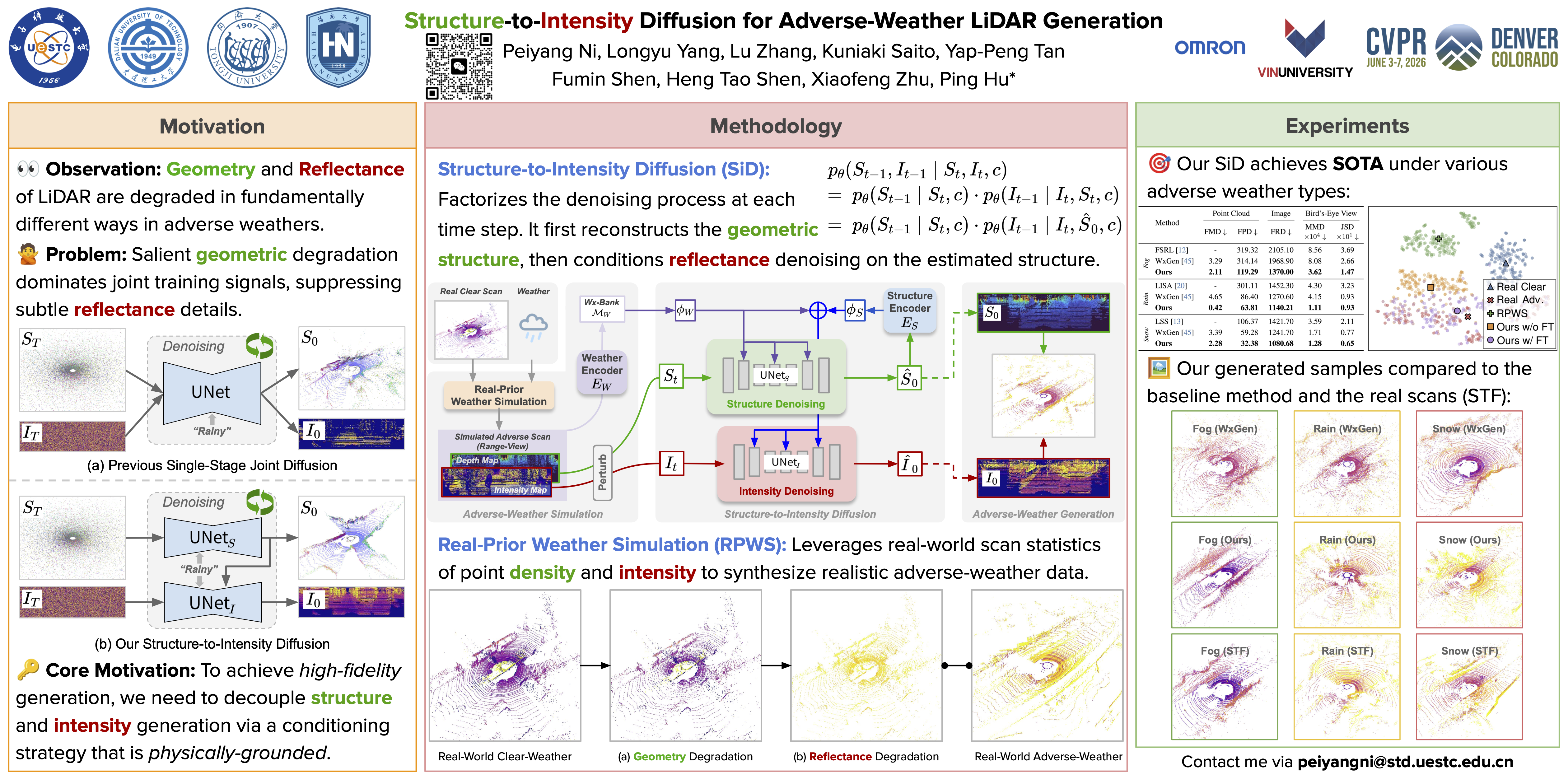
Adverse-weather LiDAR point cloud generation is challenged by complex weather-induced degradations. These degradations affect geometry and reflectance in fundamentally different ways, making joint modeling difficult and ambiguous, especially when diverse real-world training data is limited. To address this, we propose $\textit{Structure-to-Intensity Diffusion}$ (SiD), a diffusion-based framework that explicitly factorizes the denoising process at each time step: it first reconstructs the geometric structure, then conditions reflectance intensity denoising on the estimated structure. This structure-conditioned design decomposes the joint distribution, reduces modeling ambiguity, and leads to point clouds that are both geometrically coherent and radiometrically realistic. To mitigate data scarcity, we introduce $\textit{Real-Prior Weather Simulation}$ (RPWS), a degradation module that leverages real-world sensor statistics to synthesize physically plausible adverse-weather point clouds from clear scans. Extensive experiments demonstrate that, with similar model complexity, our approach outperforms the previous state-of-the-art in generating adverse-weather LiDAR scans with both structural and radiometric properties more closely aligned with real-world data.
Chat is not available.
Successful Page Load