
Fine-Grained Multi Image Object Hallucination Benchmark
Abstract
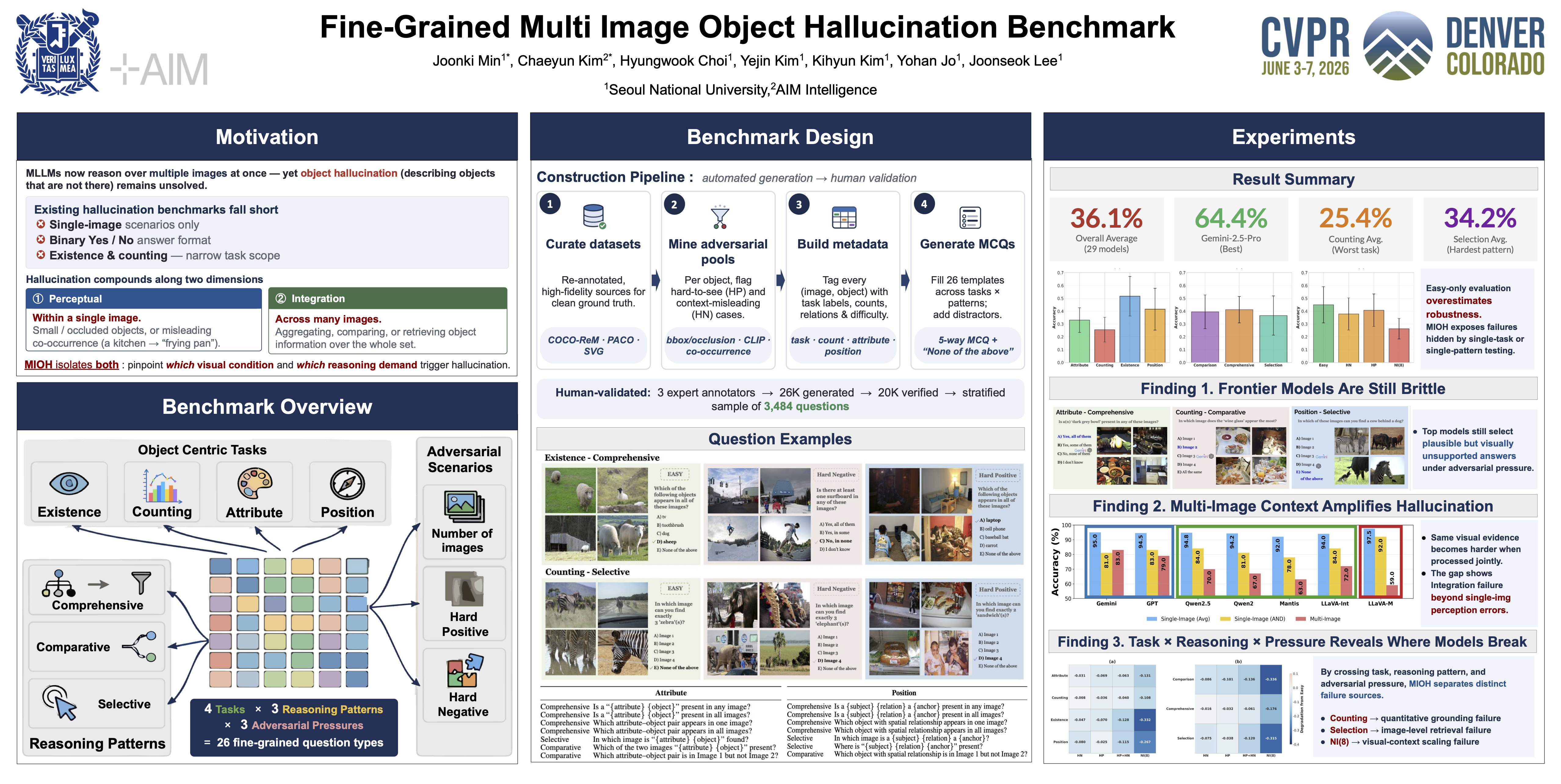
Multimodal Large Language Models (MLLMs) are increasingly deployed in multi-image scenarios requiring complex reasoning across visual contexts. However, current MLLMs remain fundamentally limited by object hallucination—generating plausible yet factually inconsistent descriptions about objects. Existing benchmarks, designed primarily for single-image settings or providing only high-level multi-image assessments, cannot systematically diagnose how visual complexity and reasoning demands trigger hallucination. To address this gap, we introduce MIOH, a fine-grained multi-image object hallucination benchmark that systematically evaluates object hallucination across four foundational tasks (existence, counting, attribute, position) through three multi-image reasoning patterns (comprehensive, comparative, selective) under three controlled adversarial pressures (visual context scale, perceptual difficulty, contextual bias). Through evaluation of 30 models, we reveal that even state-of-the-art systems like GPT-5 and Gemini-2.5-Pro exhibit distinct failure patterns across different reasoning patterns and tasks. Our evaluation reveals that hallucination stems not merely from perceptual failures but from integration-stage limitations when maintaining object representations across multiple images. MIOH provides a controlled framework for analyzing multi-image object hallucination and serves as a critical evaluation tool for developing more reliable multimodal AI systems.