
GraspALL: Adaptive Structural Compensation from Illumination Variation for Robotic Garment Grasping in Any Low-Light Conditions
 Highlight
Abstract
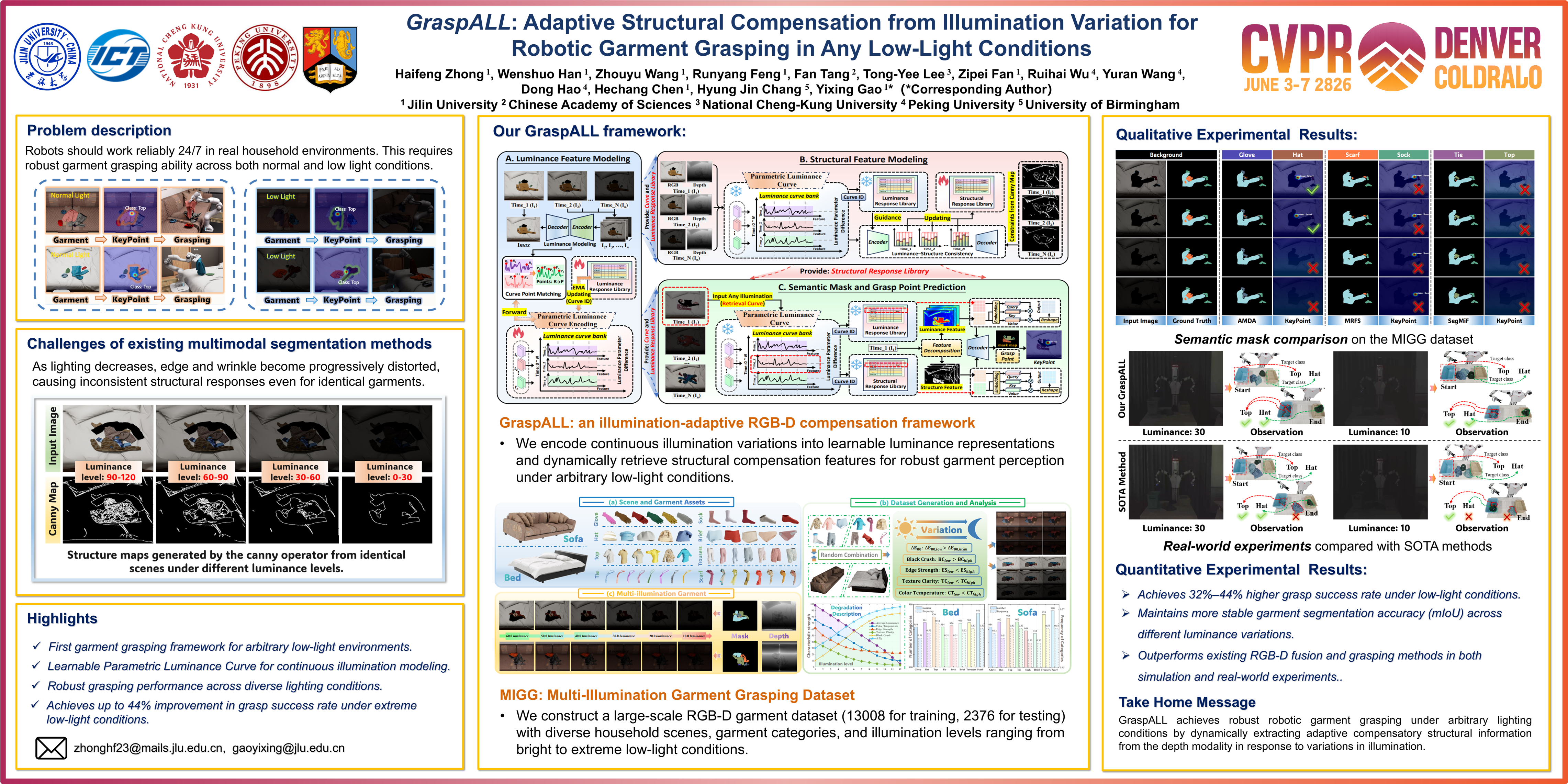
Achieving accurate garment grasping under dynamically changing illumination is crucial for all-day operation of service robots. However, the reduced illumination in low-light scenes severely degrades garment structural features, leading to a significant drop in grasping robustness. Existing methods typically enhance RGB features by exploiting the illumination-invariant properties of non-RGB modalities, yet they overlook the varying dependence on non-RGB features under varying lighting conditions, which can introduce misaligned non-RGB cues and thereby weaken the model’s adaptability to illumination changes. To address this problem, we propose GraspALL, an illumination-structure interactive compensation model. The innovation of GraspALL lies in encoding continuous illumination changes into quantitative references to guide adaptive feature compensation between RGB and non-RGB modalities, thereby generating illumination-consistent grasping representations. Experiments on the self-built multimodal garment grasping (MIGG) dataset demonstrate that GraspALL improves grasping accuracy by 32-44% over baseline methods under diverse illumination conditions.