
SDGS: Spatial Difference Guided Gaussian Splatting for Simultaneous Localization and 3D Reconstruction
Abstract
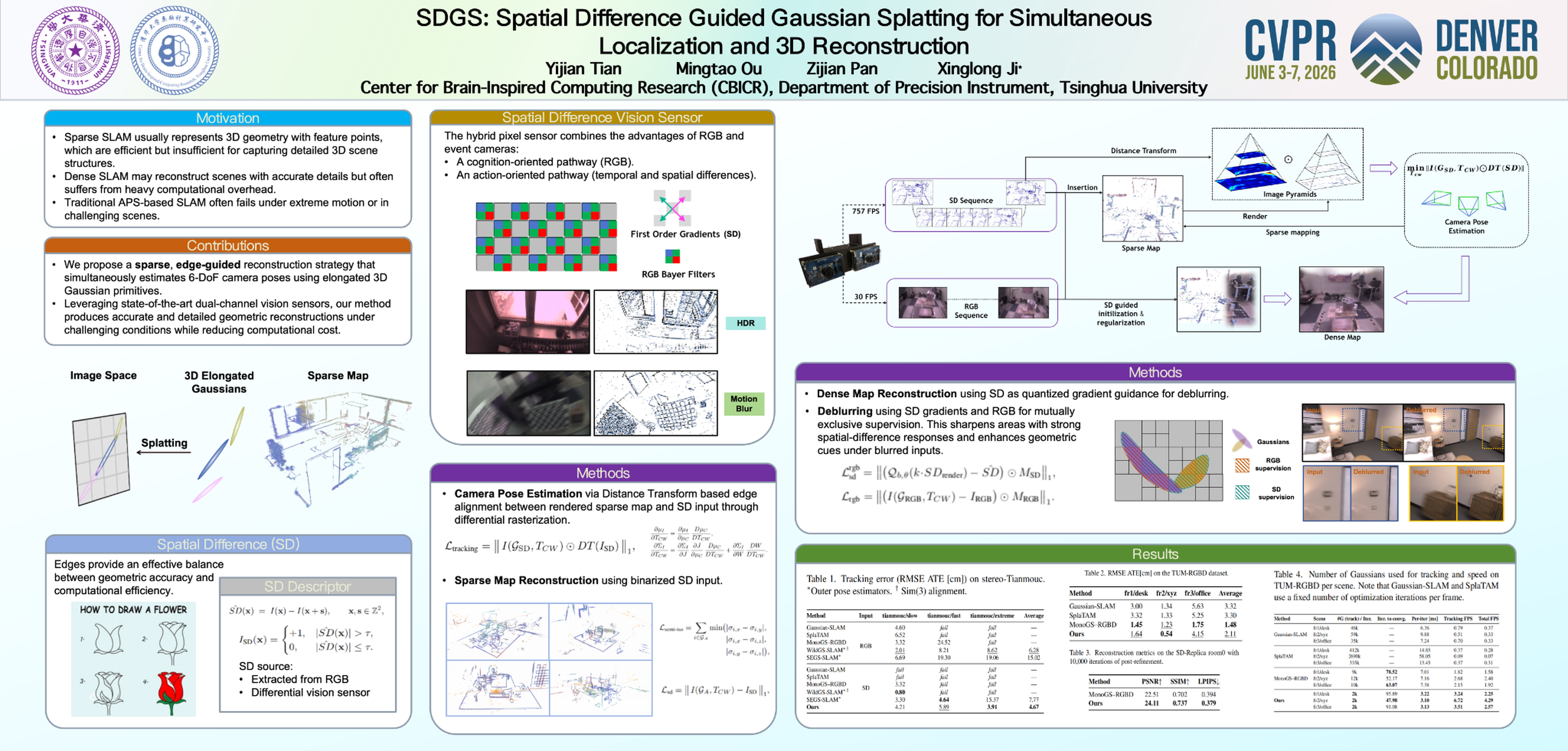
3D Gaussian Splatting (3DGS) has recently emerged as a powerful explicit 3D representation, enabling photorealistic and real-time novel view synthesis. However, most 3DGS pipelines still assume precomputed camera poses and offline optimization, which introduces latency and makes them brittle in fast-motion, real-world scenarios. Existing online 3DGS systems mostly fall into two camps: (1) hybrid systems that rely on a separate traditional SLAM system for camera poses and optimize Gaussians decoupled from tracking, increasing system complexity; and (2) purely Gaussian-based systems that estimate poses from dense photometric errors, requiring repeated rendering of a large number of Gaussians and thus incurring high computational cost. Moreover, current online methods are often sensitive to motion blur and high dynamic range scenes, limiting their applicability in practice.We address these limitations with a sparse, edge-guided online 3DGS framework. Our method represents the scene as an edge-aligned sparse Gaussian map and estimates 6-DoF camera poses by aligning rendered 3D edges with observed 2D edges using a distance transform based objective, yielding roughly 2× faster per-iteration pose optimization than existing Gaussian-based systems while recovering clear scene geometry. We further leverage a dual-channel hybrid pixel vision sensor that outputs blur-free, high-frame-rate spatial-difference edge signals alongside RGB images, and use these signals both for robust edge-based tracking and for a mutual supervision scheme that mitigates motion blur in dense 3D reconstruction. Our system maintains stable tracking and high-fidelity geometry under extremely high-speed motion, where existing RGB-only methods fail, while remaining compatible with standard RGB cameras and achieving competitive tracking accuracy.