
PALM: Progress-Aware Policy Learning via Affordance Reasoning for Long-Horizon Robotic Manipulation
Yuanzhe Liu ⋅ Jingyuan Zhu ⋅ Yuchen Mo ⋅ Gen Li ⋅ Xu Cao ⋅ Jin Jin ⋅ Yifan Shen ⋅ Zhengyuan Li ⋅ Tianjiao Yu ⋅ Wenzhen Yuan ⋅ Fangqiang Ding ⋅ Ismini Lourentzou
Abstract
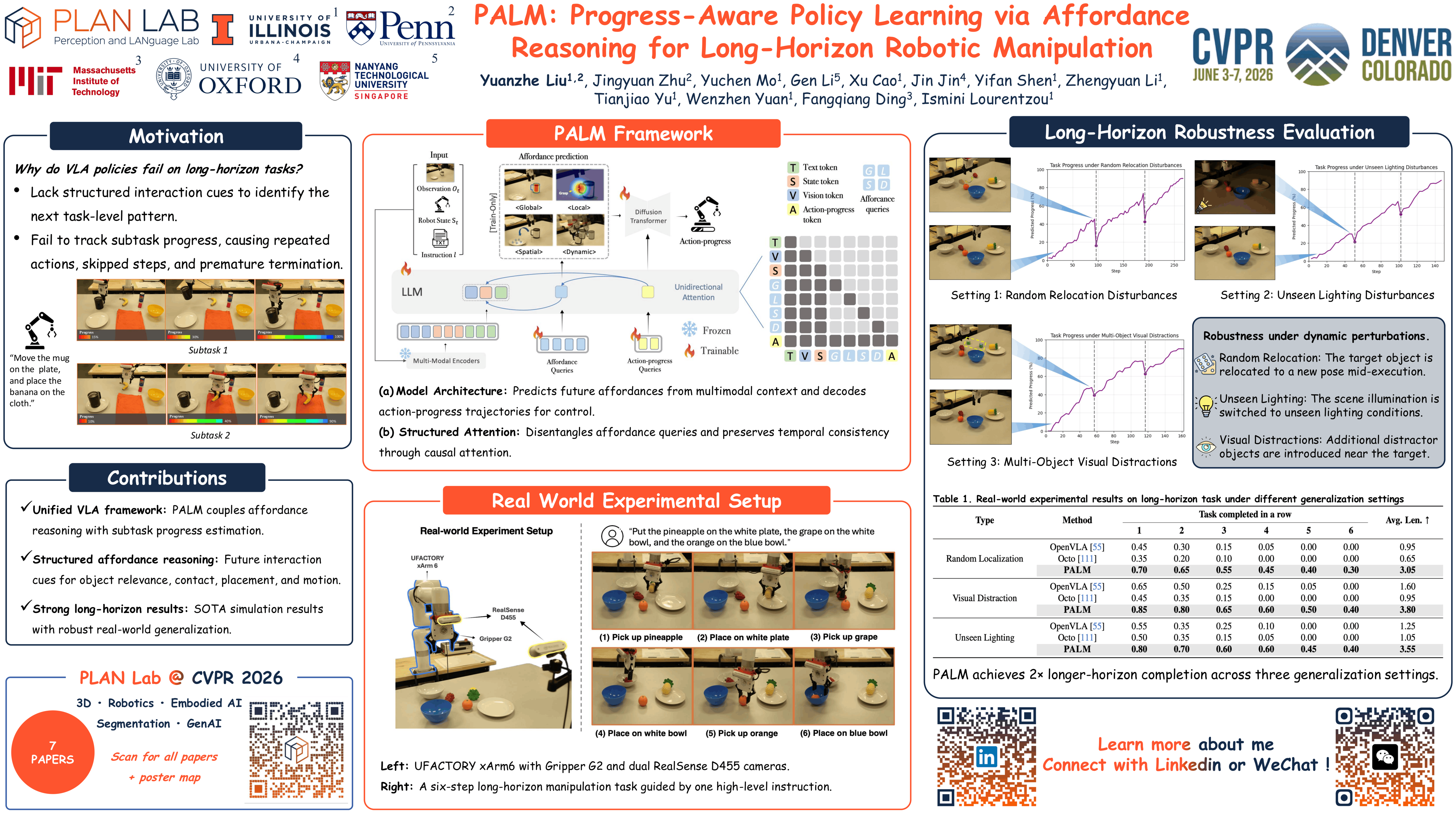
Recent advancements in vision-language–action (VLA) models have shown promise in robotic manipulation, yet they continue to struggle with long-horizon, multi-step tasks. Existing methods lack internal reasoning mechanisms that can identify task-relevant interaction cues or track progress within a subtask, leading to critical execution errors such as repeated actions, missed steps, and premature termination. To address these challenges, we introduce PALM, a VLA framework that structures policy learning around interaction-centric affordance reasoning and subtask progress cues. PALM distills complementary affordance representations that capture object relevance, contact geometry, spatial placements, and motion dynamics, and serve as task-relevant anchors for visuomotor control. To further stabilize long-horizon execution, PALM predicts continuous within-subtask progress, enabling seamless subtask transitions. Across extensive simulation and real-world experiments, PALM consistently outperforms baselines, achieving a 91.8\% success rate on LIBERO-LONG, a 12.5\% improvement in average length on CALVIN ABC$\rightarrow$D, and a 2$\times$ improvement over real-world baselines across three long-horizon generalization settings.
Chat is not available.
Successful Page Load