
ReManNet: A Riemannian Manifold Network for Monocular 3D Lane Detection
Chengzhi Hong ⋅ Bijun Li
Abstract
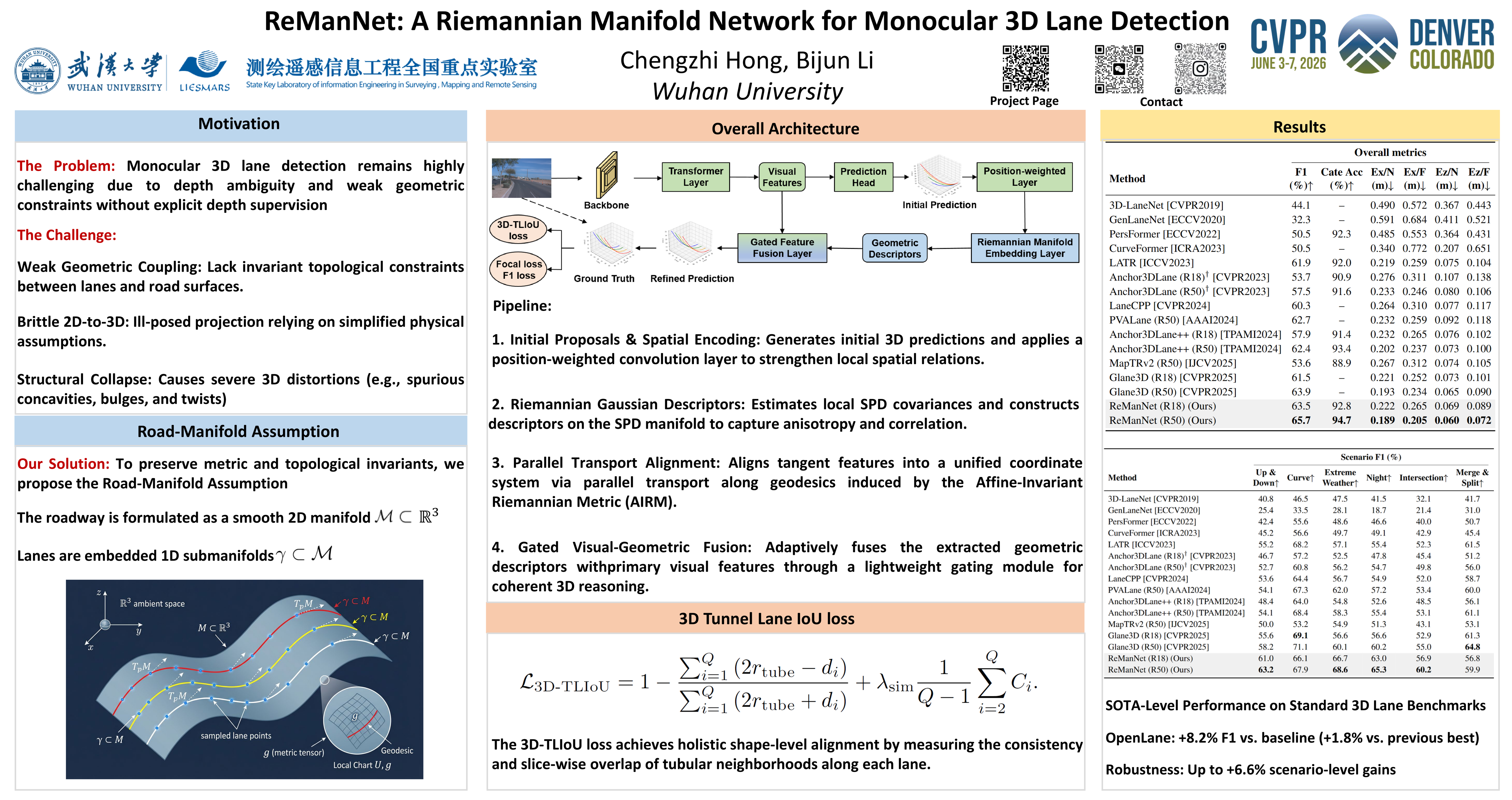
Monocular 3D lane detection remains challenging due to depth ambiguity and weak geometric constraints. Mainstream methods rely on depth guidance, BEV projection, and anchor- or curve-based heads with simplified physical assumptions, remapping high-dimensional image features while only weakly encoding road geometry. Lacking an invariant geometric–topological coupling between lanes and the underlying road surface, 2D-to-3D lifting is ill-posed and brittle, often degenerating into concavities, bulges, and twists. To address this, we propose the Road-Manifold Assumption: the road is a smooth 2D manifold in $\mathbb{R}^3$, lanes are embedded 1D submanifolds, and sampled lane points are dense observations, coupling metric and topology across surfaces, curves, and samples. Building on this, we propose ReManNet: it first produces initial lane predictions with an image backbone and detection heads, then encodes geometry as Riemannian Gaussian descriptors on the symmetric positive-definite (SPD) manifold, and fuses these descriptors with visual features via a lightweight gate to maintain coherent 3D reasoning. We also propose the 3D Tunnel Lane IoU (3D-TLIoU) loss, a joint point–curve objective that computes slice-wise overlap of tubular neighborhoods along each lane to improve shape-level alignment. Extensive experiments on standard benchmarks demonstrate that ReManNet achieves state-of-the-art (SOTA) or competitive performance, and on OpenLane it improves F1 by +8.2\% over the baseline and by +1.8\% over the previous SOTA, with scenario-level F1 gains of up to +6.6\%.
Chat is not available.
Successful Page Load