
Bridging Brain and Semantics: A Hierarchical Framework for Semantically Enhanced fMRI-to-Video Reconstruction
Yujie Wei ⋅ Chenglong Ma ⋅ Jianxiong Gao ⋅ Chenhui Wang ⋅ Shiwei Zhang ⋅ Biao Gong ⋅ Shuai Tan ⋅ Hangjie Yuan ⋅ Hongming Shan
Abstract
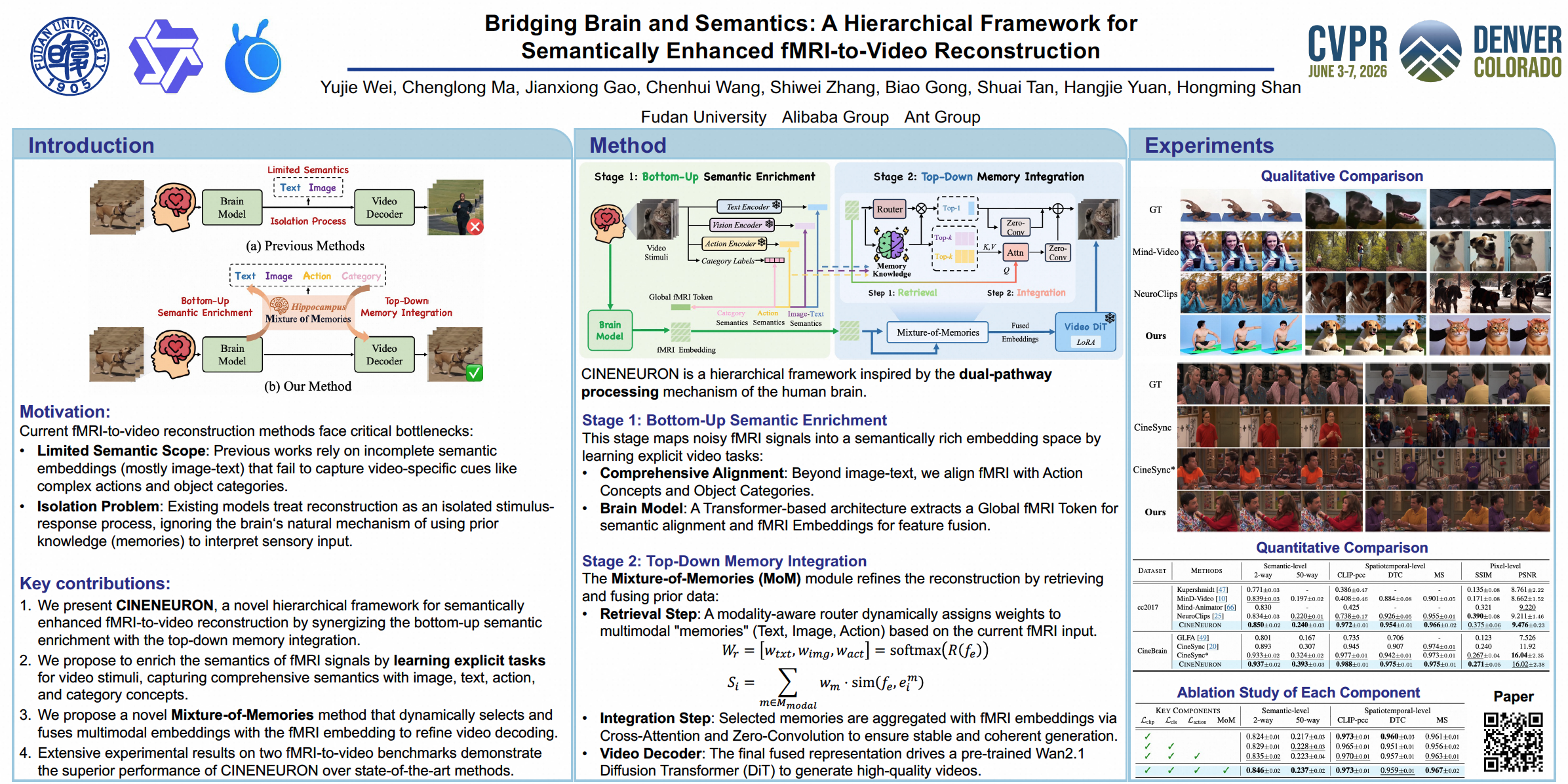
Reconstructing dynamic visual experiences as videos from functional magnetic resonance imaging (fMRI) is pivotal for advancing the understanding of neural processes. However, current fMRI-to-video reconstruction methods are hindered by a semantic gap between noisy fMRI signals and the rich content of videos, stemming from a reliance on incomplete semantic embeddings that neither capture video-specific cues (e.g., actions) nor integrate prior knowledge. To this end, we draw inspiration from the dual-pathway processing mechanism in human brain and introduce $\textbf{CineNeuron}$, a novel hierarchical framework for semantically enhanced video reconstruction from fMRI signals with two synergistic stages. First, a bottom-up semantic enrichment stage maps fMRI signals to a rich embedding space that comprehensively captures textual semantics, image contents, action concepts, and object categories. Second, a top-down memory integration stage utilizes the proposed Mixture-of-Memories method to dynamically select relevant "memories" from previously seen data and fuse them with the fMRI embedding to refine the video reconstruction. Extensive experimental results on two fMRI-to-video benchmarks demonstrate that CineNeuron surpasses state-of-the-art methods across various metrics. Code and models will be made publicly available.
Chat is not available.
Successful Page Load