
Test-Time Training for LiDAR Semantic Segmentation under Corruption via Geometric Inlier Discrimination
Abstract
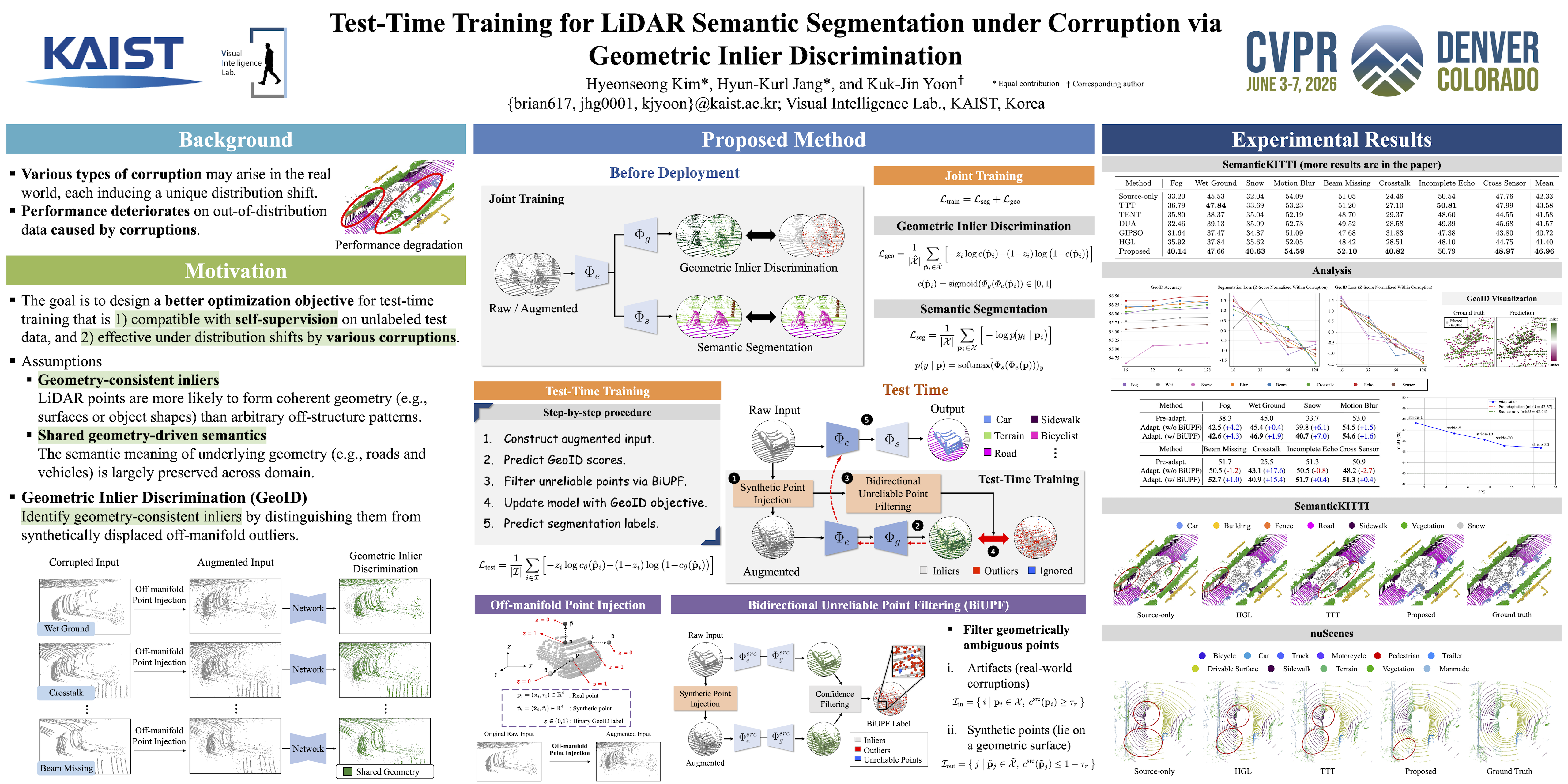
LiDAR semantic segmentation must remain robust under various sensor and environmental corruptions to be reliable in safety-critical applications.Existing test-time adaptation methods, including approaches based on pseudo-labels and normalization statistics, have shown promising results but can still struggle under severe distribution shifts.To complement these approaches, we propose a geometry-aware test-time training framework that leverages an auxiliary self-supervised objective.Our method is based on geometric inlier discrimination (GeoID), which injects synthetic off-manifold points into the input and trains the model to distinguish geometry-consistent inliers from synthetically displaced outliers, enabling adaptation on unlabeled test data.To further stabilize this process under real corruptions, we introduce bidirectional unreliable point filtering (BiUPF), which uses inlier scores from the source-trained model to filter out unreliable regions on both original and synthetic points, focusing updates on high-confidence samples.Experiments on two large-scale corruption benchmarks, SemanticKITTI-C and nuScenes-C, show that our method consistently outperforms strong test-time adaptation baselines and improves robustness across diverse LiDAR corruptions.Code will be released.