
Assignment-Driven Hash Learning in a Hyper-Semantic Space for On-the-Fly Category Discovery
Abstract
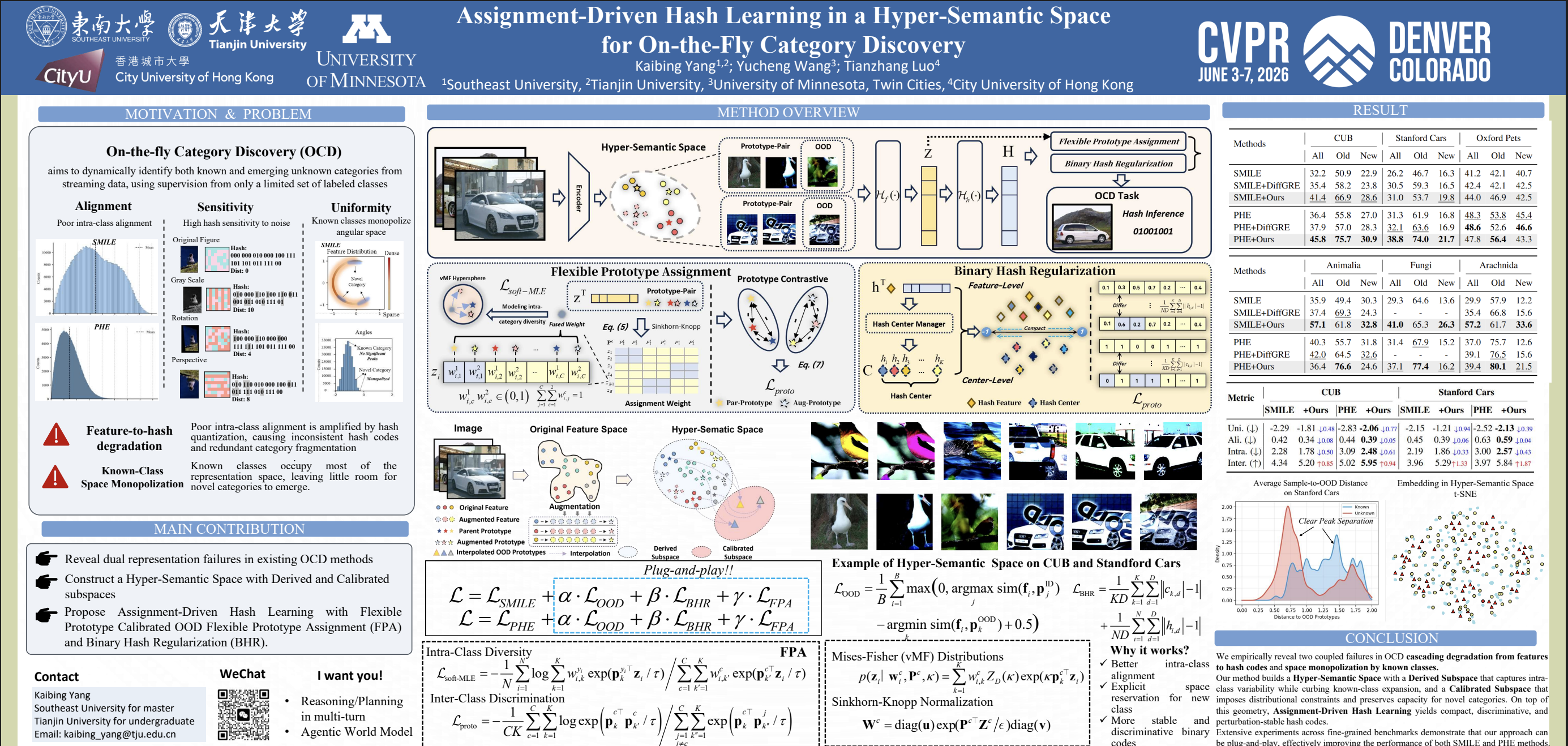
On-the-fly Category Discovery (OCD) aims to dynamically identify both known and emerging unknown categories from streaming data, using supervision from only a limited set of labeled classes. Despite recent progress, our empirical analysis reveals fundamental limitations: existing methods suffer from cascading feature-to-hash degradation and severe space monopolization by known classes, fundamentally hindering novel category discovery. To address these coupled challenges, we introduce a principled two-stage framework.We first construct a Hyper-Semantic Space with dual geometric subspaces: a Derived Subspace employing parent–derived prototype augmentation to capture intra-class diversity and enhance inter-class discrimination, and a Calibrated Subspace synthesized through cross-prototype interpolation to impose distributional constraints and prevent representational collapse.Within this geometrically-constrained space, we perform Assignment-Driven Hash Learning, where Flexible Prototype Assignment (FPA) models intra-class variations and enhances inter-class separation, alongside Binary Hash Regularization (BHR) to enforce compact and discriminative hash representations. Our framework serves as a plug-and-play module, consistently improving state-of-the-art OCD methods across fine-grained benchmarks. Code will be released upon acceptance.