
Rethinking Occlusion Modeling for UAV Tracking
Abstract
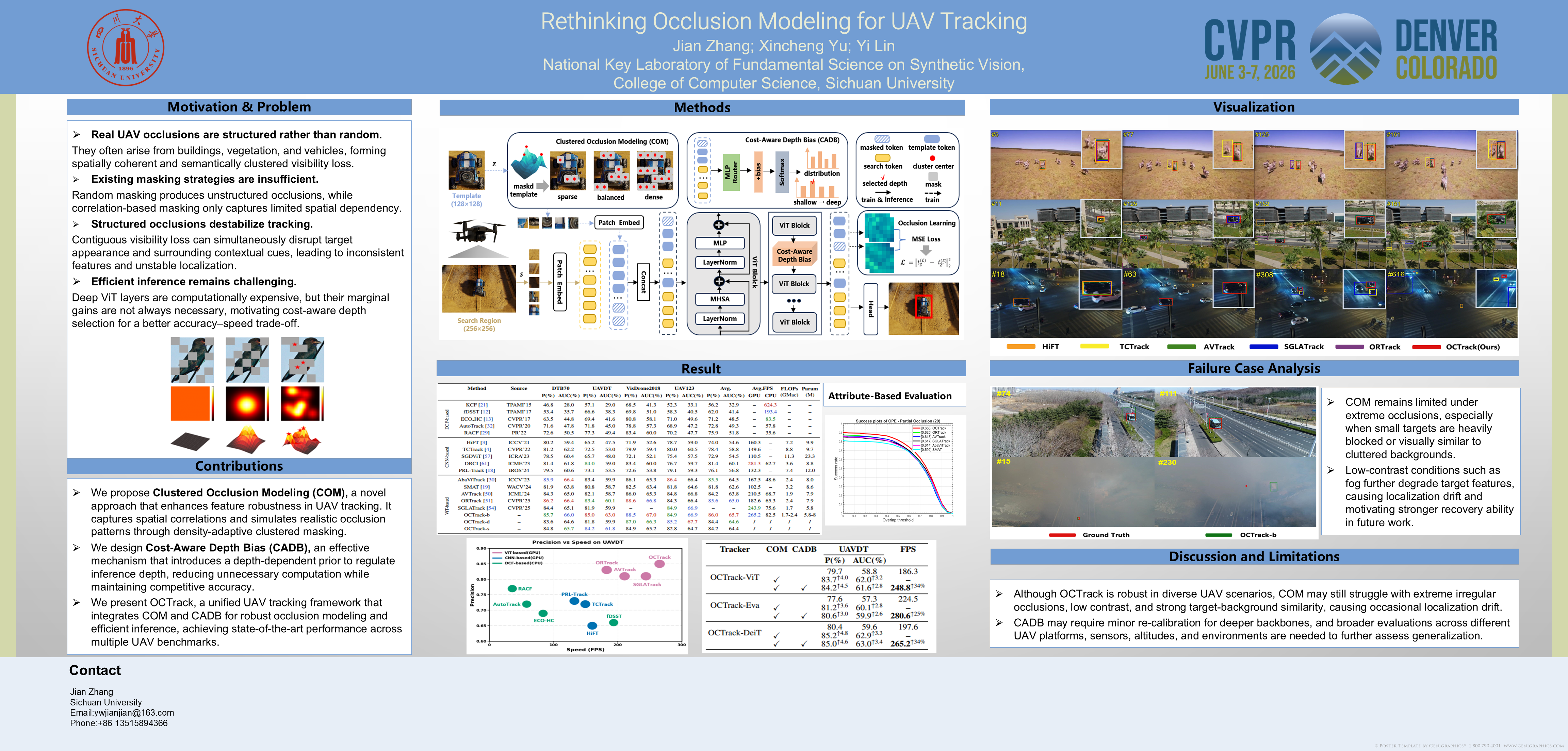
Occlusion remains one of the major challenges in UAV tracking, where dynamic viewpoints and complex environments often cause partial or complete visibility loss.Existing transformer-based trackers typically regard occlusion as random information dropout, overlooking its structured and spatially correlated nature in real-world scenes.We rethink occlusion modeling in UAV tracking as a structured process governed by spatial dependencies.Based on this insight, we introduce Clustered Occlusion Modeling (COM) to generate realistic, density-adaptive occlusion patterns that enhance feature robustness under partial visibility.Furthermore, we design Cost-Aware Depth Bias (CADB), which employs a depth-dependent prior to adjust inference depth, yielding better efficiency while maintaining competitive accuracy.Integrating COM and CADB into a unified single-stream transformer framework, termed OCTrack, our tracker achieves robust and efficient UAV tracking in occlusion-prone environments.Extensive experiments on multiple UAV benchmarks validate its effectiveness and demonstrate state-of-the-art performance. Code will be released.