
BrepVGAE: Variational Graph Autoencoder with Unified Latent Representation for B-rep
Abstract
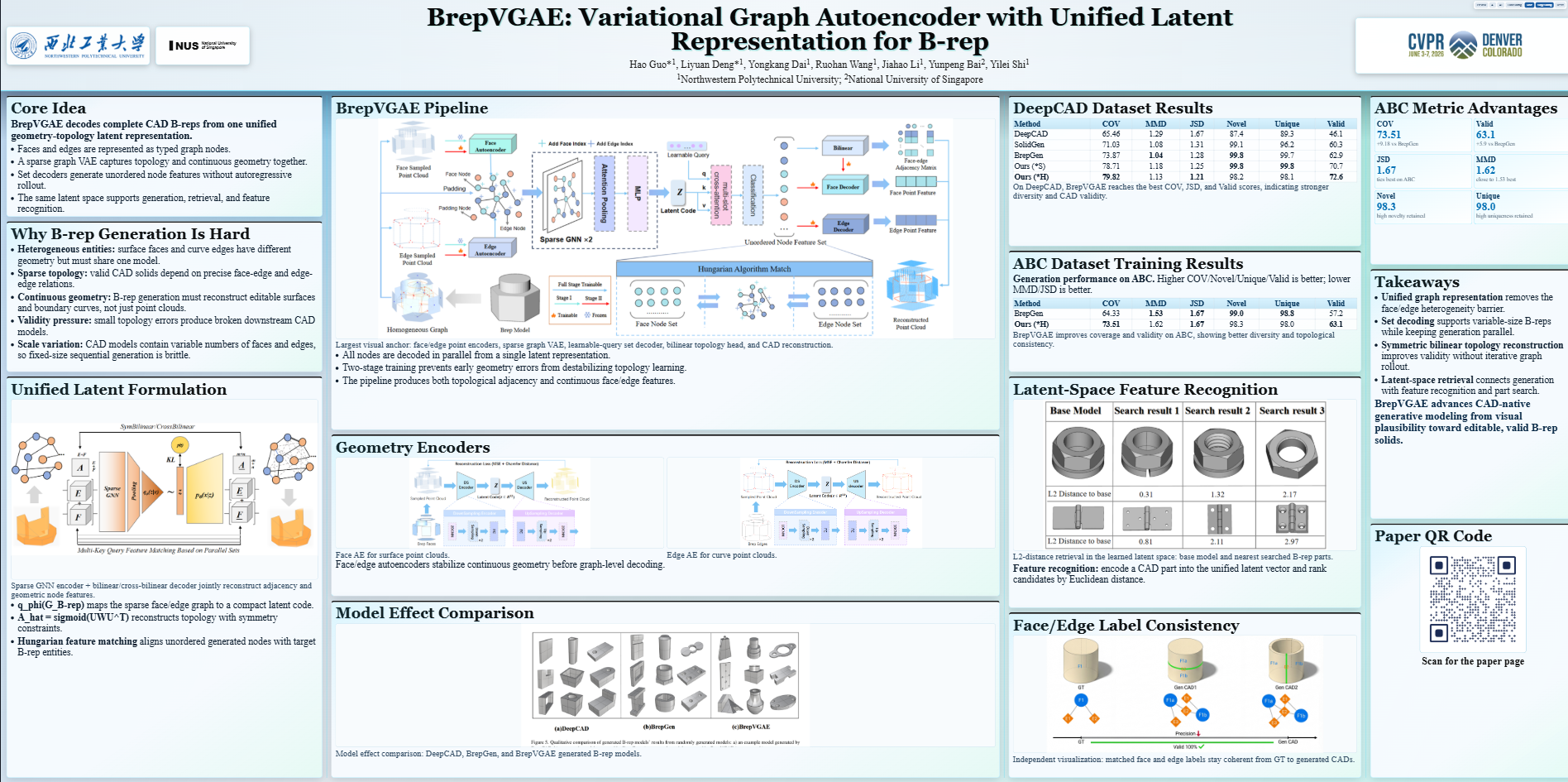
Due to the heterogeneity of faces and edges in B-rep, conventional graph-based representations is incapable of establishing a unified formulation for faces and edges, thereby constraining the capabilities of B-rep generative models. We propose a B-rep Variational Graph Auto Encoding (BrepVGAE), the first variational graph autoencoder framework capable of holistically encoding and decoding boundary representations of B-rep models.Firstly, we novelly represent both geometry faces and edges as nodes in a graph representation. We then design a sparse graph autoencoder to aggregate the complete B-rep structure into a compact global latent vector. We then construct a decoder that employs set-based generation, which uses bilinear layers to reconstruct adjacency relationships, i.e., topology, with a single latent vector. Afterwards, the same decoder generates node features for all faces and edges through learnable query vectors and cross-attention mechanisms. Finally, a two-stage training strategy ensures effective coupling of geometry and topology throughout. Comprehensive experiments demonstrate that BrepVGAE significantly outperforms existing methods in reconstruction accuracy, topological validity, and generative diversity. This validates the feasibility and efficacy of decoding complete CAD geometric-topological distributions from a unified latent representation, while also offering novel insights for CAD part retrieval and feature recognition domains.