
DriveCombo: Benchmarking Compositional Traffic Rule Reasoning in Autonomous Driving
Abstract
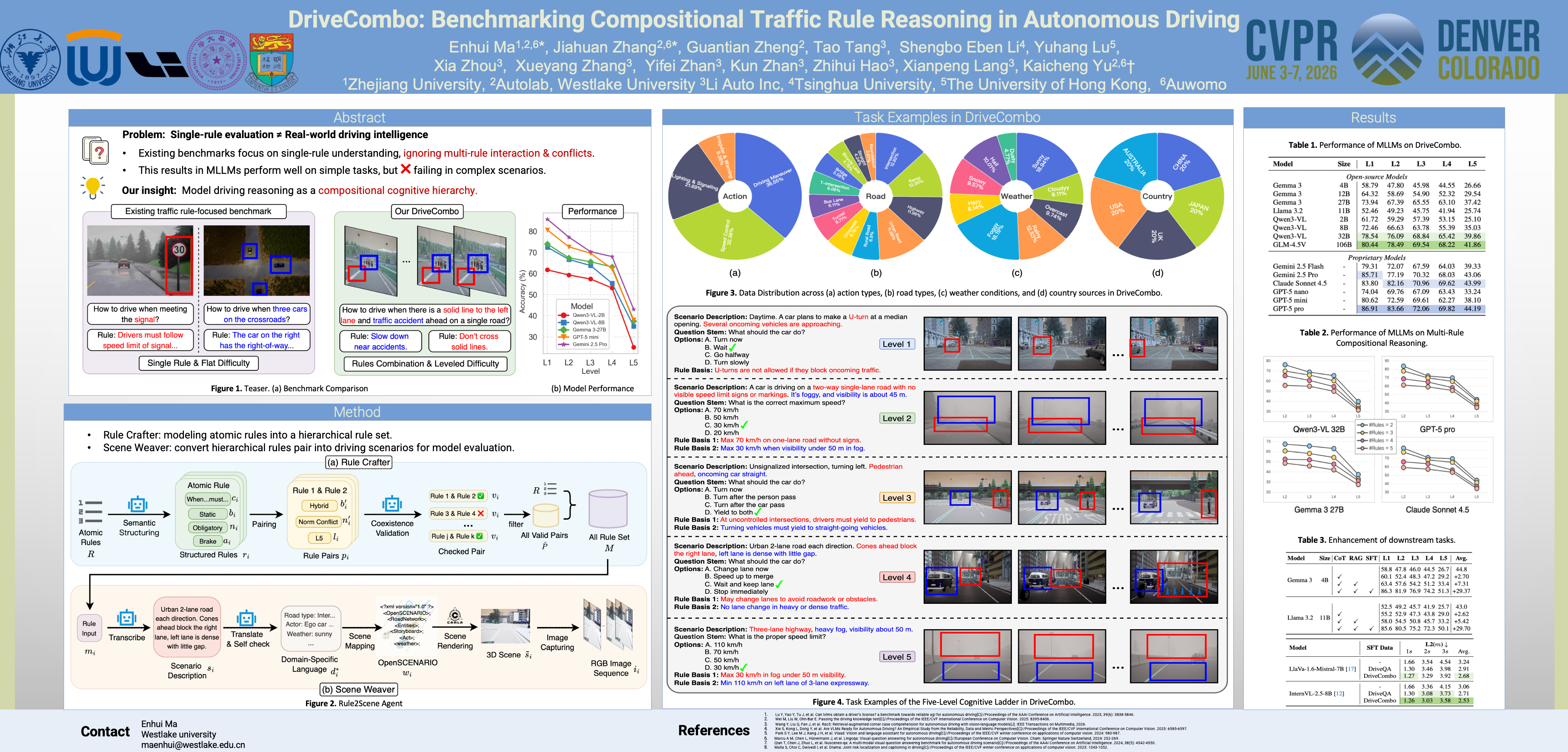
Multimodal Large Language Models (MLLMs) are rapidly becoming the intelligence brain of end-to-end autonomous driving systems. A key challenge is to assess whether MLLMs can truly understand and follow complex real-world traffic rules. However, existing benchmarks mainly focus on single-rule scenarios like traffic sign recognition, neglecting the complexity of multi-rule concurrency and conflicts in real driving. Consequently, models perform well on simple tasks but often fail or violate rules in real world complex situations. To bridge this gap, we propose DriveCTR, a text and vision-based benchmark for compositional traffic rule reasoning. Inspired by human drivers’ cognitive development, we propose a systematic Five-Level Cognitive Ladder that evaluates reasoning from single-rule understanding to multi-rule integration and conflict resolution, enabling quantitative assessment across cognitive stages. We further propose a Rule2Scene Agent that maps language-based traffic rules to dynamic driving scenes through rule crafting and scene generation, enabling scene-level traffic rule visual reasoning. Evaluations of 14 mainstream MLLMs reveal a pronounced decline in performance as task difficulty increases, especially in the rule conflict resolution task. After splitting the dataset and fine-tuning on the training set, we further observe substantial improvements in both traffic rule reasoning and downstream planning capabilities. These results highlight the effectiveness of DriveCTR in advancing compliant and intelligent autonomous driving systems.