
UniRefiner: Teaching Pre-trained ViTs to Self-Dispose Dross via Contrastive Register
Abstract
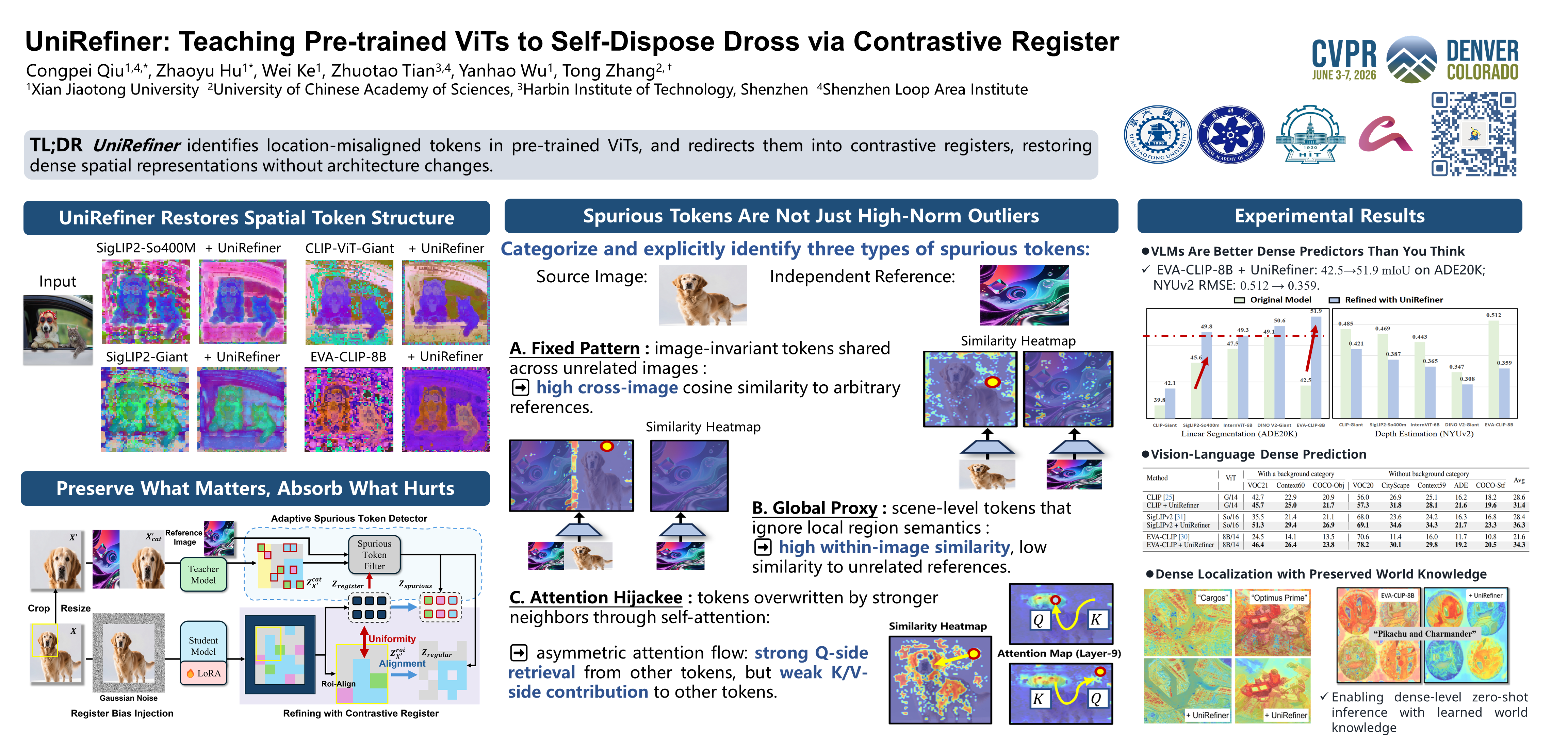
Representation learning with Vision Transformers (ViTs) has advanced rapidly, yet the utility of large-scale models in spatially sensitive tasks is hindered by spurious tokens. Prior efforts to mitigate this have been limited, often defining these artifacts narrowly, for example, as simple high-norm outliers. We argue that this scope is insufficient. For dense prediction tasks, we posit that any token failing to encode location-aligned semantics should be treated as a spurious artifact. This broader definition reveals a more complex problem, leading us to systematically categorize and characterize three fundamental types of spurious tokens that corrupt spatial representations. Based on this comprehensive diagnosis, we propose UniRefiner, a universal refinement framework that teaches pre-trained ViTs to self-dispose of these artifacts. UniRefiner uses contrastive registers to explicitly isolate and redistribute spurious tokens via a dual objective: (i) it aligns image tokens with filtered regular tokens to preserve semantics, and (ii) it aligns register tokens with detected spurious tokens to capture the spurious signals. Our method requires only a few epochs of fine-tuning on ~5k images to refine diverse ViTs, including massive models like EVA-CLIP-8B and InternViT-6B. Experiments demonstrate consistent and significant improvements: notably, the refined EVA-CLIP-8B achieves 51.9\% mIoU on ADE20K (+9.4\%), surpassing specialized vision models like DINOv2 (49.1\%), while zero-shot segmentation accuracy improves by up to 22\%. UniRefiner unlocks the latent spatial potential of existing large-scale foundation models, paving the way for their broader application.