
Test-Time Multi-Prompt Adaptation for Open-Vocabulary Remote Sensing Image Segmentation
 Highlight
Abstract
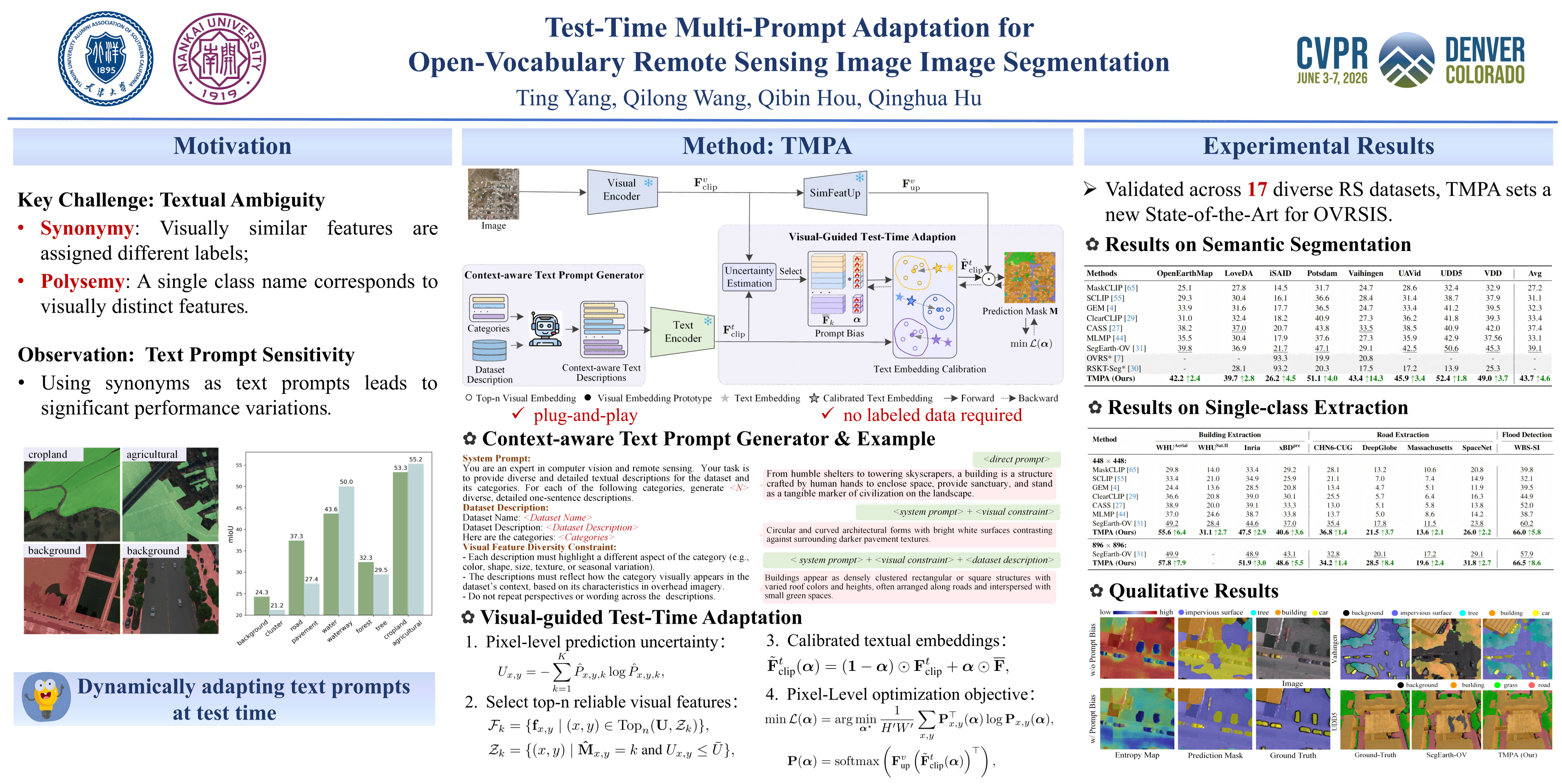
The rise of vision-language models (VLMs) has driven the initial exploration of open-vocabulary remote sensing image semantic segmentation (OVRSIS), enabling recognition of unseen categories in complex Earth observation scenes. However, existing methods primarily focus on enhancing visual representations of domain-specific remote sensing images, while overlooking the effect of textual information. In this paper, we argue that there exists a crucial issue of textual ambiguity in OVRSIS task, limiting the final segmentation performance. Therefore, we propose a plug-and-play yet effective Test-time Multi-Prompt Adaptation (TMPA) method to mitigate textual ambiguity in OVRSIS. Specifically, our TMPA first generates a group of diverse, context-aware descriptions for each category instead of the naive class name by executing a large language model with a task-driven prompt, which can effectively avoid some textual ambiguity, i.e., background class has different meanings in various tasks. Furthermore, TMPA develops a visual-guided test-time adaptation strategy for the generated multi-prompts, which adaptively refines the prompt representations of each category with high-confidence visual features for the uncertain predictions with high entropy, making our TMPA better applicable to different scenarios. Particularly, a pixel-level loss with entropy minimization is proposed to optimize the text prompt with a bias during inference, where prompt bias is constructed based on a weighted combination of high-confidence visual features. Our TMPA can be flexibly integrated into existing methods for boosting their performance. Extensive experiments are conducted on 17 remote sensing datasets, and the results show our TMPA can significantly improve its counterparts, while achieving state-of-the-art performance.