
SafeRoPE: Risk-specific Head-wise Embedding Rotation for Safe Generation in Rectified Flow Transformers
Abstract
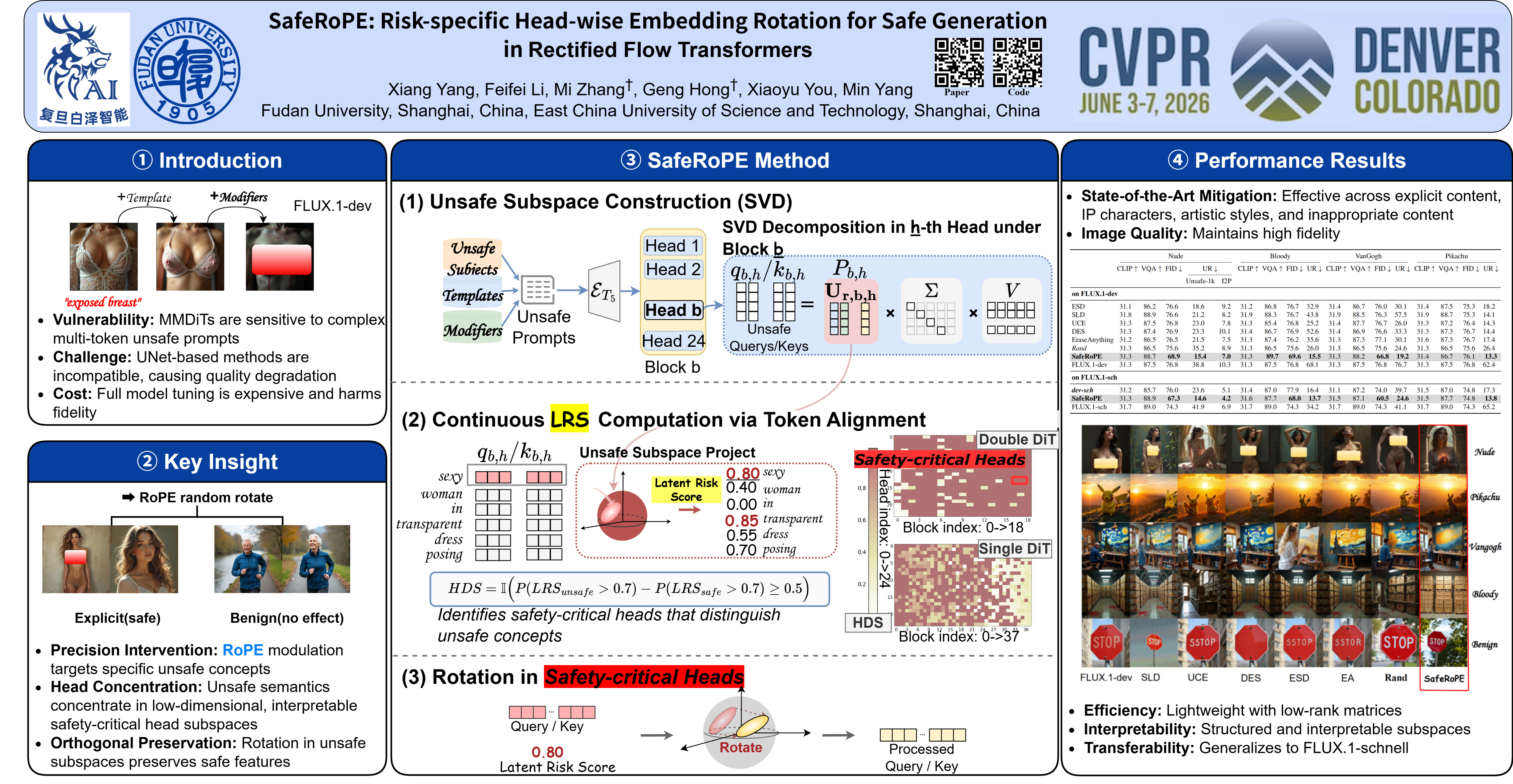
Recent Text-to-Image (T2I) models based on rectified-flow transformers (e.g., SD3, FLUX) achieve high generative fidelity but remain vulnerable to unsafe semantics, especially when triggered by multi-token interactions. Existing mitigation methods largely rely on fine-tuning or attention modulation for concept unlearning; however, their expensive computational overhead and design tailored to U-Net-based denoisers hinder direct adaptation to transformer-based diffusion models (e.g., MMDiT). In this paper, we conduct an in-depth analysis of the attention mechanism in MMDiT and find that unsafe semantics concentrate within interpretable, low-dimensional subspaces at head level, where a finite set of \textbf{safety-critical heads} is responsible for unsafe feature extraction. We further observe that perturbing the Rotary Positional Embedding (RoPE) applied to the query and key vectors can effectively modify some specific concepts in the generated images.Motivated by these insights, we propose SafeRoPE, a training-free and fine-grained safe generation framework for MMDiT. Specifically, SafeRoPE first constructs head-wise unsafe subspaces by decomposing unsafe embeddings within safety-critical heads, and computes a Latent Risk Score (LRS) for each input vector via projection onto these subspaces. We then introduce head-wise RoPE perturbations that can suppress unsafe semantics without degrading benign content or image quality. SafeRoPE combine both head-wise LRS and RoPE perturbation to perform risk-specific head-wise rotation on embeddings, enabling precise suppression of unsafe outputs while maintaining generation fidelity. Extensive experiments demonstrate that SafeRoPE achieves the SOTA performance in balancing effective harmful content mitigation and utility preservation for safe generation of MMDiT.