
Nestwork: Conditional 3D Furnished House Layout Generation through Latent Heterogeneous Graph Diffusion
Abstract
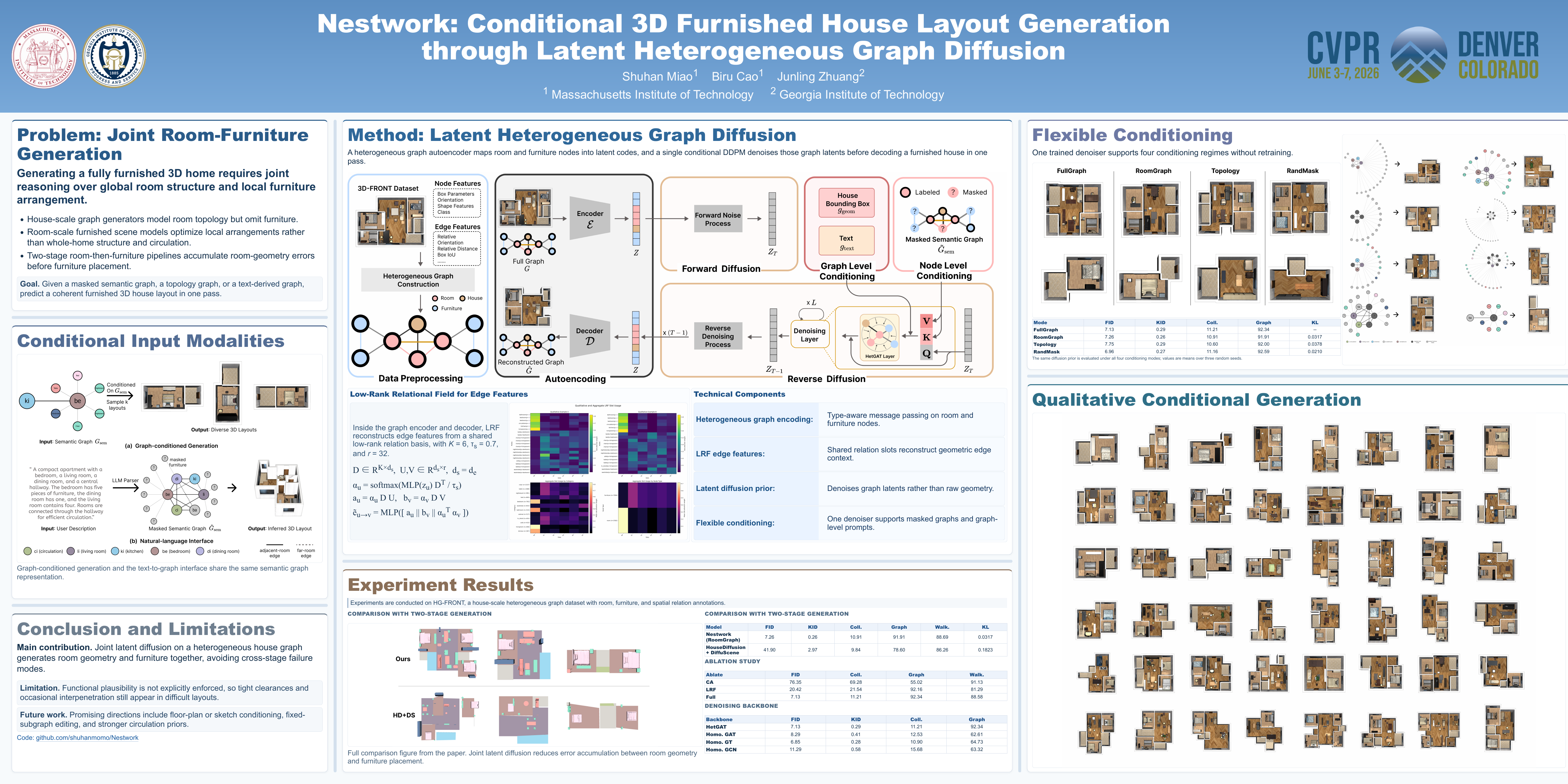
This paper introduces Nestwork, a unified latent-diffusion framework for conditional 3D furnished house layout generation using a heterogeneous graph of rooms and furniture. Designing reasonable and controllable 3D layouts that reflect the underlying semantic structure of a house is a key challenge in AI-assisted architectural design. Existing graph-based methods either produce unfurnished multi-room layouts or generate furnished scenes one room at a time, preventing joint reasoning over room structure and furniture placement. Nestwork represents an entire house as a heterogeneous graph with typed room and furniture nodes and multiple spatial relations. A single unconditional autoencoder based on a heterogeneous graph attention network embeds this graph into a compact latent space, and a low-rank relational field compensates for missing geometric edge information at test time. A diffusion denoiser is trained once using random masking, enabling the same model to operate under different conditioning strengths, from topology-only to fully annotated graphs. Multi-level conditioning combines masked node-level attention with graph-level embeddings to support flexible user control, including layouts specified through natural-language descriptions. Experiments on the 3D-FRONT dataset show that Nestwork achieves high fidelity, structural consistency, and diversity. Controlled ablations further validate the contributions of each component.