
Towards Universal Computational Aberration Correction in Photographic Cameras: A Comprehensive Benchmark Analysis
Abstract
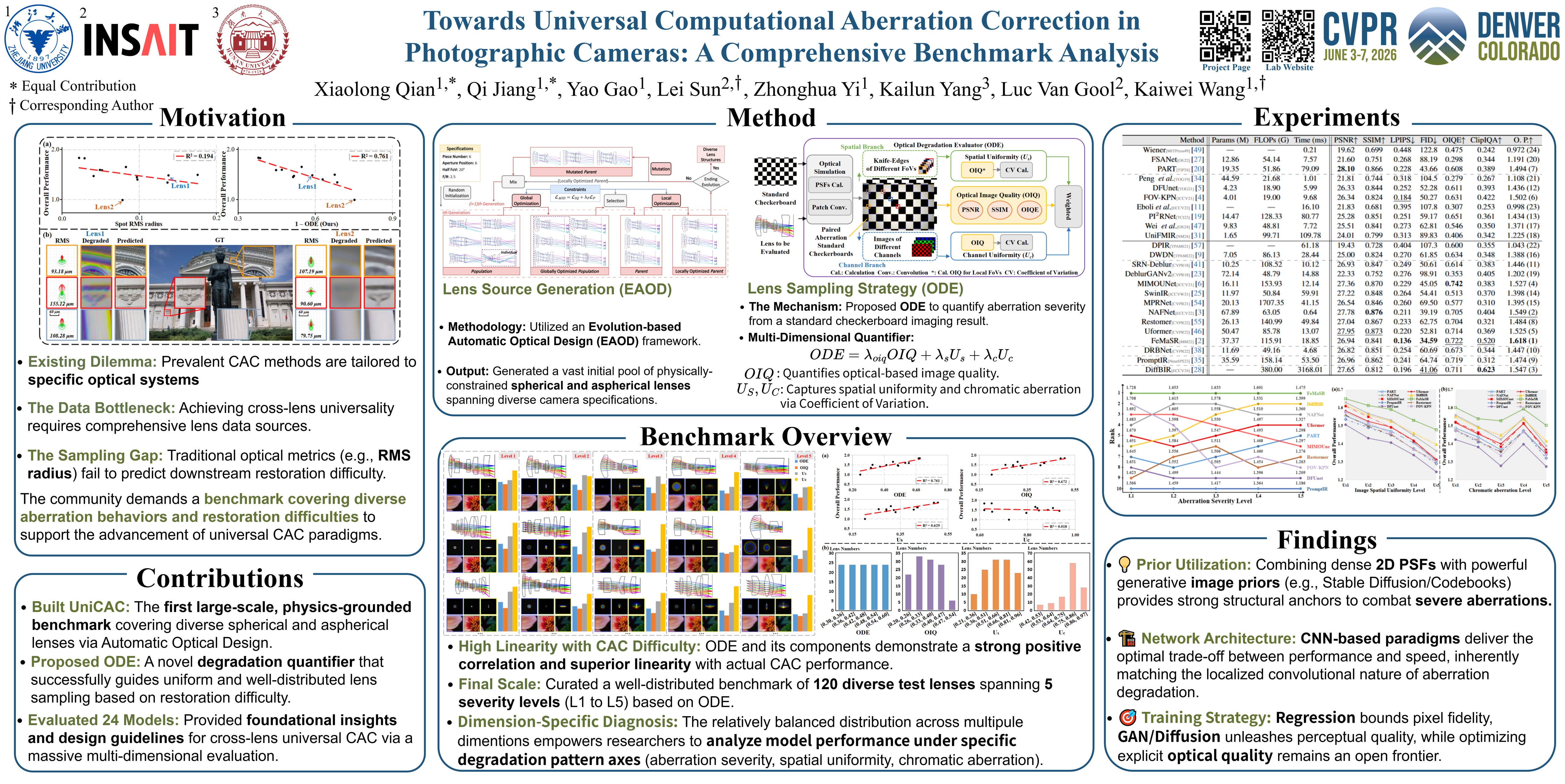
Prevalent Computational Aberration Correction (CAC) methods are typically tailored to specific optical systems, leading to poor generalization and labor-intensive re-training for new lenses.Universal CAC paradigms trained on datasets encompassing diverse aberrations offer a promising solution to these challenges.However, efforts to develop universal CAC are still in their early stages due to the lack of a \textit{comprehensive} benchmark that encompasses a sufficiently wide range of optical aberrations. Furthermore, it remains unclear \textit{which} specific factors influence existing CAC methods and \textit{how} these factors affect their performance.In this paper, we present comprehensive experiments and evaluations involving 24 image restoration and CAC algorithms, utilizing our newly proposed \ourdataset, a large-scale benchmark constructed via automatic optical design. The Optical Degradation Evaluator (ODE) is introduced as a novel framework to objectively assess the difficulty of CAC tasks, offering credible quantification of optical aberrations and enabling reliable evaluation.Drawing on our comparative analysis, we identify three key factors -- \textit{prior utilization}, \textit{network architecture}, and \textit{training strategy} -- that most significantly influence CAC performance, and further investigate their respective effects.We believe that our benchmark, dataset, and observations contribute foundational insights to related areas and lay the groundwork for future investigations.Benchmarks, codes, and \textit{Zemax} files will be available upon acceptance of the paper.